Full Article
about Guadiana
A modern, functional planned farming town; recently made independent and focused on intensive agriculture.
Hide article Read full article
First look: a place built in the twentieth century
If you are heading to Guadiana, keep it simple and go by car. The village sits between Mérida and Badajoz, reached from the EX‑390, with a turn south at Montijo. Once there, park on any street and start walking. It is flat, compact and quick to cross on foot.
Guadiana has around 2,400 residents and a relatively recent origin. It was created in the late 1940s as one of Spain’s “colonisation villages”, planned settlements linked to new irrigated farmland. For many years it depended on Badajoz. Since 2012 it has been its own municipality, and in 2020 the name was shortened to Guadiana.
There are no palaces or medieval lanes here. What defines the place is irrigation agriculture, tomatoes, and rows of houses built to a shared plan.
Getting there and moving around
The drive from Mérida or Badajoz is straightforward, along a direct road with little traffic. There is no complicated approach into the village.
Parking is equally uncomplicated. There are no regulated zones or large car parks. You leave the car on any street and carry on. Some pavements fill up with vans belonging to agricultural workers. On Saturday mornings it can take a bit longer to find a space, but it is rarely a problem.
The centre takes only a few minutes to walk across. Streets run straight and everything sits close together, so there is no need to plan routes in advance.
What you will find, and what you will not
The layout and architecture follow the model used in mid‑20th‑century colonisation settlements. Houses are low-rise, many with a rear patio. You will see exposed brick as well as whitewashed façades, and roofs with two slopes.
Street names still reflect an earlier era. Some have been updated on maps, while others remain unchanged on the physical street signs.
The church dates from the 1950s. It is white and simple, with little history beyond that of the village itself. The town hall occupies a low building from the same period.
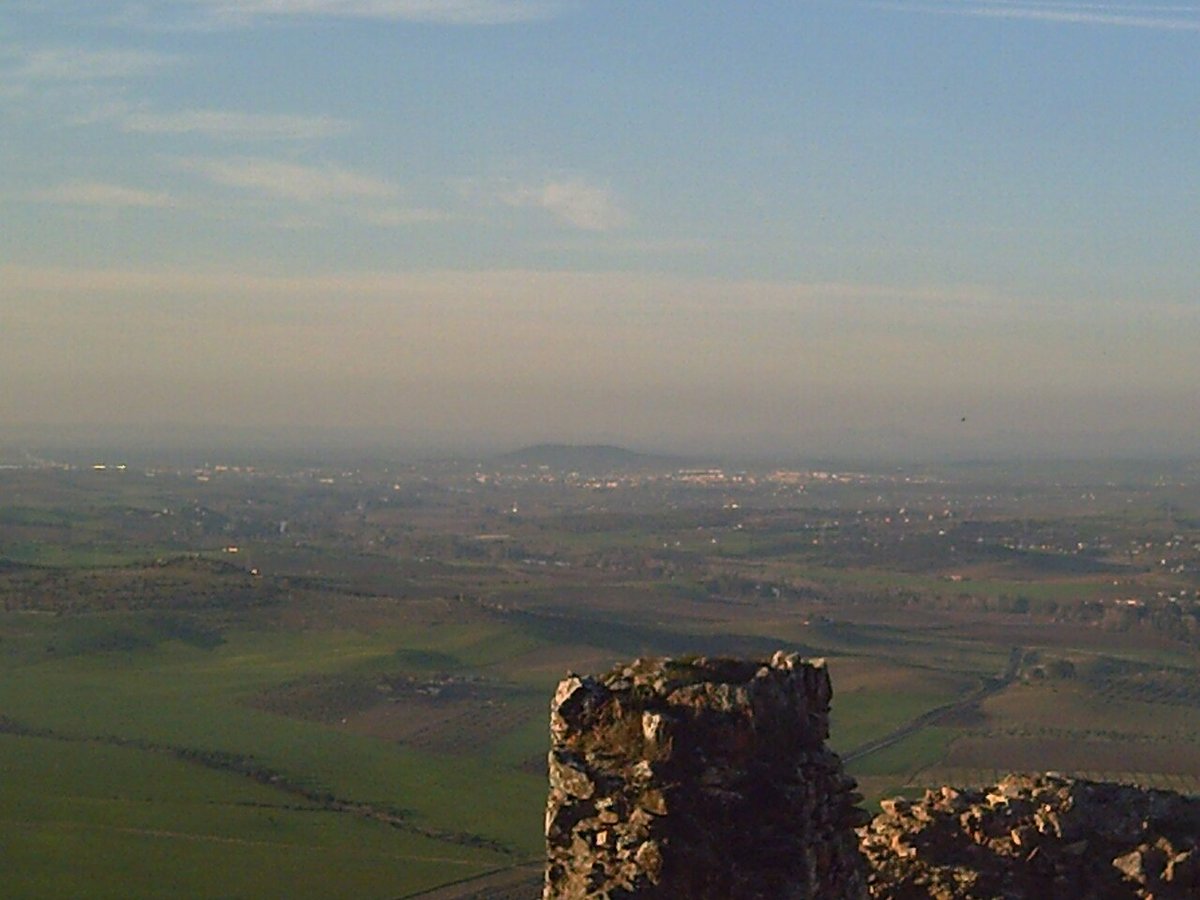
There is no historic quarter. You will not find viewpoints or a single landmark that draws all attention. From a distance, the most recognisable feature is a painted water tower.
Even so, Guadiana functions like a lived-in village rather than a display. There is a pharmacy, a health clinic, a school and basic shops. Early in the day, agricultural labourers head out to the fields. Later on, children cycle through the streets. The rhythm follows the surrounding farmland.
Eating and local festivities
Food here reflects the irrigated fields and the nearby dehesa, the traditional landscape of pasture and scattered trees. Gazpacho appears with bread, sometimes with chopped hard-boiled egg. When colder weather arrives, dishes linked to the traditional pig slaughter come to the fore. Local sheep’s cheese and honey are also part of the picture.
There are no well-known, guidebook-listed restaurants. People eat where locals eat. Asking around will point you to a place to sit down. It is worth going early, as kitchens do not keep long hours.
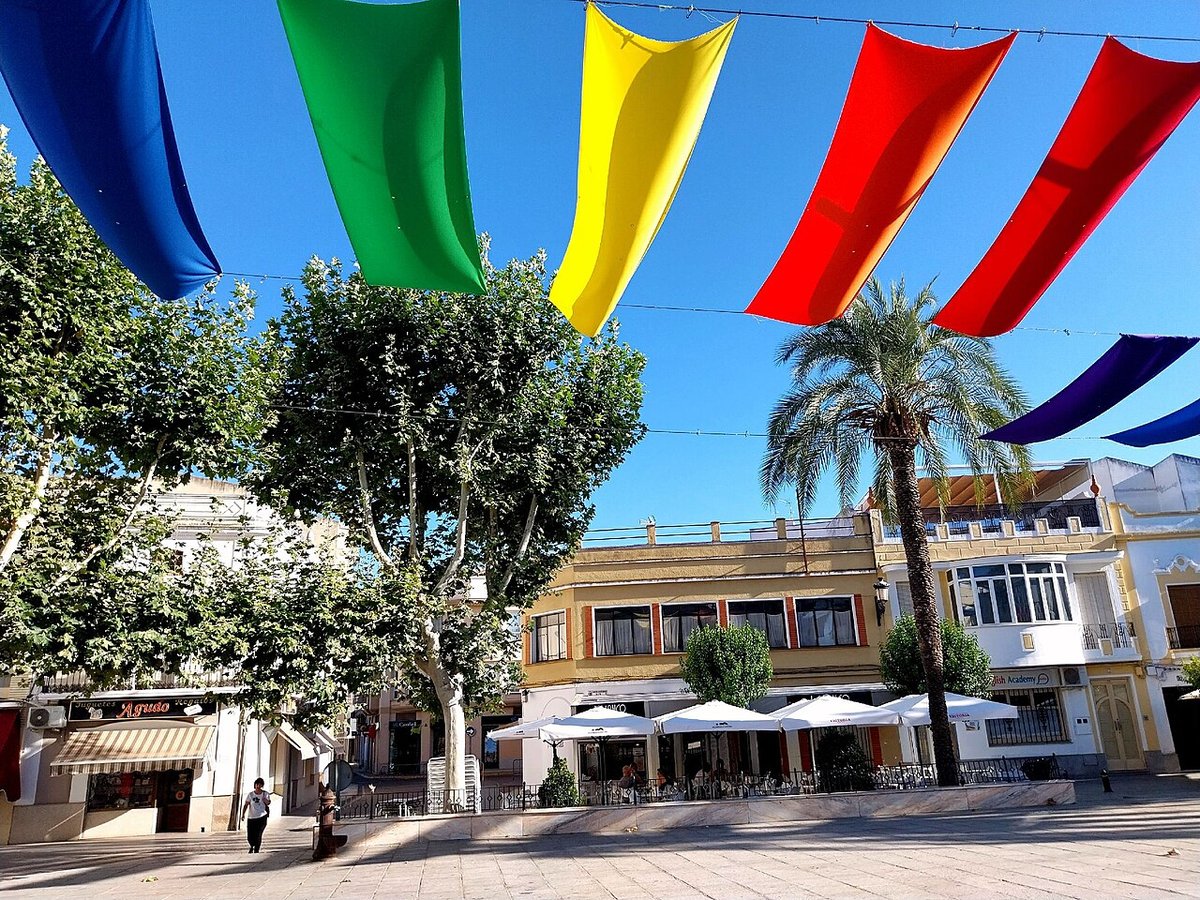
In summer, the village usually holds a fair dedicated to the tomato, which makes sense given how much of the local economy depends on that crop. A stage goes up in the main square and the atmosphere is that of a traditional open-air village celebration.
Around mid-August, a pilgrimage takes place to the hermitage of the Virgen de la Soledad. The route is about three kilometres from the centre, and many people make the journey on foot.
Paths along the Guadiana
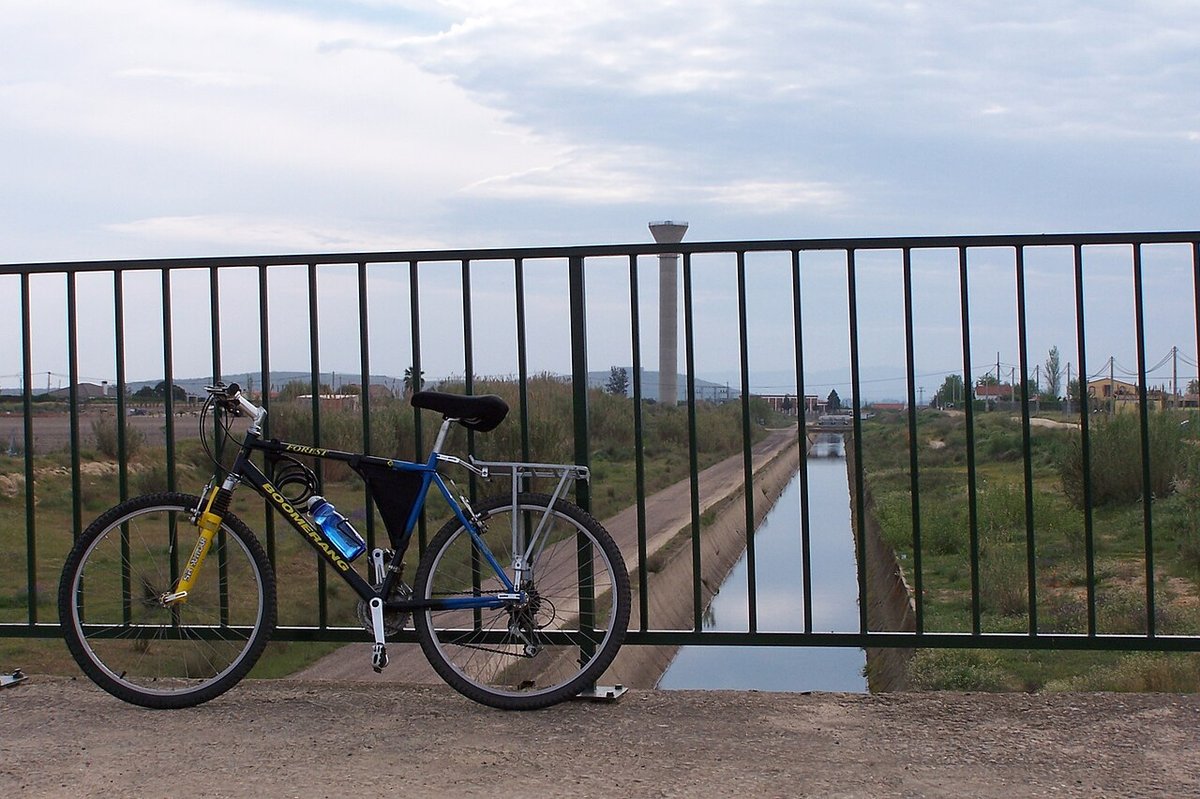
Several agricultural tracks lead out from the village and can be followed on foot or by bicycle. The terrain is flat throughout.
One of the most common routes runs alongside the Guadiana river. It passes between poplar groves and cultivated plots. In spring, birdlife is noticeable. In summer, mosquitoes appear, so it helps to be prepared.
Other tracks head into the nearby dehesa, with its red soil, holm oaks and grazing animals. Do not expect detailed signposting. These are working paths rather than marked trails.
Carry water with you. Shade is limited.
A place that keeps its focus
Guadiana does not revolve around tourism, and it shows. A short visit is enough to understand how it works. Spend some time in the square towards the end of the day and watch the pace of life.
For overnight stays or a wider range of services, people usually base themselves in Montijo or head to Mérida. In Guadiana, most things connect back to the land and its cycles. That is the point of the place.