Full Article
about Marchagaz
Small mountain village surrounded by olive trees and cork oaks
Hide article Read full article
A Village That Doesn’t Shout for Attention
There are villages you drive through and assume nothing happens there. Marchagaz can seem like one of them. Then you stop, walk around for ten minutes and realise that this quietness is exactly the point. The place does not try to impress from a distance. It makes sense once you step into its narrow streets and slow your pace.
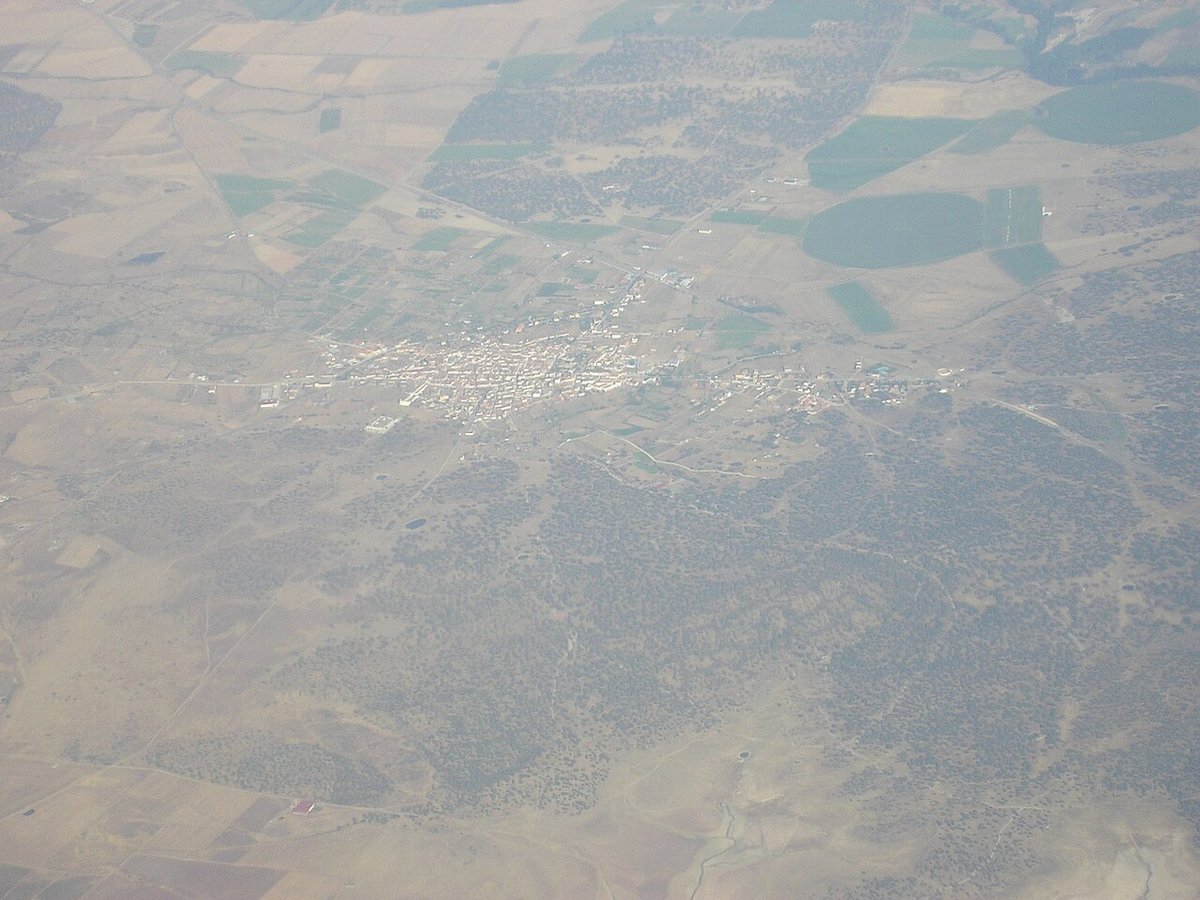
Marchagaz sits in the comarca of Trasierra‑Tierras de Granadilla, in the north of the province of Cáceres, Extremadura. A comarca is a traditional regional district, grouping together several small municipalities. Here, that means open countryside, scattered villages and a way of life closely tied to the land. Marchagaz has just over two hundred residents, which makes it small even by rural Extremadura standards.
There are no streets designed for hurried strolls or corners arranged for quick photographs. Instead, you find yourself wandering without much direction, looking at stone façades, hearing a cockerel somewhere in the distance and sensing that the clock runs slightly slower here.
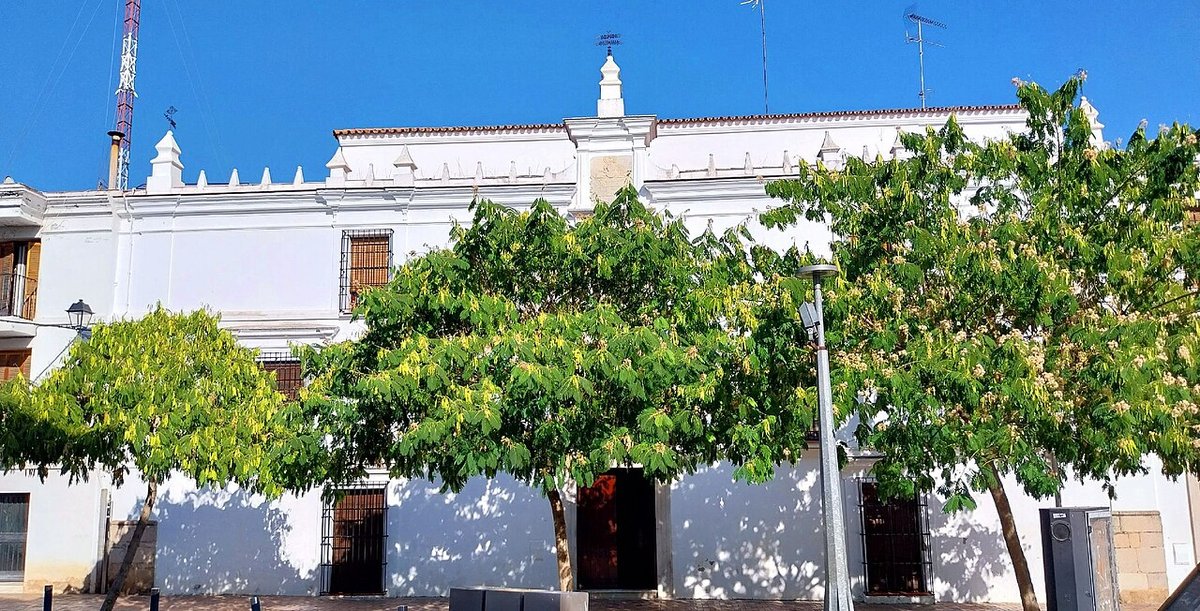
The streets are narrow and built largely in stone, with granite façades typical of this part of Cáceres. Nothing feels monumental, yet everything feels coherent: low houses, solid wooden doors and walls that have stood for more years than anyone can quite remember.
The Parish Church and the Old Streets Around It
At the centre of the village stands the parish church of the Asunción. It does not dominate the skyline or tower over the houses. Rather, it blends into the fabric of the village. Its simple bell gable rises above the rooftops and often comes into view as you walk nearby, making it a useful point of reference if you lose your bearings.
Around the church are some of the oldest houses in Marchagaz. Many still display carefully worked granite walls and roofs covered with traditional curved clay tiles, known in Spain as teja árabe. In certain courtyards, stone wells can still be seen. These are no longer decorative features but practical remnants of another time. Today they are more often used as storage spaces or work areas, yet they remain as reminders of how domestic life was organised decades ago.
Step beyond the compact urban centre and the landscape opens quickly. Scattered holm oaks, old olive groves and small plots of land stretch outwards. Many of these plots have been in the same families for generations. It is common to see livestock grazing in nearby fields, including cows, goats and Iberian pigs moving among the trees.
Dirt Tracks and Open Skies
Several rural tracks lead out from Marchagaz, used by residents to reach their fields or simply to move around the surrounding countryside. Visitors should not expect signposted routes with panels every few metres. The logic here is straightforward: a dirt track leaving the village, holm oaks on either side and the occasional gate that needs to be closed after passing through.
For those who enjoy walking without much infrastructure, the setting works well. The landscape is open, with a mix of olive groves and dehesa. The dehesa is a traditional Iberian landscape of scattered oaks and pasture, used for grazing livestock. In spring and autumn, temperatures tend to be more comfortable, making these seasons especially pleasant for spending time outdoors.
It is also a good place to sit quietly and look at the sky. In this part of Cáceres, birds of prey are often seen circling above the open fields. Smaller birds move constantly among the olive trees. The sense of space and the steady rhythm of rural work define the atmosphere more than any single landmark.
From the Land to the Table
Food in Marchagaz is closely tied to what is raised and grown nearby. The Iberian pig is as much a part of the landscape as the holm oaks, since the animals feed on acorns in the dehesa. Olive oil continues to hold an important place in the local economy, and small kitchen gardens are still cultivated for household consumption.
In season, many residents head out into the surrounding countryside to gather wild asparagus, known as espárragos trigueros, or mushrooms. These are not activities promoted on leaflets or organised as attractions. They are habits that remain alive in villages of this size, passed on quietly from one generation to the next.
The connection between land and food is visible rather than advertised. What appears on the table reflects what grows in nearby fields and groves, and what is reared under the shade of the oaks.
Festivities in a Small Community
The main local festival takes place around the feast of the Asunción, in mid‑August. During those days there is a procession, music in the village square and gatherings that often stretch late into the night. In a community of just a few hundred people, celebrations are shared events rather than large spectacles.
Holy Week is also observed, though on a very modest scale. Religious images are carried through the narrow streets, and the atmosphere is one of quiet reflection. In a village this size, everything happens close to home and everyone knows one another. The celebrations feel domestic and familiar, shaped by neighbours rather than by visitors.
Reaching Marchagaz
Marchagaz lies in the northern part of the province of Cáceres, within the comarca of Trasierra‑Tierras de Granadilla. The usual way to arrive is by car from larger towns in the surrounding area, continuing along regional roads for the final stretch.
It is not a major stop on established tourist routes, and it does not function as a place of mass transit. That may explain why it retains the air of a village that works first and foremost for its residents, rather than for those arriving from outside.
Approach it with that in mind: pause for a while, walk without a fixed plan and take in what is around you. In places like Marchagaz, that is often enough to understand what makes them what they are.