Full Article
about Alcollarín
Small village near Zorita with a ruined manor house and ideal surroundings for crane-watching.
Hide article Read full article
A small village tied to the fields
Alcollarín, in the comarca of Trujillo in Cáceres, is one of those places where daily life still revolves around the countryside. With just over 250 inhabitants, its scale explains much of what visitors will find. Streets are quiet, agricultural work blends into everyday routines, and it is common to see tractors passing through the centre on their way to nearby plots.
The surrounding landscape, made up of open dehesa and cultivated land, helps explain both the layout of the village and its pace. A dehesa is a traditional system of scattered oak trees and pasture typical of western Spain, used for grazing and farming. Here, the calendar remains closely linked to the seasons. Sowing, harvesting and olive picking shape not only the local economy but also the rhythm of conversation.
The church and the central square
The village centre is organised around a handful of streets that converge on a small square. This is where the parish church of the Asunción de Nuestra Señora stands, the most recognisable building in Alcollarín.
The current structure brings together elements from different periods. Stonework in some doorways and openings points to earlier phases, likely connected to a medieval settlement. Later alterations, possibly in the 18th century, changed parts of the building’s structure. The tower is simple and rises just enough to act as a reference point from almost anywhere in the village.
It is not a monumental church, yet it has long been at the heart of collective life. Religious celebrations, local gatherings and many of the village festivities begin or pass through this space, reinforcing its role as a shared meeting point.
Houses and everyday life
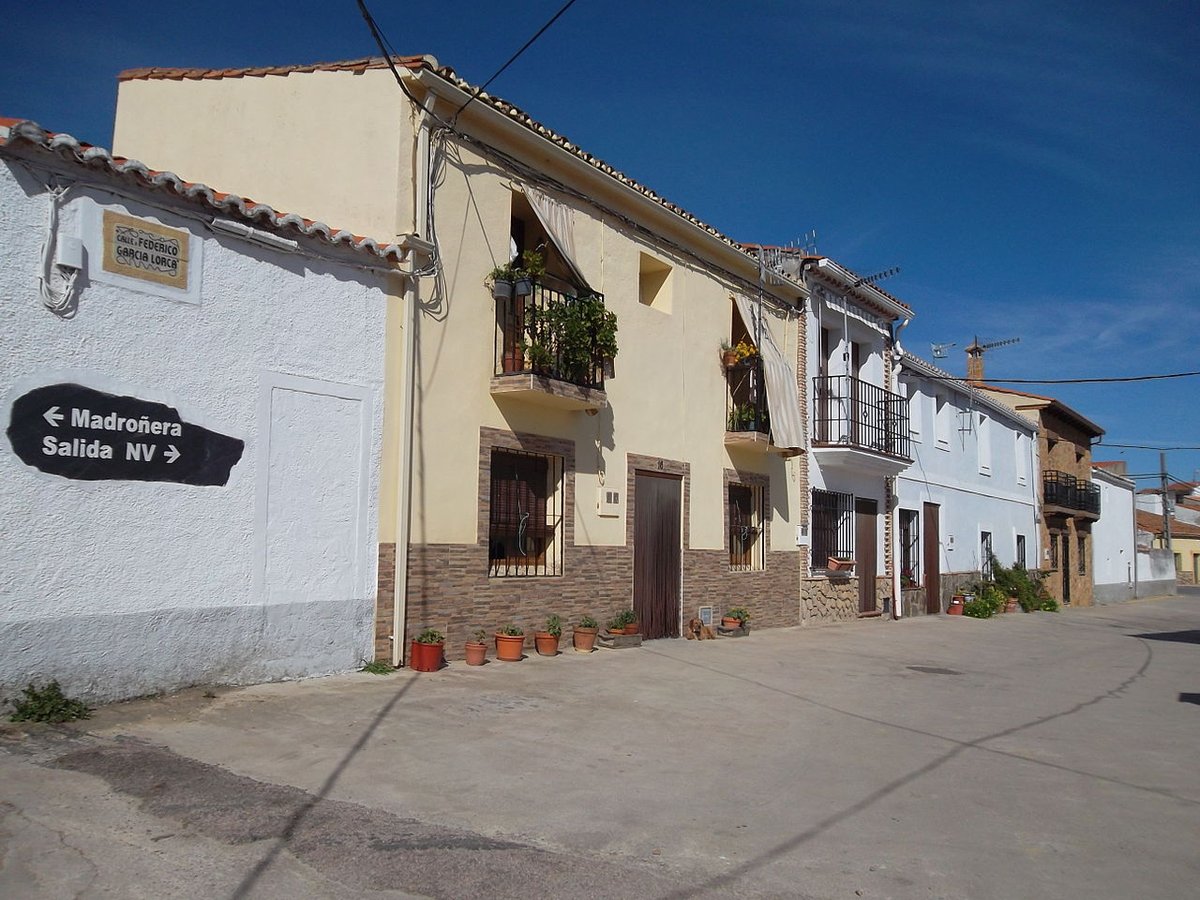
Walking through Alcollarín reveals features typical of rural architecture in Extremadura. Whitewashed façades dominate, paired with curved roof tiles and restrained granite doorways.
Many houses still include courtyards, inner patios or small agricultural outbuildings. These are not decorative features but practical ones, shaped by a way of life in which home and work were closely connected. In a village of this size, that connection remains visible.
The built environment reflects a community that has adapted to its surroundings over time. There is little separation between domestic and agricultural space, and this overlap gives the village its particular character.
Tracks through the dehesa
The immediate surroundings of Alcollarín are defined by the dehesa landscape. Holm oaks are scattered across open grassland, with paths linking livestock areas and cultivated plots.
Some of these tracks can be followed on foot or by bicycle, although signposting is limited. It is sensible to carry a map on a phone or a route track if the area is unfamiliar. The calm setting makes it a good place for observing common birdlife associated with this type of environment. Depending on the time of year, small birds of prey and species typical of open plains can often be seen.
This is not an area of dramatic routes or steep terrain. The interest lies instead in a traditional agricultural landscape that continues to function much as it has for generations.
Festivities and the rhythm of the year
The main local celebration usually takes place around the feast of the Asunción in mid-August. At that time, many people who have moved away return, and the village becomes livelier. Religious events, evening festivities and family gatherings in the square shape these days.
Semana Santa, or Holy Week, also has a presence within the community. Processions are simple and organised by residents themselves, reflecting the scale of the village.
At other points in the year, there may be romerías, which are traditional pilgrimages or gatherings often linked to nearby hermitages, as well as events connected to local customs. In a place of this size, the calendar is not always fixed and depends largely on the initiative of the people who live there.
Practical notes before visiting
Alcollarín lies a short distance from Trujillo and is reached via local roads that cross agricultural land. The journey from nearby towns is relatively short by car.
Services in the village are limited, and opening times can be reduced. It is worth planning ahead if spending the day or staying in the area, or considering nearby municipalities that have more facilities.
Alcollarín is not a conventional tourist destination. It offers a direct glimpse into rural life in this part of Extremadura, where the landscape and agricultural work continue to set the pace.