Full Article
about Garciaz
Mountain village in the Sierra de las Villuercas with oak and chestnut forests
Hide article Read full article
The square and the church
By mid-morning, when the sun has begun to warm the stone, the main square in Garciaz is almost silent. A door closes somewhere, footsteps echo over uneven ground, and little else breaks the quiet. At the centre stands the church of Santiago Apóstol, built from rough granite blocks that feel coarse to the touch, darker along the joints where damp lingers.
This is where most visits to Garciaz begin, because the building has set the pace of the village for centuries.
The tower is straight, with no ornament. The windows are small and set deep into the walls. Inside, light struggles to enter and falls softly onto wooden benches worn smooth by use. The altarpiece is restrained. Nothing feels excessive.
Streets of stone and light
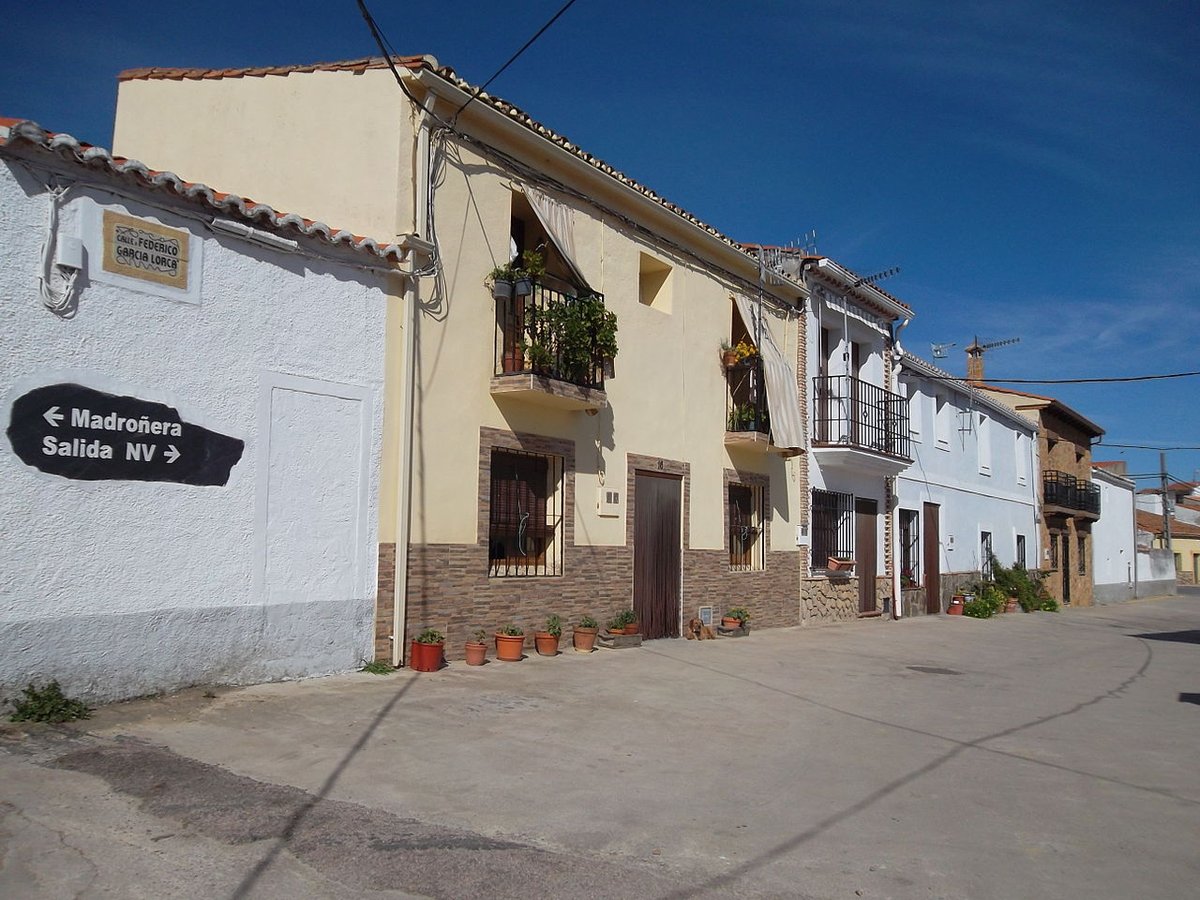
Walking through Garciaz means moving slowly along stone streets that rise and fall without any clear pattern. Facades alternate between whitewash and exposed granite. Some doors still have old metal fittings, and on several walls there are coats of arms softened by time.
In the early afternoon, the whitewashed surfaces reflect the light so strongly that it forces the eyes to narrow. As evening arrives, the streets fall into shadow and the air turns cooler. The shift is gradual but noticeable, as if the village itself settles into a quieter rhythm.
The scale remains intimate throughout. There are no grand avenues, just narrow routes that lead from one corner to another, sometimes opening onto small squares or viewpoints that look out towards the surrounding countryside.
The landscape beyond the village
Step outside the built-up area and the terrain changes quickly. Holm oaks appear, spaced apart, their canopies letting the sky show through. Rounded rocks sit across the land, and reddish dirt tracks run between them. When dry, passing vehicles lift a fine dust into the air.
This is dehesa country, a type of landscape typical of parts of Spain where pasture and woodland exist together. In spring, grass covers the ground beneath the trees. By autumn, colour fades and brown tones dominate, from the soil to the fallen leaves.
Among the trees, large granite formations known as berrocales appear without warning. These irregular stacks of rock can seem almost arranged by hand, though they are entirely natural. On clear days, the sounds carry well across the open land: wind brushing through branches, the distant ring of a bell, and sometimes a bird of prey circling on rising air.
Paths across the dehesa
Several agricultural tracks lead out from Garciaz into the surrounding land. They are used by farmers and local residents, and they are not always signposted. It is worth asking for directions before setting out, especially after rain, as some sections turn into thick mud.
The landscape is easier to walk in the early morning or late afternoon. In summer, the sun becomes intense from late morning onwards, and there is little shade beyond the holm oaks.
Iberian pigs are a common sight within fenced estates, part of the traditional use of the dehesa. Cattle are also present, and depending on the time of year, birds of prey can be seen taking advantage of the warm air currents over the open terrain.
Traditions that shape the year
When summer arrives, the village becomes more animated. Families who spend much of the year elsewhere return, and the streets fill again in the evening as temperatures drop.
In winter, some households still carry out matanzas, traditional family slaughtering days. These are long sessions focused on preparing cured meats and working around a fire. They are not organised for visitors, but form part of everyday life.
During Semana Santa, or Holy Week, processions pass through the narrow streets of the centre. They are not large-scale events. The pace is slow, the atmosphere quiet, and residents watch from their doorways as they pass.
When to go
Spring is usually the most comfortable time to walk in the surrounding countryside. The fields are green and the temperatures allow for unhurried movement.
Autumn also brings good days, with lower light that defines the shapes of the holm oaks and the granite rocks more sharply.
In summer, starting early is advisable if planning to walk, as the heat builds quickly by mid-morning. In winter, the air can be cold, but the stone surfaces of the village reveal their textures clearly under the crisp light of dry days.
A short walk through the centre
The village itself can be covered quickly. From the church square, several narrow streets lead off towards small open spaces or informal viewpoints over the dehesa.
Within a couple of hours, the scale of the place becomes clear: low houses, interior courtyards, thick walls designed to keep interiors cool in summer. Garciaz is not defined by large monuments. Attention tends to settle on smaller details, a window with geraniums, a stack of firewood against a wall, the smell of smoke on cold afternoons.
Practical notes before visiting
Garciaz lies about 45 kilometres from Cáceres. The final stretch follows secondary roads with gentle bends through the dehesa landscape. Comfortable footwear is advisable for walking beyond the village centre, as paths can become slippery after rain.
There is no need to set aside a full day to understand the village. Half a day is enough to walk through the centre, head briefly into the surrounding countryside, and see how the houses and landscape form part of the same setting. The visit works best without rushing, and with simple expectations.