Full Article
about La Aldea del Obispo
Quiet village near Trujillo, surrounded by pasture and scrubland; perfect for switching off.
Hide article Read full article
At the hour when the sun is still low, the church tower rises above the holm oaks. The stone is a pale grey that shifts quickly as the light strengthens. In La Aldea del Obispo, the day begins unhurriedly: a car passing through, the dry clang of a metal door, storks shifting on the bell tower.
The Iglesia de Nuestra Señora de la Asunción stands on a slight rise within the village. It is a restrained building of rubble masonry and whitewash. Curved roof tiles and thick walls speak of another time. It is not a large church, yet it can be seen from several points around the area, particularly when the sky is clear and the outline of the tower cuts across the dehesa landscape.
La Aldea del Obispo is a small place in Extremadura, with just over two hundred residents. There are no major visitor facilities and no steady flow of tourism. What you find instead is quiet, earth tracks and the sense that the landscape keeps to the same rhythm it has followed for decades.
The Heart of the Village
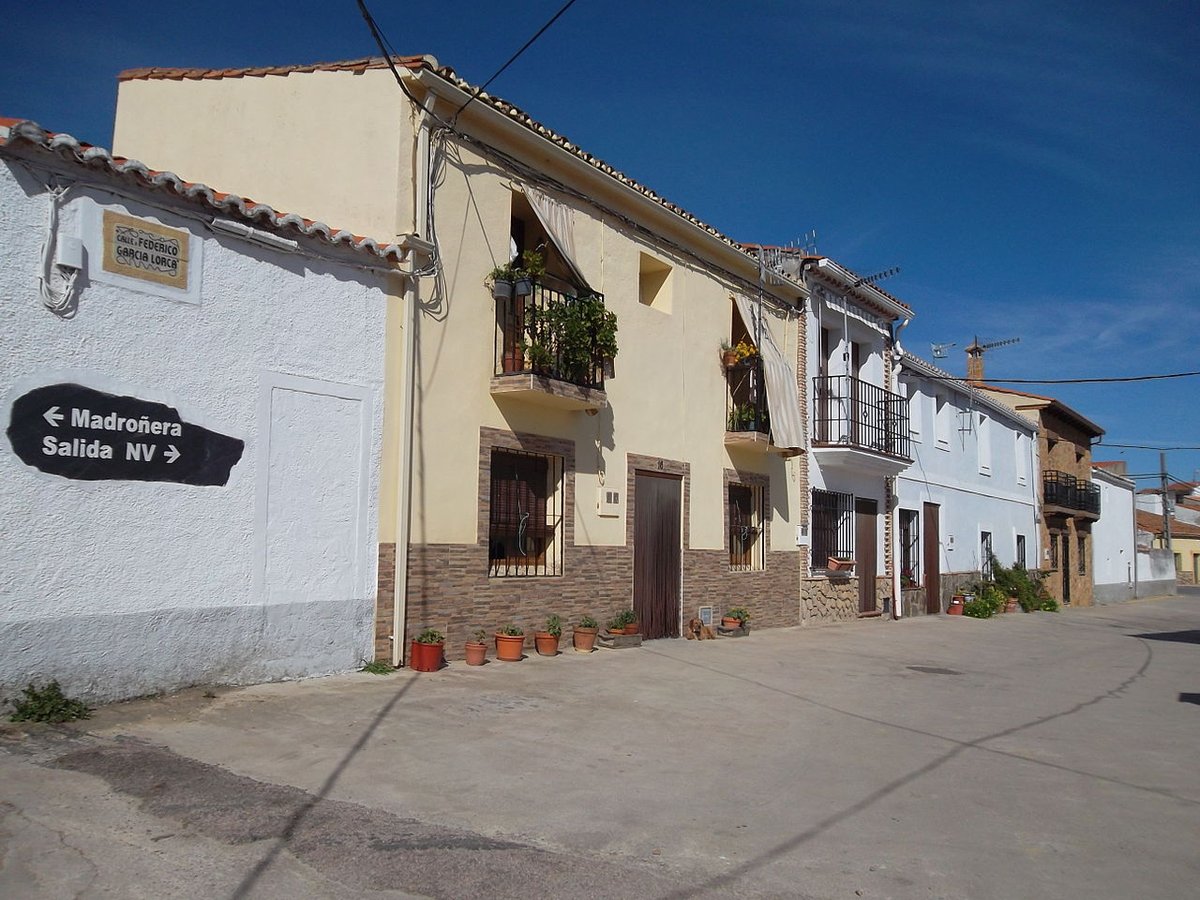
The streets are short and calm. White houses, many single storey, line the way. Dark wooden gates still show the marks of long use. Through some open entrances you can glimpse old animal pens and small haylofts, reminders that life here has always been tied to the land.
The main square sits near the entrance to the village. A stone well stands there, along with a few benches where locals tend to gather in the late afternoon. Conversations stretch out without hurry as the light fades. In a place of this size, almost everything and everyone is familiar after a single circuit of the streets.
There is no rush-hour feel, no obvious centre of activity beyond the square and the church. The scale is modest, and that modesty shapes the experience of being here. It is easy to walk from one end of the village to the other in a matter of minutes, pausing to notice details: the texture of whitewashed walls, the weight of wooden doors, the way the church tower remains in view from different angles.
The Dehesa All Around
Step beyond the last houses and the dehesa begins almost immediately. The dehesa is a traditional landscape of south-west Spain, a mix of pasture and scattered trees, shaped over centuries by grazing. Here, holm oaks stand well apart from one another, their canopies casting rounded patches of shade. The ground is stony, with low grass between the trunks.
When the heat builds, the air often carries the scent of dry earth. After the first rains, it changes to damp grass. Livestock forms part of the everyday scene. Sheep, goats and Iberian pigs move slowly between the trees. Above them, storks and kites pass overhead. In wetter winters, seasonal pools form, and near these you may spot a heron.
The openness of the dehesa means that light plays a constant role. Morning and late afternoon bring longer shadows. At midday, especially in the hotter months, the landscape can feel still, as if sound itself has thinned out.
Walking the Rural Tracks
There is no marked network of footpaths around La Aldea del Obispo. The usual approach is to follow agricultural tracks that link farms and plots of land. Some lead into denser stretches of oak woodland. Others cross open fields where the wind can be heard before it is felt.
If birdwatching is of interest, early morning is the best time to head out. At that hour the countryside is full of sound: larks rising, the call of a crow, the soft movement of branches. The experience is less about reaching a particular viewpoint and more about paying attention to what is happening around you.
Because several tracks fork without signposts, it helps to carry a map or use GPS. The terrain is not dramatic, but its uniformity can make orientation harder than expected. The sense of space is wide rather than vertical, with gentle shifts rather than sharp changes.
Walking here is straightforward in practical terms. There are no ticket booths, no designated routes, no interpretive panels. The simplicity is part of the appeal. A common plan is equally simple: walk for a while, stop beneath a holm oak and listen.
The Landscape Through the Seasons
Summer alters the ground first. The soil turns hard and brittle. Underfoot, small stones crunch against boots. Rockrose and broom shrubs lose some of their brightness, and during the central hours of the day the air can feel motionless.
Spring brings a different look. Low flowers appear among the holm oaks, adding patches of colour to the pasture. The contrast between green grass and dark tree trunks is at its clearest. It is one of the most comfortable times for walking, before the stronger heat arrives.
In autumn, the overall tone shifts towards ochre and yellow, especially in areas near the streams that flow towards the Almonte river. The changes are gradual rather than dramatic, yet noticeable if you spend time outdoors. After rain, the scent of the earth returns and the seasonal pools may begin to form again in low-lying ground.
Winter depends largely on rainfall. In wetter years, the temporary ponds attract more birdlife. The trees remain a constant presence throughout, their forms defining the horizon in every season.
When to Go and Getting There
From Cáceres, La Aldea del Obispo is reached by car along regional roads that pass through dehesa and small cultivated plots. The final stretch is quiet, with little traffic. It is best taken without haste, as there are bends and some junctions that are not clearly signposted.
Spring and early autumn are generally the most comfortable times for walking in the surrounding countryside. Summer can be very dry and hot here, particularly from midday onwards. In those months, it makes sense to set out early and leave the central hours of the day for the shade within the village.
La Aldea del Obispo does not offer a packed schedule or a list of headline sights. Its appeal lies elsewhere. The church tower against a clear sky, the murmur of conversation in the square, the steady movement of livestock across the dehesa. Time is measured less by attractions and more by light and temperature.
For travellers used to busy itineraries, the adjustment may take a moment. Here, the most typical plan is uncomplicated: a short walk along a dirt track, a pause under a holm oak, and the simple act of listening to what is going on around you.