Full Article
about Plasenzuela
Historic mining village on the Trujillo plains
Hide article Read full article
Arrival Across Open Land
Plasenzuela sits along the EX-390, reached through a landscape that feels wide and spare. Fields of cereal stretch out on either side, broken here and there by a holm oak, but little else interrupts the view. The turn-off does not announce itself loudly, so it is easy to miss if attention drifts.
Once inside the village, parking is straightforward. Most visitors leave the car in the main square or on nearby streets. Everything is close together, and the place reveals itself quickly. Within half an hour, it is easy to get your bearings and understand how the village fits together.
There is no extended old quarter or long promenade to explore. Plasenzuela works best as a short stop rather than a place to linger for hours.
The Square and Its Landmarks
Life here gathers around a single space. The main square holds almost everything of note: the church, the rollo de picota and a local bar. It is a compact setting that gives the village its centre of gravity.
The Iglesia de la Asunción stands out immediately. Its origins go back to the late Middle Ages, although it has been altered over time. From the outside, the building looks restrained, with little ornament beyond its main doorway, which is the most detailed part of the structure. Step inside and the atmosphere changes. The interior is usually dim, with the kind of cool air typical of large rural stone churches. It feels solid and unadorned rather than elaborate.
Near the church is the rollo de picota, a stone column with a specific historical meaning. These structures were erected when a town gained its own jurisdiction during the early modern period, serving as a visible sign of authority. In Plasenzuela today, it stands quietly beside the benches, more a marker of the past than an active symbol.
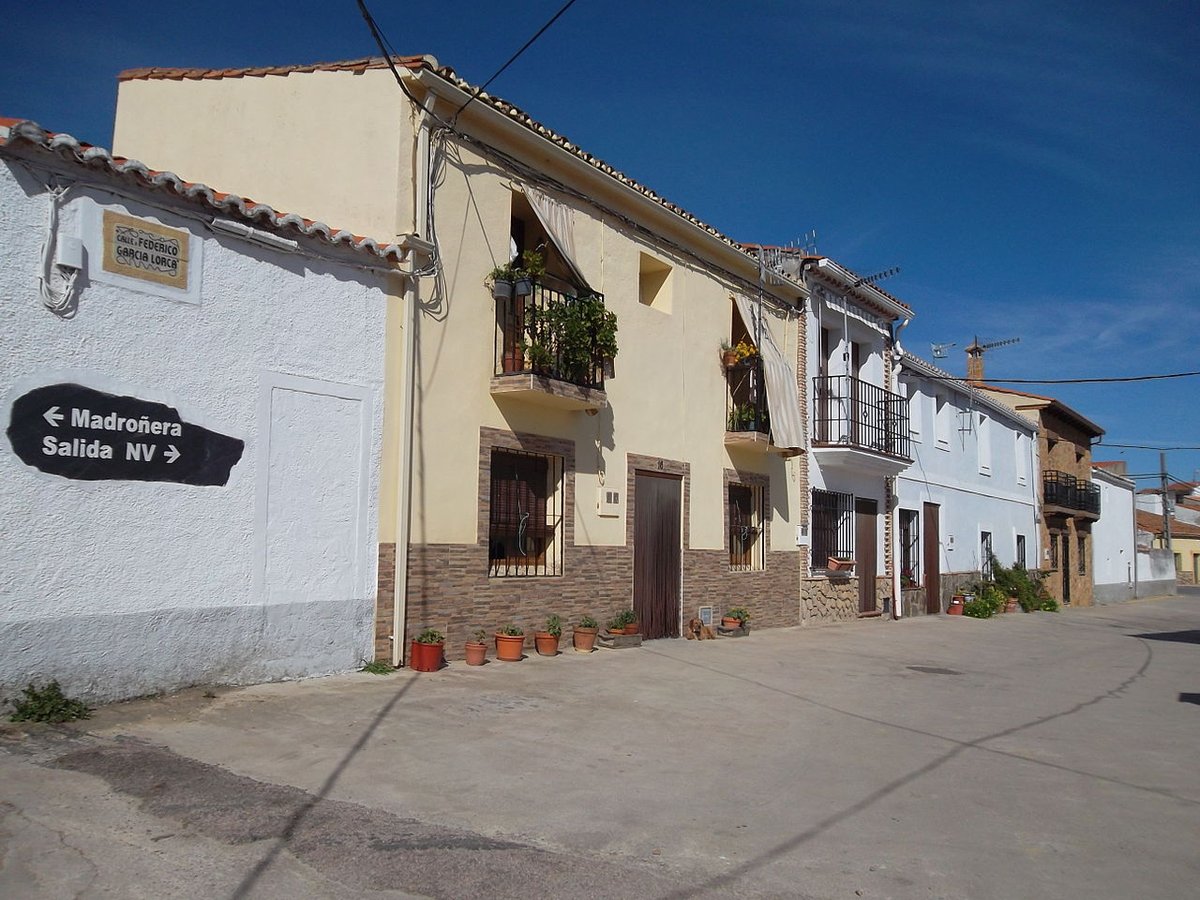
Beyond these elements, the village offers no major monuments. The rest of the streets follow a familiar pattern for this part of the Trujillo area: whitewashed houses, short and quiet lanes, and yards or corrals behind many homes. It is a setting shaped by everyday rural life rather than by grand architecture.
For those interested in archaeology, the most significant remains are not within the village itself. The site of Villasviejas del Tamuja lies several kilometres away and requires a drive to reach. Plasenzuela does not present those remains directly, but it sits within their wider landscape.
A Village Shaped by the Countryside
Plasenzuela has a population of around five hundred people. Its municipal area is relatively large, and the surrounding land defines much of its character. Cereal crops dominate, alongside dehesa pasture and some livestock. The rhythm of life follows the needs of the countryside.
This is not a place arranged around visitors. The square is often quiet, especially during the week, and there is little sense of constant movement. What activity there is tends to be local and low-key, tied to daily routines rather than to tourism.
Reaching Plasenzuela without a car is not straightforward. The nearest train station is in another municipality, so in practical terms a car is needed both to arrive and to explore the surrounding area. Once there, distances are short, but the wider region depends on road travel.
When the Landscape Changes
The time of year affects the experience more through the surrounding fields than through events in the village itself.
Spring is often the most rewarding season. The countryside turns green, and the agricultural tracks around Plasenzuela are easier to walk. The open land feels softer at this time, with more variation in colour.
Summer brings intense heat. There is strong sun and very little shade outside the built-up area, which shapes how long visitors tend to stay outdoors.
Winter does not usually mean snow, yet the cold of the plain is noticeable. The air can feel sharp, especially without shelter from wind.
Autumn is quieter still, with less light during the day. The landscape remains largely the same in form, even as the tones shift.
A Short Pause Rather Than a Destination
Plasenzuela makes sense as a pause along the way rather than a destination in its own right. The main square, the church and the picota can all be seen quickly, without the need for a long visit.
For those who want to extend their stop, the surrounding agricultural paths offer a chance to walk through the same open land seen on arrival. Another option is to continue towards Trujillo and nearby villages, where there is more to explore.
The appeal here lies in its simplicity. Stop, stretch your legs, take in the square, and move on. The experience is defined by calm and by the expanse of the countryside rather than by a packed itinerary.