Full Article
about Villamesías
Farming village crossed by the Búrdalo River on the rolling plateau.
Hide article Read full article
Late in the afternoon, when the heat begins to ease, Villamesías almost falls silent. A door stands open. Somewhere, the metallic drag of a chain crosses a farmyard floor. Beyond the edge of the village, holm oaks cast long shadows. Light slants across pale façades and dust rises slowly from the road when a car passes.
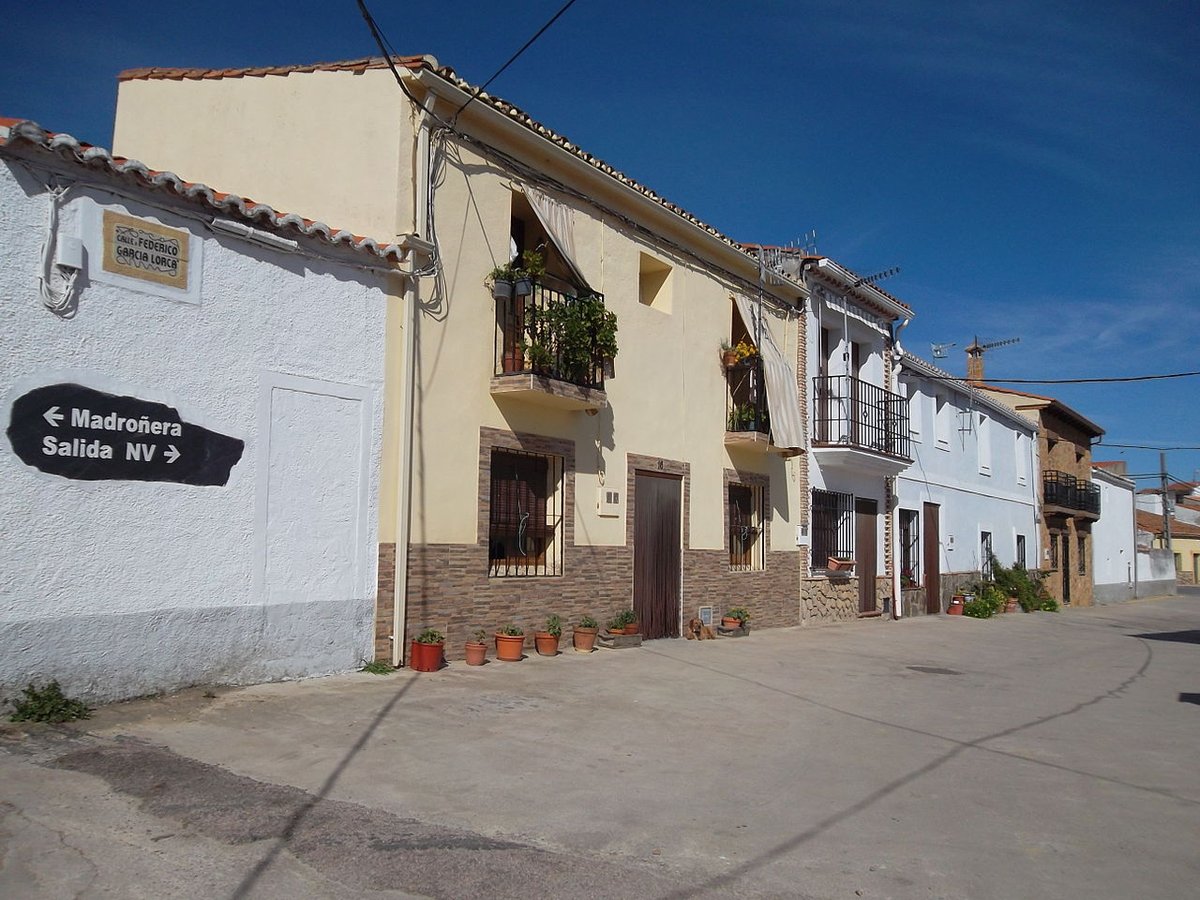
Tourism in Villamesías has little to do with packed schedules. This small municipality in the comarca of Trujillo, home to just over two hundred residents, makes more sense at a slow pace, simply walking and looking around. The houses are low, built of adobe or brick. Many have curved roof tiles and wooden gates darkened by time. The centre is easy to spot: a modest square with the parish church and a handful of streets leading out in different directions towards open countryside.
Its proximity to Trujillo means many visitors arrive on a short trip. The drive is brief, and the landscape shifts quickly from the city’s towers and walls to more open ground, with dehesas and cultivated fields.
A Village Shaped by Its Church
The urban centre can be covered in little time. Streets run straight or with a slight bend, and in places asphalt gives way to rougher patches. On some façades, adobe walls show the marks of repeated repairs, layers of limewash reflecting the hard white light of midday.
The parish church, dedicated to San Pedro, stands at the most recognisable point in the village. Its form is simple, with thick walls and a brick bell tower visible from several spots. Part of the building dates back to the 16th century, although it has been repaired over time. Inside, the atmosphere is restrained. Dark wood, worn pews and an altarpiece without grand decoration define the space.
Around the square there is usually some movement early in the morning and again towards evening. For the rest of the day, calm returns.
The Dehesa Around Villamesías
Beyond the last houses, holm oaks begin to appear. The ground turns reddish and tracks emerge, marked by tractors or livestock. This is the typical landscape of this part of Extremadura: trees spaced apart, rounded pools of shade, and a horizon that always seems gently uneven.
There are no signposted trails. Even so, the paths leading out from the village allow for easy walking, provided the houses remain in sight in the distance. In summer, the air carries the scent of dry grass and dust. In winter, after rain, dark soil clings to shoes and the fields shift to deeper greens.
The sounds are sparse. A rook calls out. A cowbell rings somewhere far off. Early risers may notice quick movement between the holm oaks, rabbits darting across a track or birds lifting suddenly into flight when someone comes too close.
Walking the Surroundings
Many local residents use the nearby paths to stroll or to check on their land. These are straightforward routes, without steep gradients. It is enough to leave by one of the minor roads and turn onto a dirt track.
Much of the land is privately owned, although traditional paths are generally passable. Gates and fences should not be crossed. Asking someone in the village before setting out remains the safest way to understand where to walk.
Close to the village there are small areas with springs or ponds that, in rainy years, retain some water. In dry summers the scene changes. Grass yellows, earth cracks and shade is scarce away from the holm oaks.
Festivals and Everyday Traditions
The main celebrations revolve around San Pedro, towards the end of June. During those days the square regains some bustle. Religious events take place alongside gatherings of neighbours, and the atmosphere remains very local in character.
Another custom that continues in many households is the winter matanza del cerdo, the traditional pig slaughter. It is not presented as a spectacle or an activity for visitors. It is a family task lasting several days, producing cured meats and preserved foods that will be eaten over the following months.
Local cooking is closely tied to this cycle. The dishes are substantial, suited to long working days and the colder part of the year.
When to Visit
Villamesías changes noticeably with the seasons. In spring the surrounding fields turn green and the air is fresher for walking. Autumn is also comfortable, with mild temperatures and clear light at the end of the day.
Summer requires some planning. At midday the sun is strong and there is little shade in the streets. It is easier to head out early or to wait until later, when the temperature drops and the village regains a little activity.
Arriving by car makes getting around straightforward, and parking is rarely an issue. The village is small and everything lies within a few minutes on foot. What matters most here is not ticking off sights, but adjusting to the slower rhythm of a place that continues to revolve around its square, its church of San Pedro and the wide dehesa that frames it.