Full Article
about Mengabril
Small farming village on the Guadiana floodplain; noted for its church and quiet streets.
Hide article Read full article
“Shall we go to Mengabril?”
“To do what?”
“Mengabril, the village of garlic.”
“Oh right, I thought it was a cough syrup.”
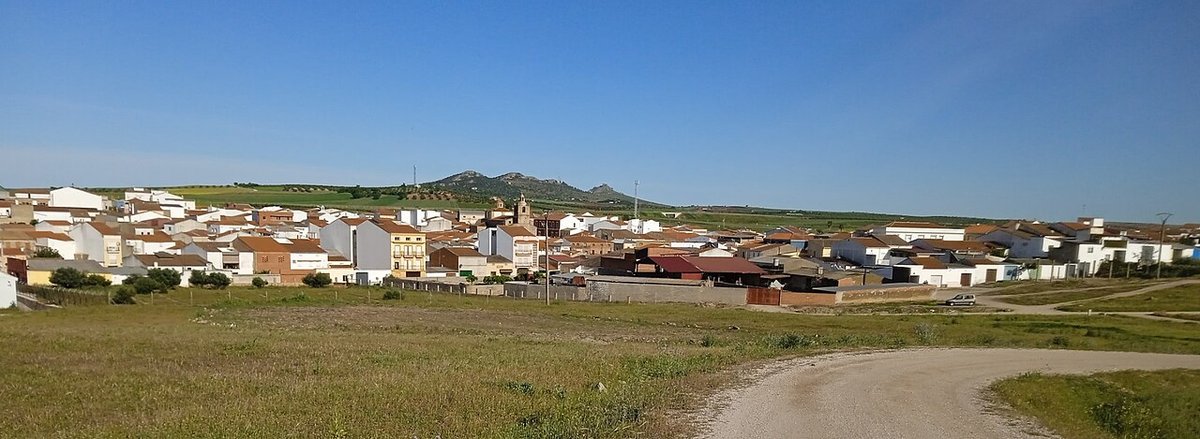
That is the tone people often strike when the name comes up. Tourism in Mengabril sounds like an odd plan when you say it out loud. The name could pass for something from a pharmacy, and the place itself is a small village in the Vegas Altas area of Extremadura. A little over five hundred residents, a lot of farmland around it, and a church that feels bigger than expected when you arrive.
It does not appear on many itineraries. That is part of why it works.
A road that never seems to end
On the map, getting there looks straightforward. From Don Benito you head towards Campanario and at some point a turn-off appears. After that, signs for Mengabril start to show up every few kilometres.
The feeling is a curious one. You see the name, keep driving, and the village does not quite materialise. The land is flat. Agricultural plots stretch out on either side, with tractors moving about and the occasional farm building.
When you finally enter, everything gathers quickly. You park in the main square without much thought. There is no traffic tangle and no maze of streets to figure out.
Step out of the car and the first thing that stands out is the smell of the countryside. Anyone who has spent time in this irrigated part of Extremadura will recognise it.
A church that feels too large
The parish church of Santa Margarita shifts expectations a little. You anticipate something modest and find a rather serious stone building.
It is an old church of the kind that appears in Extremaduran villages when you least expect it. A heavy door, thick walls, and inside a quiet that makes voices drop without thinking.
There is no set-up for visitors. If it is open, you go in, look around for a while, and leave. It is a short visit, and also a place to escape the heat when it becomes intense.
Easter Monday out in the fields
If the visit coincides with Easter Monday, another side of the village comes into view. That day many people head out to the nearby countryside.
There is traditional music, with the sound of the tamboril, and families bring folding tables along with food prepared at home. It is not organised like a formal festival. It is closer to what people have always done: gathering, eating, spending the day outdoors.
In one scene, a man grills meat over a metal drum cut in half and offers bread with it. He sums it up in a simple line: “This is what there was before photos of food.” The point lands easily.
Cabrito, when it is on
In this part of Extremadura, cabrito, roast or stewed kid goat, comes up often in conversation. Ask about it and someone will usually say it has always been eaten here.
Mengabril does not have an area packed with restaurants or anything like that. The usual approach is to go into a local bar, ask what is available that day, and sit down.
If cabrito is on, it becomes obvious straight away because many people will be eating the same dish. It is straightforward food, served in generous portions, with conversation around it.
It does not need much explanation.
Quiet streets and village life
Mengabril does not have a historic centre that demands constant attention to façades. The streets are wide, the houses are low, and as evening approaches many doors are left open.
Later in the day, chairs come out onto the pavement. People talk, someone cycles past, a tractor returns from the fields.
For anyone coming from a large city, a small shift happens. At first the pace is quick. Within minutes it matches everyone else’s.
It is common for someone to ask where you are from. When the answer is a big city, the reply tends to be along the lines of, “Here you can rest.”
A short wander around Mengabril
Mengabril does not take long to see. Go into the church if it is open. Walk around the square. Head on foot towards the Ortigas river along nearby paths.
The landscape is typical of the Vegas Altas: fertile land, long plots and a flat horizon. It is agricultural and everyday.
After that, return to the centre, sit for a while and watch the afternoon pass. That is enough to understand the place.
Mengabril is not somewhere that aims to impress at first glance. It is closer to spending time with a calm friend, the kind where two hours slip by in conversation without much notice.