Full Article
about Navalvillar de Pela
Known for the La Encamisá festival; set among reservoirs and hills in a privileged natural setting.
Hide article Read full article
The land before the water
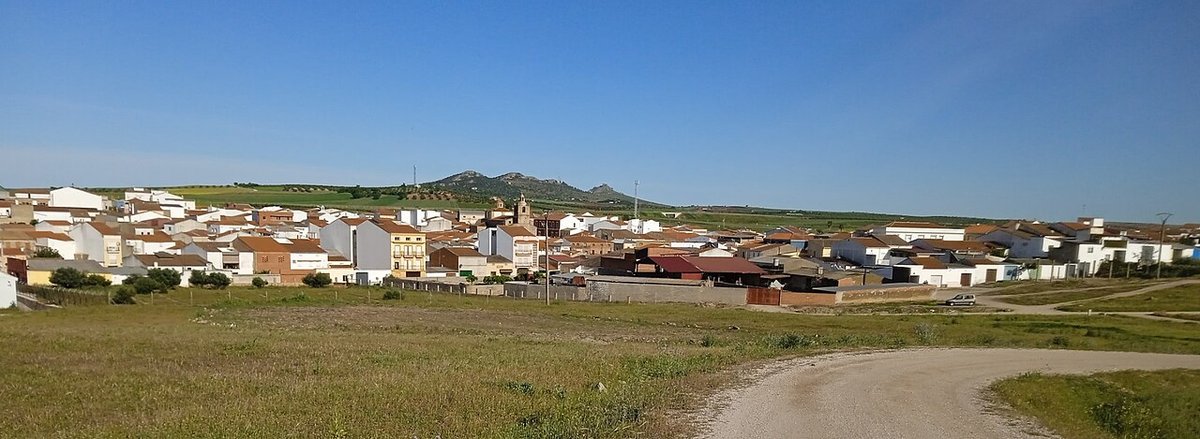
Navalvillar de Pela holds four thousand people and a particular gravity. The town sits where the agricultural plain of the Vegas Altas meets the first slopes of the Sierra de Pela. This geography, a transition from flat fields to limestone hills, has defined its character more than any single monument.
The 20th century left a difficult mark here. On the outskirts, near the cemetery, an iron cross stands over a grave from the summer of 1936. It is not a signposted stop. The event remains part of the local memory and contributes to a certain sober tone in the streets.
A boundary in the landscape
The Sierra de Pela forms a natural border with La Siberia. These are not high mountains but rolling hills covered in holm oak, rockrose and some Portuguese oak. The vegetation softens the silhouette. Much of the area has protection as a bird zone, which has prevented the scattered development seen near other reservoirs.
From the higher points, you see the Orellana reservoir in the distance. The water appears framed by stretches of dehesa, the traditional pastureland. The view clarifies the lay of the land: a vast plain interrupted by water and these ancient hills.
The road from Don Benito makes the shift clear. After kilometres of uniform farmland, the route bends and the sierra comes into view.
Built for purpose
The town climbs a slope. Streets narrow as they reach the upper part. The Plaza Mayor gathers the main civic and religious buildings.
The church of San Juan Bautista dominates the square. The current structure is largely from the 18th century, built after an earlier one proved too modest. Inside, a late 18th-century neoclassical altarpiece draws the eye. Local accounts say it replaced another damaged in a major earthquake of that period.
Older houses show a practical architecture. Whitewashed walls, generous ground floors and spaces for animals or tools were standard. These homes served needs, not aesthetics.
A different economy once thrived here. The 18th-century Catastro de Ensenada records a surprisingly high number of beehives for a town this size. Honey production shaped work patterns for generations, as integral to life as the surrounding fields.
Fire in January
Each year on the 16th of January, the routine of the town breaks for La Encamisá, the festival of San Antón. Riders on horseback move through the streets after dark, wearing white shirts and carrying torches.
The scene has a theatrical, archaic quality. Older stories linked it to battles with Moorish raiders, but surviving documents suggest a simpler origin. Written references from the 18th century describe a night procession to bless the fields.
The organisation still runs through local families. Many riders hold the place their fathers or grandparents once did. This continuity matters more than spectacle.
Older lines
A few kilometres from town lie the remains of Lacimurga, a Roman settlement known locally as Cogolludo. It occupied a strategic point along the Guadiana, controlling routes and nearby mining activity.
Today you find foundations and fragments of walls. The value of the site lies in its location. From here, you understand why they built here: the river, the low hills, the natural corridors. The Romans read the territory well.
The Orellana reservoir changed the local economy in the mid-20th century. Work once centred on dryland cereals and seasonal labour. The dam brought irrigation and different jobs.
Yet the agricultural world remains immediate. Olive groves and cereal plots reach the town's edge. The rhythm of the countryside still sets the pace.
On foot in the sierra
The simplest way to reach Navalvillar de Pela is by car, via Don Benito or Mérida.
Spring is usually the best time to walk in the sierra. The heat is not yet intense and aromatic plants line the paths. One established route follows an old livestock track down toward the Arroyo de la Sierra, forming a circuit of about six kilometres. A 19th-century flour mill, now silent, stands along the way.
Carry water. Fountains are scarce on these slopes, and the sun gains strength quickly. The challenge of a walk here comes more from exposure than from difficult terrain.