Full Article
about Santa Amalia
A 19th-century settlement and farming town; key transport hub in the Vegas Altas.
Hide article Read full article
An afternoon that explains everything
At five in the afternoon, when the sun drops just enough for the rice fields to glint like broken mirrors, Santa Amalia smells of damp earth and freshly baked bread. Cicadas have been droning for hours in the steady heat of summer. By a roadside table, a man stirs sugar into his coffee and watches tractors roll past along the N-430. There is no sense of hurry.
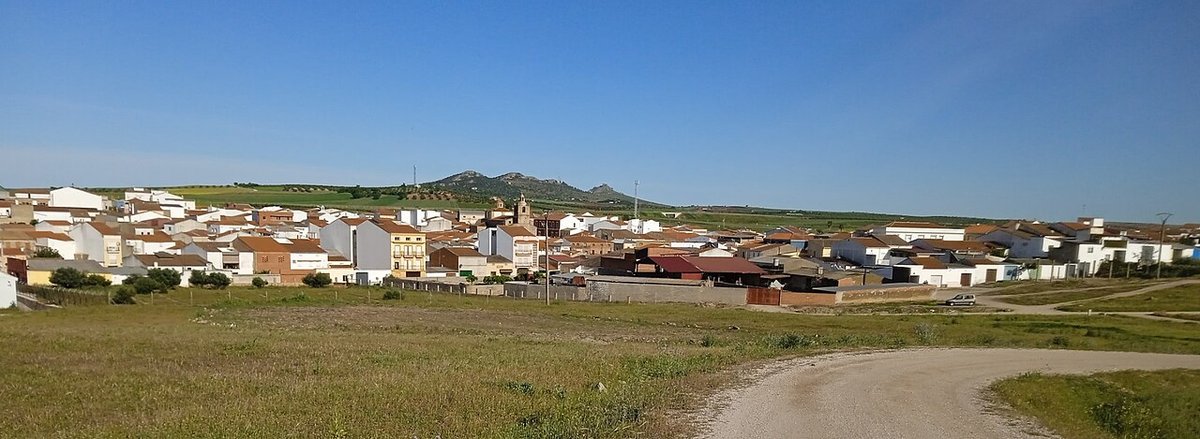
That moment says a lot about Santa Amalia. Light settles on pale façades and reveals something that stands out straight away: many of the houses follow an almost mathematical alignment. Streets run straight and parallel, as if someone had drawn the plan first and then placed the town on top. This is no coincidence. Santa Amalia was founded in the 19th century as a planned settlement, which is unusual for villages in this part of Extremadura.
A town drawn with a ruler
Walking through Santa Amalia means following a design that is still easy to read. Streets meet at right angles, and the houses, with their simple doorways and painted iron grilles, keep a certain uniformity that is hard to find in nearby towns. Over time, each family has made small changes, a closed-in balcony, a new façade, a different coloured shutter, yet the original structure remains in place.
At the centre, there is a square that feels generous for the size of the municipality. Early in the morning, the sound of metal shutters being raised mixes with the low murmur of greetings exchanged from one corner to another.
The parish church occupies one side of the square. It is a restrained building with neoclassical lines and a tower that seems to stop halfway through its gesture when seen from below. Inside, the air is noticeably cooler than outside, even in high summer. The scent is of wax and old stone, and when the door closes, the echo lingers for a few seconds before fading.
The rice fields of the Vega Alta del Guadiana
To understand Santa Amalia, it helps to look beyond its streets. The Vega Alta del Guadiana is an agricultural plain where water dictates the rhythm of the year. In spring, many fields are flooded for rice cultivation, and the landscape shifts completely. Rectangles of water reflect the sky, broken only by the slow movement of a heron.
At dawn, birds can be heard that are not always common in other parts of Extremadura. Black-winged stilts, herons and other water birds use these flooded fields to feed. For anyone interested in birdwatching, early morning is usually the best moment, before machinery begins its work.
From the town, agricultural tracks stretch out across these vegas. They are not always signposted routes, but they can be explored on foot or by bike with some care around tractor traffic. After irrigation or rain, mud clings stubbornly to boots, so solid footwear is a sensible choice.
Pilgrimage paths and working land
In May, when the heat has not yet reached its peak, there is a noticeable shift along the tracks near the Búrdalo stream during the pilgrimage of San Isidro. This rural festival, dedicated to the patron saint of farmers, brings families out of the town on foot or in trailers decorated with branches. The soundscape changes as well, with music, raised voices and children weaving between parked cars along the edges of the path.
For the rest of the year, these same routes return to their quieter role. Farmers move through them as part of daily work, local cyclists pass by, and the occasional walker seeks out a stretch of silence. Around midday, the air carries a mix of dust, dry grass and, depending on the season, the soft, damp sweetness of the rice fields.
June nights and shared food
In early June, the pace of the town shifts for a few days. Streets are lit up, and temporary stalls appear in the square where food is prepared for large gatherings. In wide pans, migas are cooked, a traditional dish of fried breadcrumbs mixed with pieces of panceta, stirred constantly so they do not stick.
Soon after comes the night of San Juan. Bonfires are lit in the square, and the smell of grilled sardines lingers in the smoke. Children tend to edge a little too close to the flames, while older voices repeat familiar stories: that people once washed their faces at dawn with herb-infused water, that jumping over the fire brings good luck. At some point, a guitar will make an appearance.
A place best taken slowly
Santa Amalia is not defined by monuments or sweeping viewpoints. It makes more sense at a slower pace. Early in the day, when windows begin to open and the sound of sweeping pavements carries along the streets. Or during the afternoon lull, when everything seems to pause and the only constant is the hum of cicadas.
For walking through the town and heading out along the tracks of the vega, June and September tend to be easier months. August brings intense heat, and the asphalt holds onto it well into the night.
A practical approach is to leave the car near one of the entrances and continue on foot. Distances are short, and this way the rhythm of the place becomes clearer: the smell of bread from the first batches out of the oven, the sound of water running through nearby irrigation channels, and the quiet, steady pace that defines Santa Amalia.