Full Article
about Villanueva de la Serena
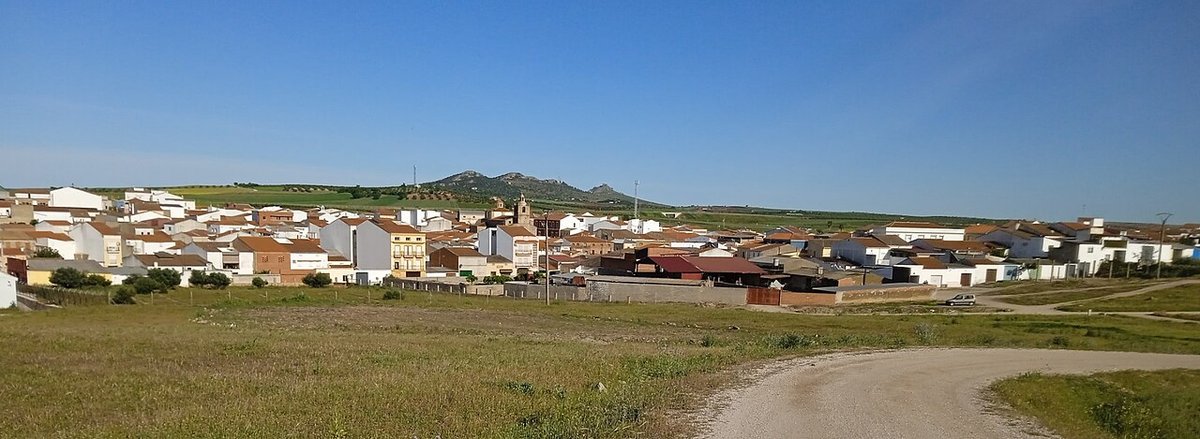
Modern city and gateway to La Serena; birthplace of the potato omelet and a hub for shopping and services.
Hide article Read full article
A Thursday That Starts at the Market
At nine in the morning, the covered market smells of ripe tomatoes and sheep’s cheese beginning to soften in the warmth. Older women test peppers with their fingertips, almost like fabric, while somewhere in the background a sack of potatoes is tipped out with a dry, repeated thud. In Villanueva de la Serena, Thursday has its own soundtrack: voices crossing over one another, carts squeaking, bags filling slowly.
Arriving at that hour makes one thing clear. A good part of tourism in Villanueva de la Serena begins here, among fruit stalls and conversations that have been repeating for decades. It is less about sights and more about rhythm, about how the town moves through the week.
Food That Takes Its Time
In this part of the Vegas Altas, meals are not rushed. Bread comes dense, olive oil is used generously, and many dishes grow out of whatever was left from the day before.
Migas extremeñas still appear on some mornings, especially when the air turns cooler. Stale bread is brought back to life with a little water, then cooked with olive oil and garlic. Torreznos follow, properly crisp, sometimes joined by fried peppers. The large pan moves slowly, as if someone were stirring warm sand.
Cheese deserves a bit more attention. The usual choice here is queso de La Serena, made from Merino sheep’s milk and set with vegetable rennet. It has a slight bitterness and a depth that lingers on the hands, carrying a faint scent of the countryside. When properly matured, it opens easily and the inside turns creamy, almost spreadable. In many homes it is served simply with bread, nothing else.
For anyone curious to try it, the market or a food shop in the centre during the morning tends to offer more choice than later in the day.
A Square That Holds the Day
Plaza de España is broad and bright, its pale paving reflecting light upwards. Early on, the stone leans towards grey; by late afternoon it warms, and the façades seem to shift in tone.
At the centre stands the fountain known as the Cuatro Caños, which has been part of daily life for centuries. The benches around it are worn smooth along the edges, shaped by years of people sitting and watching the day pass. It is still common to see groups gathering at the same hour, discussing whether winter will be dry or if this year’s tomato crop has turned out better.
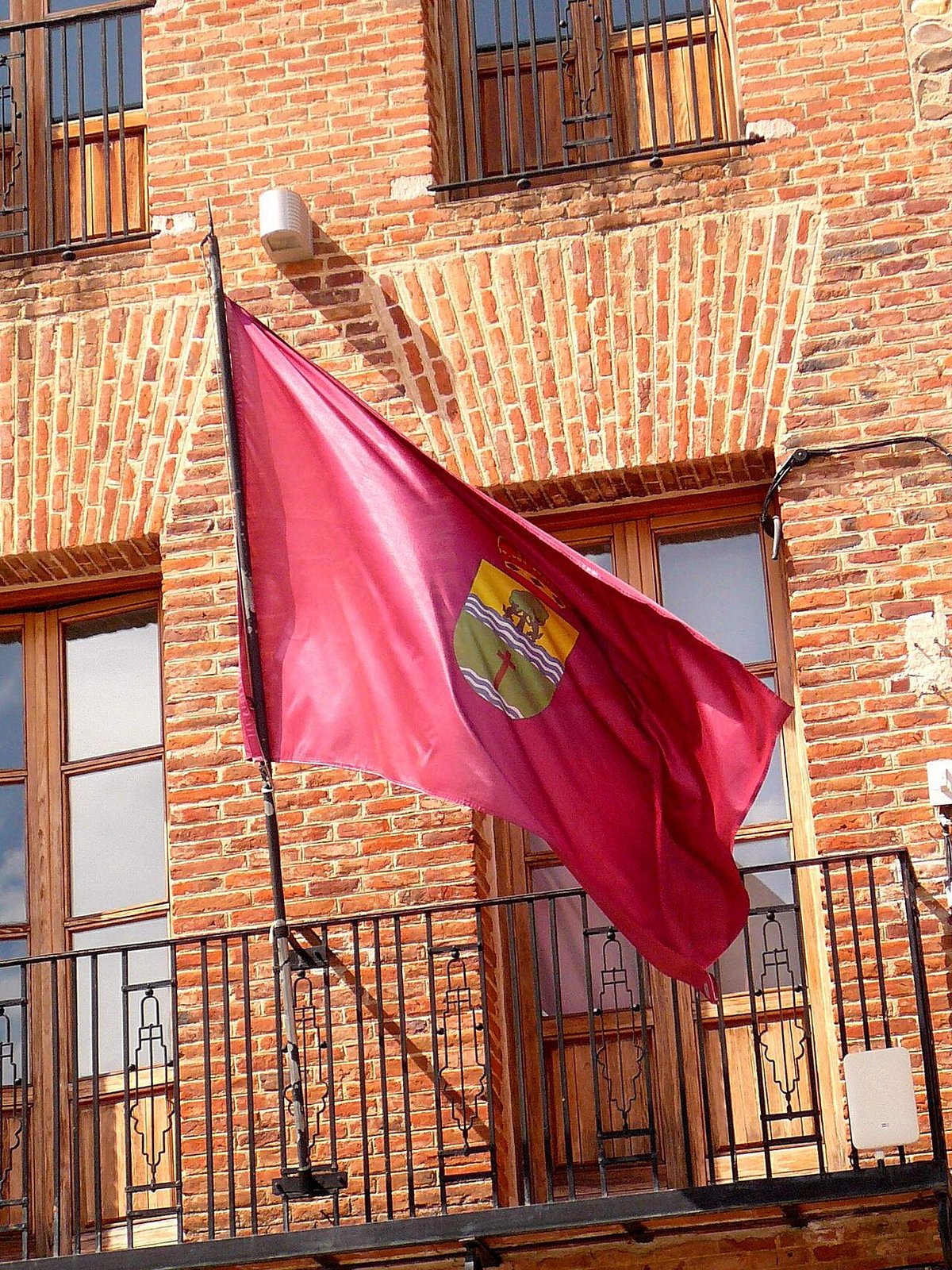
The town hall occupies one side of the square. It is not grand, but it carries the feel of an old municipal building that sets the pace of the centre. People come and go to deal with paperwork, others wait in the shade when the sun grows strong.
A Low Hill and a Wide Plain
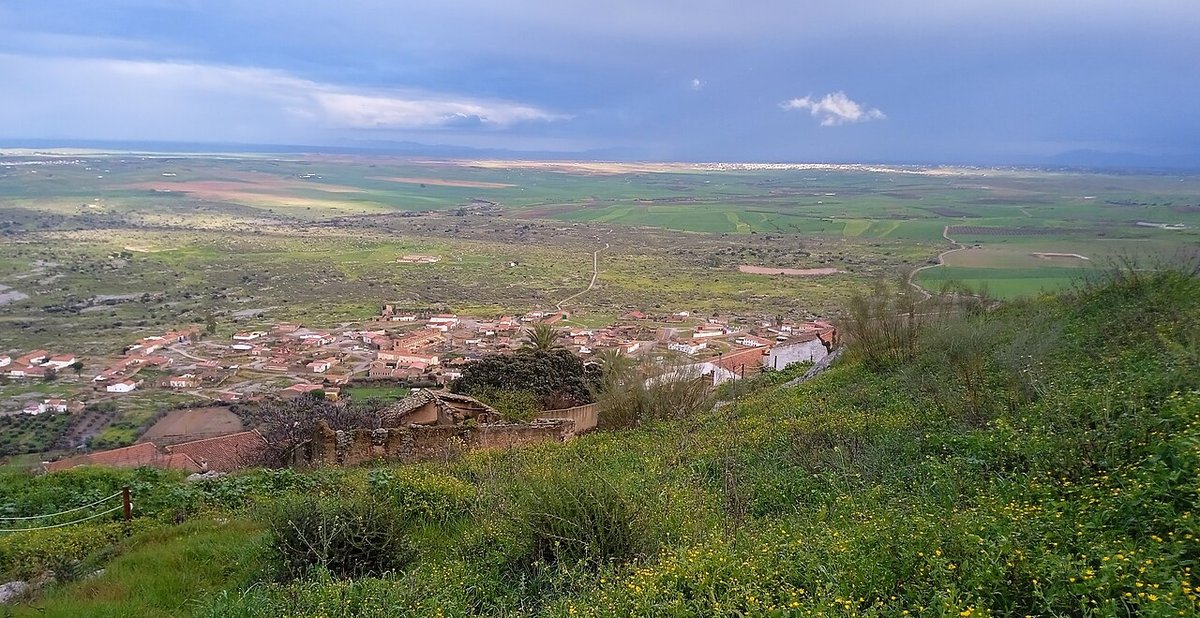
On the outskirts, small rises offer a clearer sense of how the farmland spreads around the town. One of these is Castilnovo, a modest hill that can almost go unnoticed from below. From the top, the landscape falls into place: large plots, straight tracks, and the intense green of irrigated fields.
Access is usually along dirt paths that leave from the sports area. It is not a long outing, though the middle of the day in summer is best avoided. The sun falls directly here, and shade is scarce.
Spring carries the smell of damp grass and turned earth. By July, the constant buzz of cicadas takes over.
Along the Old Railway Towards the Zújar
Villanueva de la Serena also links to sections of the vía verde that follow the old railway line towards Logrosán. Locals use it for walking or cycling, often later in the day.
The first stretch crosses open ground, with scattered holm oaks and cultivated fields. There is no need to go far to notice the shift. As soon as the town is left behind, the noise fades and only the sound of tyres on gravel remains, with the occasional tractor in the distance.
In summer, it is worth heading out early or waiting until the sun drops. The long evenings across the plain bring a softer light that turns the tracks golden.
Days of Celebration
At the beginning of February, around the feast of La Candelaria, the centre fills from very early on. It is the day of La Carrerita, a celebration with strong roots in the town. Streets fill before sunrise, and people wait in near silence until the moment arrives for the image to be carried in a run. When it ends, the square returns to conversation and shared food.
Summer brings the patron saint festivities. For several days, the centre shifts its rhythm. Music takes over the nights, families head out for a stroll after dinner, and stalls appear around the busiest areas. The heat is intense, but life moves into the evening, when the air finally begins to stir.
When to Go, and When to Pause
Summer here is serious. In July and August, temperatures rise easily and the streets empty at midday. Those visiting at that time tend to follow the local pattern: early morning, a long pause after lunch, then a walk as evening approaches.
Winter is quieter, with a slower pace that suits the town’s everyday routines.