Full Article
about Villar de Rena
Agricultural town in the Vegas Altas; known for its artistic nativity scene made from recycled materials.
Hide article Read full article
A village shaped by the vegas
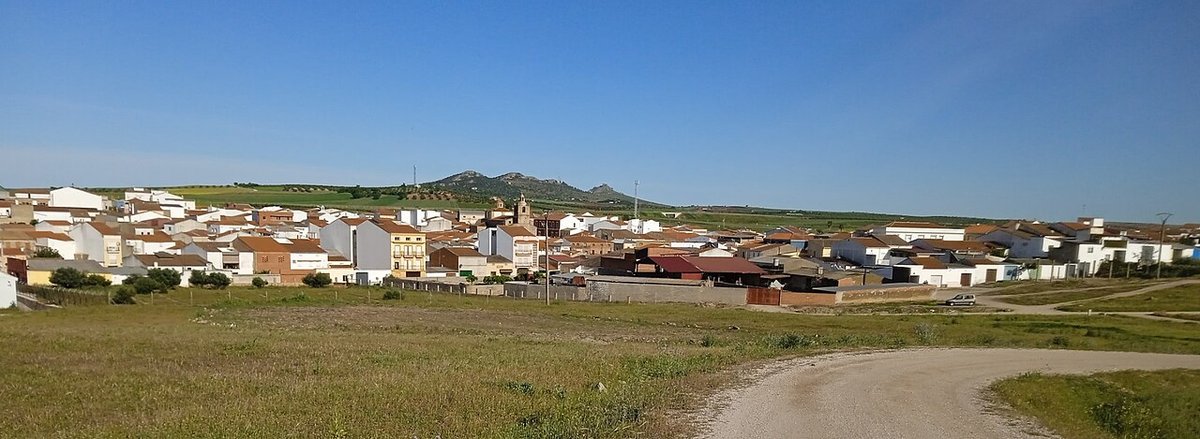
The geography of the Vegas Altas is uncompromising: flat land, a grid of irrigation channels, and a horizon defined by crops. Villar de Rena exists because of this. With around 1,300 inhabitants, its layout and rhythm are those of a working agricultural settlement. The nearby rice fields aren't just a view; they explain the village's economy, its annual calendar, and the particular light that reflects off flooded plots in spring.
This isn't a destination for monumental architecture. Its interest lies in reading a landscape that has been entirely shaped by water management and cultivation. The village makes sense as part of that system.
The church and the street plan
The parish church of Nuestra Señora de la Esperanza anchors the village. Its construction is generally dated to the 16th century, with subsequent modifications. The result is an austere building: pale rendered walls, a simple volume, and minimal ornamentation.
The streets around it are broad and orderly. Houses are typically single-storey, whitewashed, with iron rejas on the windows. Many are built around interior courtyards, private spaces for family life and work that are invisible from the public way. This architecture speaks of practicality, not ostentation.
Walking here feels open and quiet. There is space between buildings, and the church tower remains a constant visual marker in a settlement where life has historically been organised around the cycles of the land, not around a plaza mayor.
The rice fields: a landscape of reflection and work
Leave the last houses behind and the vegas open up. Rice is the dominant crop. When the fields are flooded—typically from spring into summer—the plain becomes a vast, shallow mirror. The sky doubles itself on the ground, and the light shifts throughout the day.
This aquatic environment attracts birds. It's common to see grey herons, black-winged stilts, and various ducks foraging in the flooded plots or perched on the bunds. The best observation points are the unpaved service tracks that run between the fields.
By late summer, the water is drained and the landscape turns ochre and brown during the harvest. The underlying structure—the precise geometry of canals, plots, and tracks—becomes even more apparent. The beauty here is in its scale and its stark functional clarity.
Festivals tied to the land
The village's main fiestas revolve around its patron saint, Nuestra Señora de la Esperanza, with celebrations usually held in August. They are local gatherings, with religious events and social meals.
Holy Week is observed with processions through the straight streets. More telling is how the agricultural year frames other activities. By September, the focus shifts to the rice harvest. While not always a public festival, it's the period when the village's economic pulse is most visible. The rhythm of these celebrations still follows the old agricultural calendar.
Walking Villar de Rena and its surroundings
You can see the village's core in under an hour. Walk the main grid, see the church, and note the domestic architecture.
To understand Villar de Rena, however, you need to go into the fields. A five-minute walk on any farm track heading east or south places you within the rice landscape. Bring binoculars if you have them; the birdlife is active at dawn and dusk. The terrain is completely flat, suitable for a leisurely walk or a bike ride. The experience is one of space and silence, broken only by bird calls or distant farm machinery.
Practical information
Villar de Rena is accessed from the A-5 motorway, taking the exit for Villanueva de la Serena and then following local roads north.
Everything within the village is navigable on foot. If you plan to walk the farm tracks, wear sturdy shoes—they can be dusty or muddy depending on the season. For services like fuel, supermarkets, or a wider range of dining options, you will need to go to the larger towns in the Vegas Altas comarca.