Full Article
about Cañamero
Famed for its pitarra wine and cave paintings; gateway to the Villuercas Geopark.
Hide article Read full article
A landscape that sets the rules
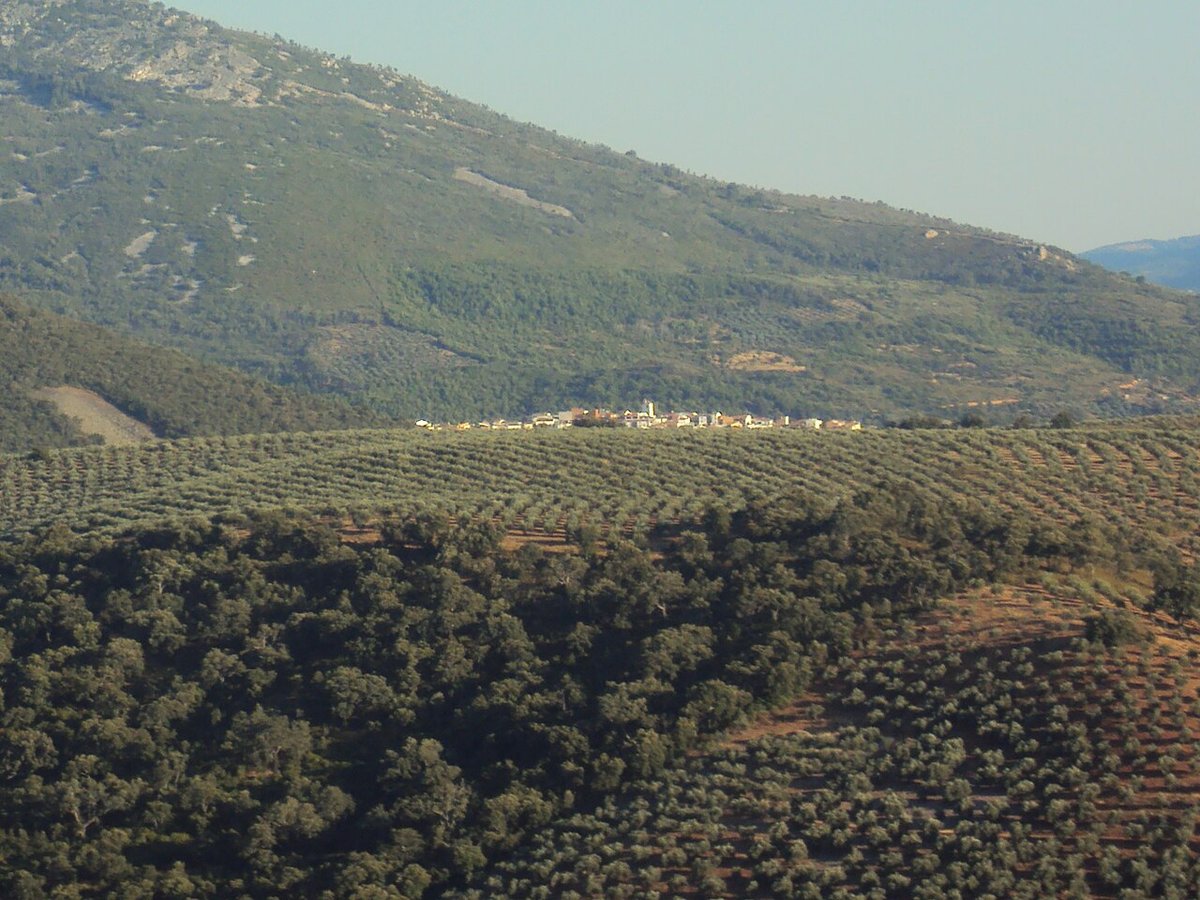
Tourism in Cañamero makes more sense when you start with the ground beneath it. The village sits in the comarca of Villuercas‑Ibores‑Jara, in the south-east of the province of Cáceres, within an area recognised as a UNESCO Global Geopark. Here, the landscape is not a backdrop. Quartzite mountain ranges, dehesas dotted with holm oaks and cork oaks, and narrow valleys all influence how the settlement looks and how people have lived for generations.
Quartzite appears clearly in the surrounding relief. These are very old, hard rocks that resist erosion and form long, rugged ridges. This type of geology is typical of the Villuercas and has shaped paths, farming patterns and where people have built their homes over centuries. The terrain is not incidental. It explains why routes wind as they do and why the village developed in a compact way rather than spreading widely.
The village and its centre
Cañamero has a compact urban layout, adapted to gentle slopes. Streets are narrow, and in some stretches you can still sense the logic of a place that grew without formal planning, as houses were added near the main square and along the routes leading out of the village.
At the Plaza Mayor stands the church of Nuestra Señora de la Consolación. The current building dates from the 16th century and was later modified, which is quite common in rural parishes across Extremadura. Its exterior is plain, with solid walls and little decoration. Inside, there are processional images and a number of ex-votos, objects offered in thanks, which speak more about popular devotion than about any particularly ambitious artistic programme.
The church remains a central reference point for the village. This goes beyond religion. For a long time, the square has been the place where markets, gatherings and celebrations came together, shaping local life as much as the surrounding countryside.
Everyday architecture
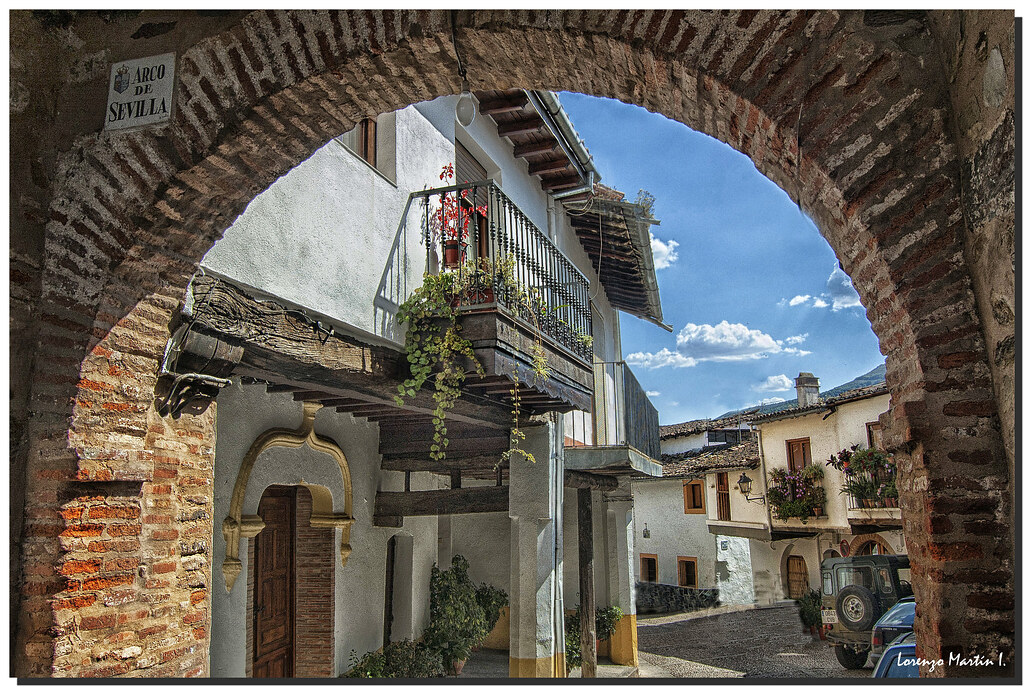
Domestic architecture in Cañamero is straightforward and closely tied to local materials. Houses are built with stone, lime and wood, using what was readily available nearby. Thick walls are common, along with large wooden doors and iron bars on windows. Many homes include enclosed interior courtyards, practical spaces for storing tools or keeping small animals sheltered.
There are no grand manor houses or monumental buildings. The interest lies in smaller details: an old doorway, a wrought-iron balcony slightly bent with age, or subtle shifts in construction materials depending on when a house was built. Walking through the streets, these variations offer a quiet record of how the village has changed over time without losing its overall character.
Paths through dehesa and rock
Once outside the built-up area, the landscape quickly takes over again. Rural tracks cross open dehesas where scattered holm oaks appear, and in some places quartzite outcrops form low ridges and angular blocks. The terrain feels shaped more by geology than by design.
From certain paths, the structure of the Villuercas ranges becomes easy to read. Long alignments of rock separate narrow valleys, creating a pattern that repeats across the horizon. It is suitable ground for walking if you are comfortable with rural tracks and uneven paths.
In these areas, it is fairly common to see small or medium-sized birds of prey gliding over the dehesa. With a bit of quiet, signs of other wildlife can also be noticed: tracks in the soil, partially eaten acorns, or faint trails marked by animals moving through the same routes again and again.
It is sensible to check conditions before heading out into the countryside, especially during rainy periods or when hunting activity is taking place, which still has a presence in this comarca.
Festivities and daily rhythms
Devotion to the Virgen de la Consolación shapes the festive calendar of Cañamero. Celebrations usually take place in August, bringing together religious events and popular activities in the streets and around the main square.
Semana Santa also has a role in local life, with processions moving through the centre of the village. These moments connect the present-day community with long-standing traditions, using the same streets that organise everyday life.
Beyond specific dates, daily routines are still closely linked to the land. Olive groves, small-scale livestock farming and work connected to the dehesa remain part of the local economy and identity.
Visiting Cañamero
The centre of Cañamero can be explored in a short amount of time. In less than half an hour, it is possible to walk through the square, visit the church and wander a few of the nearby streets.
With more time, it is worth heading out on foot along one of the paths that surround the village. Within minutes, the setting changes noticeably as dehesas open up and the quartzite reliefs that define this part of Extremadura come into view.
Spring and autumn are generally the most comfortable seasons for walking. Summer brings intense heat around midday, so it is better to be out early or later in the day. Cañamero is also often used as a توقف within wider routes through the Villuercas‑Ibores‑Jara Geopark, particularly when continuing towards Guadalupe.