Full Article
about Castañar de Ibor
Famous for the Cueva de Castañar and its eccentric formations; setting of chestnut trees and geology
Hide article Read full article
A hillside village shaped by its landscape
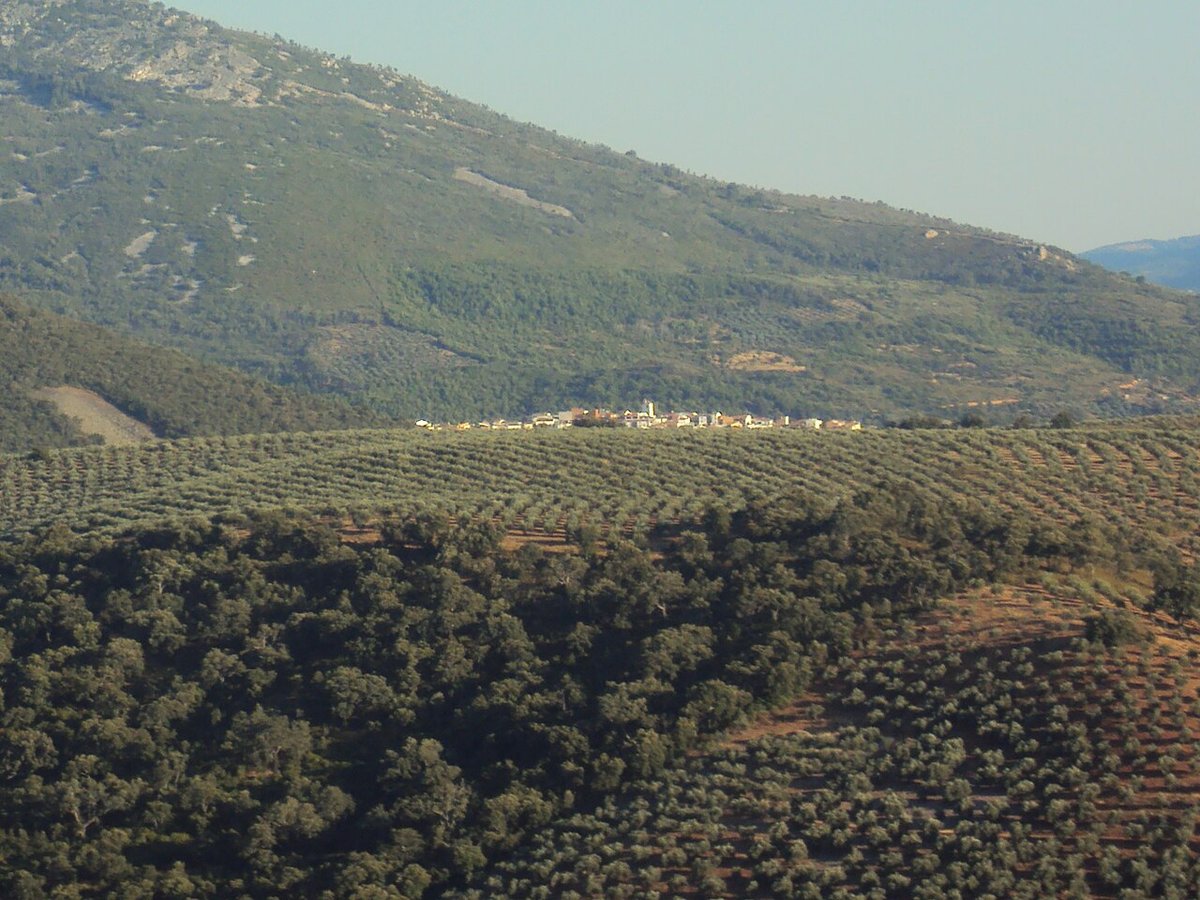
Castañar de Ibor sits in the east of the province of Cáceres, within the Villuercas‑Ibores‑Jara comarca, at just over 700 metres above sea level. The village occupies a slope that drops towards the valley of the river Ibor, placing it firmly within the Villuercas‑Ibores‑Jara UNESCO Global Geopark. Here, geology plays a central role in everything from the shape of the land to the way settlements developed.
The surrounding terrain is defined by quartzite ridges and narrow valleys. These hard rock formations resist erosion, creating long, pronounced crests, while the softer areas between them form channels where rivers flow. The result is a landscape that feels structured and contained, with the village tucked into its contours rather than spreading widely across open ground.
Woodland has always carried more weight here than farmland. The chestnut groves that give Castañar de Ibor its name still influence the agricultural calendar. For generations, they provided food, timber and a modest additional income. Today they remain a visible part of the immediate surroundings, blending with holm oaks and patches of Mediterranean scrub.
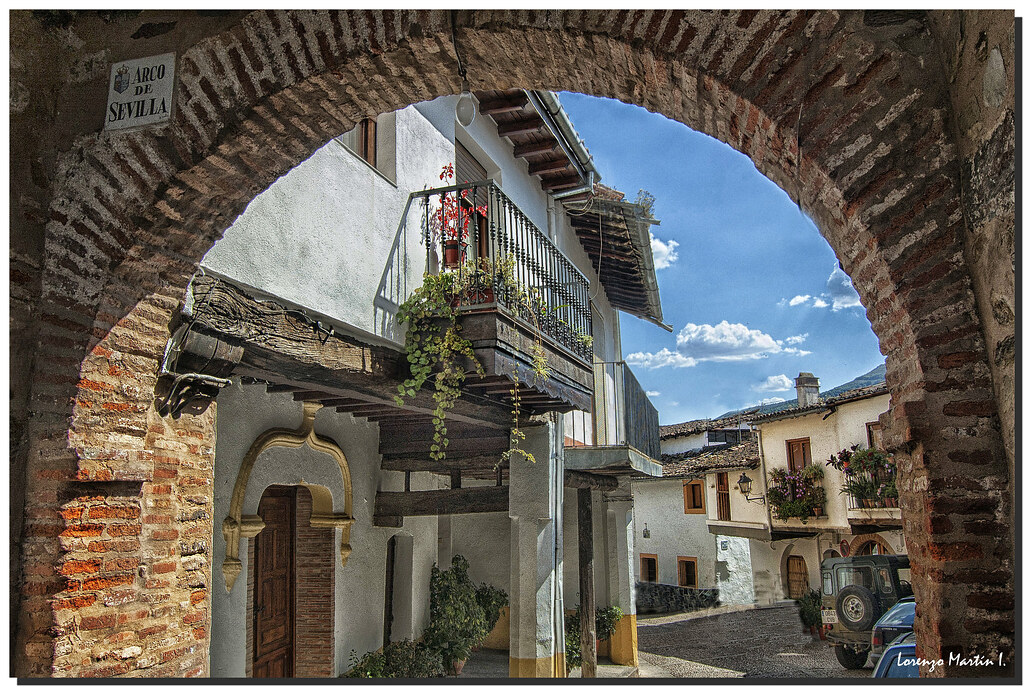
The village itself is compact and unadorned. Narrow streets, some with stretches of stone paving, wind between masonry houses topped with curved roof tiles. In many cases, the same stone found in the nearby hills appears in the walls. The uneven terrain introduces small changes in level and short uphill climbs, which occasionally open out into views across the Ibor valley and the surrounding sierras.
Traces of local history in stone and street
At the centre of the village stands the church of San Vicente. Its origins date back to the 15th century, although the current building reflects later alterations, particularly from the 18th century. From the outside, it appears restrained, built in masonry with balanced proportions rather than elaborate decoration. Inside, Baroque altarpieces and devotional objects remain, pointing to the church’s importance in everyday life over the centuries.
Elsewhere in the streets, houses with carved stone coats of arms and wrought-iron balconies appear sporadically. They do not form a grand architectural ensemble, but they hint at periods of greater economic stability. These homes are generally linked to families with a certain local standing, connected to woodland use and livestock, rather than to a formal aristocracy.
A slower walk through the centre reveals smaller details worth noticing. Granite lintels, slightly more elaborate doorways than expected, and interior courtyards that can only just be glimpsed from the street all add texture to the built environment. Nothing feels monumental, yet each element contributes to understanding how the village evolved.
Quartzite ridges and changing seasons
The landscape around Castañar de Ibor is one of the most recognisable geological settings in Extremadura. The nearby sierras are formed by long alignments of quartzite, a particularly hard rock that shapes the terrain into extended ridges. Between them lie narrow valleys carved by watercourses such as the Ibor.
Chestnut groves tend to occupy cooler, shaded areas. In autumn, they transform the slopes, while in summer the darker green of the holm oaks becomes more prominent. Although human activity has shaped these hills over centuries, it has not erased their underlying structure. The geological forms remain clearly visible and continue to define how the area looks and functions.
From the edges of the village and along nearby paths, there are wide views across the valley. These are not cluttered landscapes. Instead, they allow a clear reading of how the sierras organise the territory, with ridges and valleys creating a strong sense of order.
Walking through woodland and ridge
Exploring the surroundings on foot offers the most direct way to understand the area. Traditional paths and marked trails link the village with nearby woodland and chestnut groves. Some sections involve uneven ground and noticeable gradients, which is typical of this comarca. For longer routes, it is advisable to seek information locally or through Geopark information points.
Autumn coincides with the chestnut harvest. Many of the groves are privately owned and remain in active use, so respecting fences and boundaries is essential. This period continues to be an important part of the agricultural calendar for the village.
The rocky slopes and surrounding hills also provide habitat for birds of prey. Griffon vultures are among the species that can often be seen taking advantage of air currents along the ridges. With a bit of patience, it is not unusual to spot them circling overhead.
Traditions tied to the rural year
Local traditions in Castañar de Ibor remain closely connected to the rural calendar. The patron saint festivities take place around San Vicente at the end of January. These are days centred on religious observances and simple community celebrations, reflecting the scale and character of the village.
Holy Week is marked in a restrained way, with processions moving through the central streets. The tone is quiet rather than elaborate, in keeping with the overall atmosphere of the place.
In autumn, attention turns again to the chestnut harvest. During this time, daily life is shaped by work in the groves, reinforcing the long-standing connection between the village and its surrounding woodland.
A place for a short, thoughtful visit
Castañar de Ibor can be explored in a relatively short time. Its interest lies less in individual landmarks and more in the experience of walking its streets and looking out towards the landscape that frames it. The relationship between terrain, woodland and traditional economic activity becomes clear with even a brief visit.
For those interested in understanding the Villuercas‑Ibores‑Jara comarca, the village offers a useful perspective. It shows how geology, natural resources and rural life have combined over time to shape both the physical setting and the way people have lived within it.