Full Article
about Guadalupe
Spiritual center of Extremadura with a stunning Royal Monastery, a World Heritage Site.
Hide article Read full article
A village defined by a monastery
Tourism in Guadalupe revolves, almost inevitably, around a single building: the Real Monasterio de Santa María de Guadalupe. The village sits in the comarca of Villuercas‑Ibores‑Jara, on the lower slopes of the Montes de Toledo, at just over 600 metres above sea level. Around 1,700 people live here today, yet for centuries its importance far exceeded its size.
That prominence came from devotion to the Virgen de Guadalupe. From the late Middle Ages onwards, this valley became a destination for pilgrims travelling from across the Iberian Peninsula. The settlement grew in response, expanding around the monastery that drew visitors in the first place.
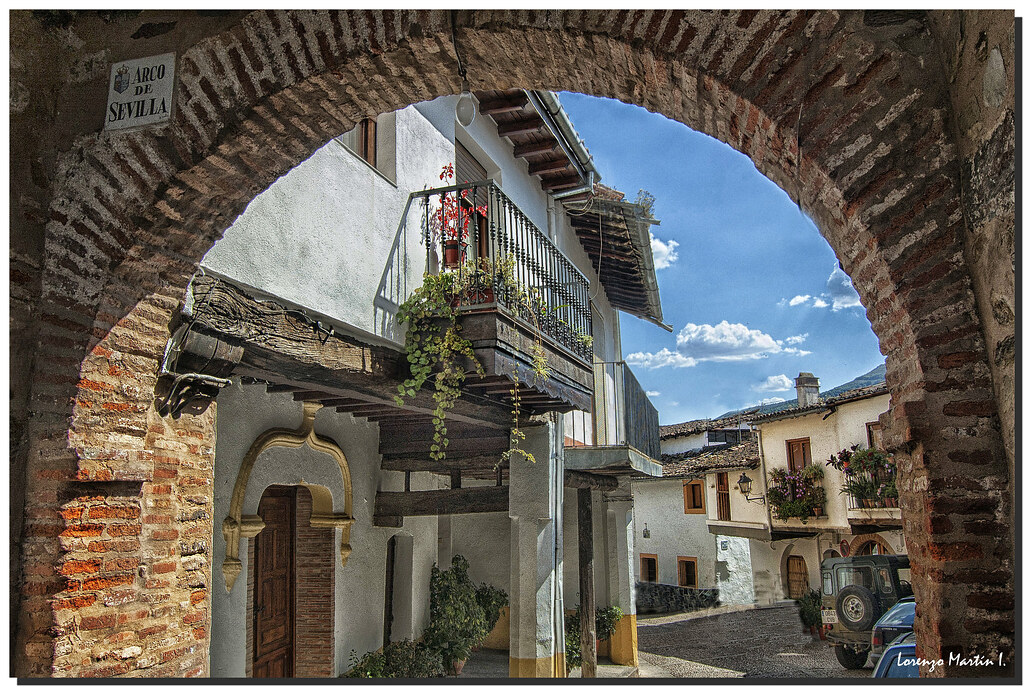
The layout still reflects that origin. Streets descend from the main square towards vegetable plots and small olive groves that fill the valley floor. Many houses retain wooden balconies and arcaded ground floors, a style common in northern Extremadura. Despite the steady flow of visitors, everyday life remains visible. People carry shopping up the slopes, shutters are half closed during the hottest hours, and washing hangs out across balconies.
The monastery and its place in Extremadura
The Real Monasterio de Santa María de Guadalupe began to take shape in the 14th century and continued to expand over several hundred years. As a result, the complex brings together different architectural styles, including Mudejar, Gothic, Renaissance and Baroque. It is less a single structure than a small monastic complex organised around several cloisters.
At its centre is the basilica, which houses the image of the Virgen de Guadalupe, regarded as the patron saint of Extremadura. During the Early Modern period, the sanctuary held considerable religious and political weight. Monarchs, members of the nobility and travellers passed through regularly, giving the monastery a presence that reached well beyond the region.
The monastery was also an active cultural centre. It included a scriptorium, a library and workshops connected to monastic life. Inside, various collections of sacred art have been preserved. The sacristy is often singled out, particularly for its paintings by Zurbarán. Another space that draws attention is the Baroque camarín, the richly decorated room where the image of the Virgin is placed, reflecting the depth of devotion associated with the sanctuary.
Streets shaped by pilgrimage
The Plaza de Santa María de Guadalupe acts as the natural starting point for exploring the village. The monastery occupies one side and sets the scale for everything around it. From here, narrow streets branch out, many of them steep and lined with arcades.
These streets still hold houses with dark wooden frameworks set against whitewashed walls, a combination that defines much of the historic centre. The overall layout feels compact but layered, shaped over time by the constant arrival of pilgrims.
A short walk brings you to other buildings linked to the monastery’s past. Among them are the church of the Santa Trinidad and the former pilgrims’ hospital of San Juan Bautista. The presence of this hospital is a reminder of Guadalupe’s long-standing role as a stopping point for people travelling from many different parts of the peninsula.
The Villuercas landscape
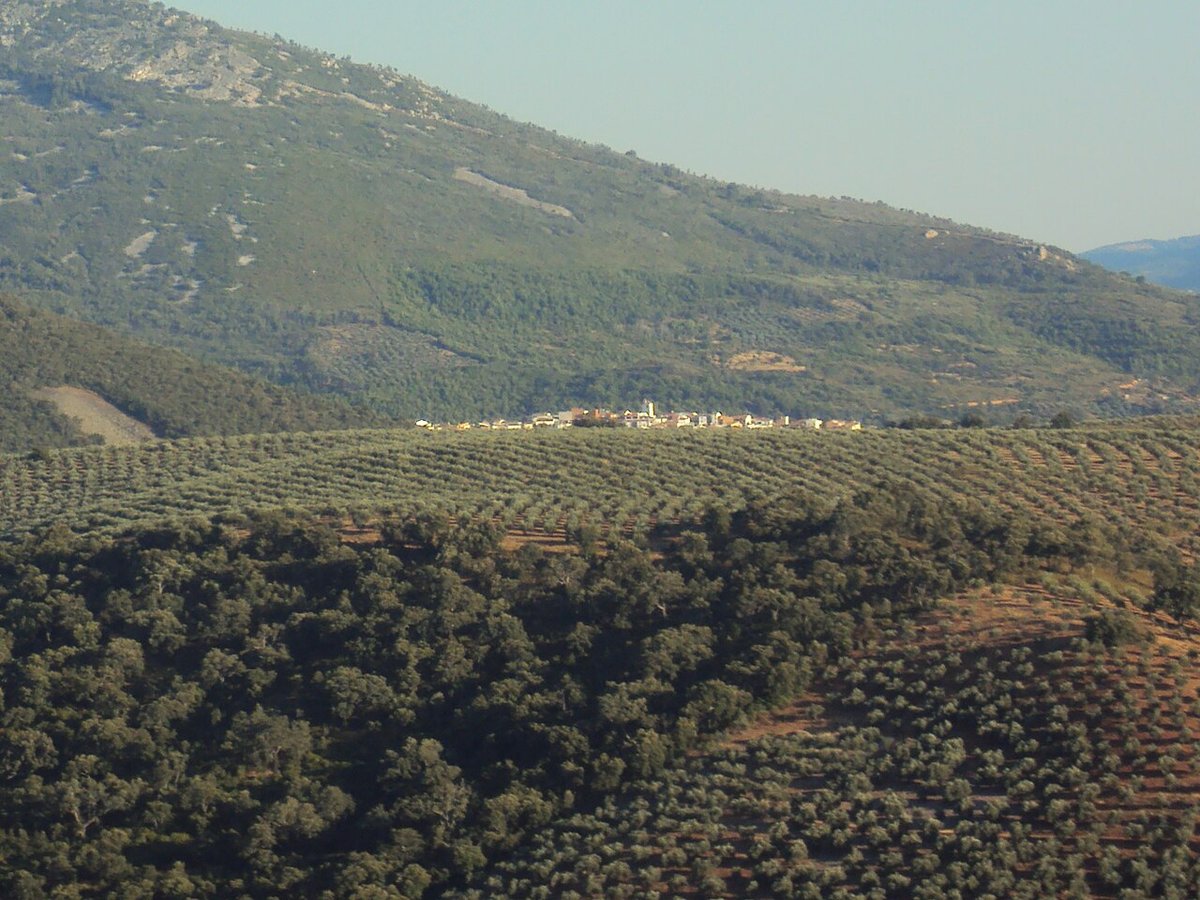
Guadalupe lies within the Villuercas‑Ibores‑Jara Geopark, a region known for its distinctive terrain of parallel mountain ranges and narrow valleys. The surrounding landscape combines dehesas, chestnut groves and Mediterranean woodland. This mix gives the area a changing appearance across the year.
In autumn, the chestnut trees covering the slopes alter the look of the valley quite noticeably. Spring tends to bring a greener tone than is typical in other parts of Extremadura. The shifts are subtle but visible, especially when viewed from above.
There are several natural viewpoints not far from the built-up area. From these spots, the position of both the monastery and the village becomes clearer, set tightly between the surrounding hills. The relationship between architecture and landscape is easy to read from here, with the monastery standing out as the central landmark.
Paths and routes around Guadalupe
Guadalupe also serves as a starting point for walking routes through the comarca. Some of these follow traditional paths that once linked the monastery with other settlements in the Villuercas. Today, they are still used as footpaths.
Certain routes climb towards viewpoints that overlook the valley and offer a clear view of the monastery’s silhouette. The terrain can vary depending on the time of year, and the slopes are often long rather than steep in short bursts. It is sensible to check conditions before setting out, as the landscape can change with the seasons.
Local food and crafts
The local cuisine follows the pattern found in many rural parts of Extremadura. Dishes are generally substantial and tied to ingredients such as pork, garden produce and olive oil. Goat’s cheese is common in the area, as is honey sourced from the nearby hills.
Traditional crafts are still present. Work linked to ceramics and embroidery continues, both of which have historical connections to the monastery itself and its workshops.
Practical notes for a visit
The historic centre is best explored on foot. Distances are short, although there are constant slopes to contend with. Parking is usually found on the outer edges of the old town, so most visits involve walking in towards the monastery square.
For those planning to go inside the monastery, it is worth checking access conditions in advance. Routes through the complex depend on how the monastic site is organised at any given time.