Full Article
about Valdelacasa de Tajo
Border town with Toledo; rockrose and holm-oak landscape with history
Hide article Read full article
A village shaped by its land
Tourism in Valdelacasa de Tajo is less about ticking off landmarks and more about understanding a place. This small village sits in the comarca of Villuercas‑Ibores‑Jara, in a transitional landscape where low mountain ranges give way to wide stretches of dehesa, the traditional pastureland of western Spain. At around 459 metres above sea level and with just over three hundred inhabitants, it retains a rural scale that has barely shifted in recent decades.
Daily life still follows the rhythms of agriculture and livestock farming. That continuity is visible in how the village functions and in how its surroundings are used. Visitors will not find a concentration of major sights, but they will find a setting where landscape and livelihood remain closely tied.
Between the Jara and open pasture
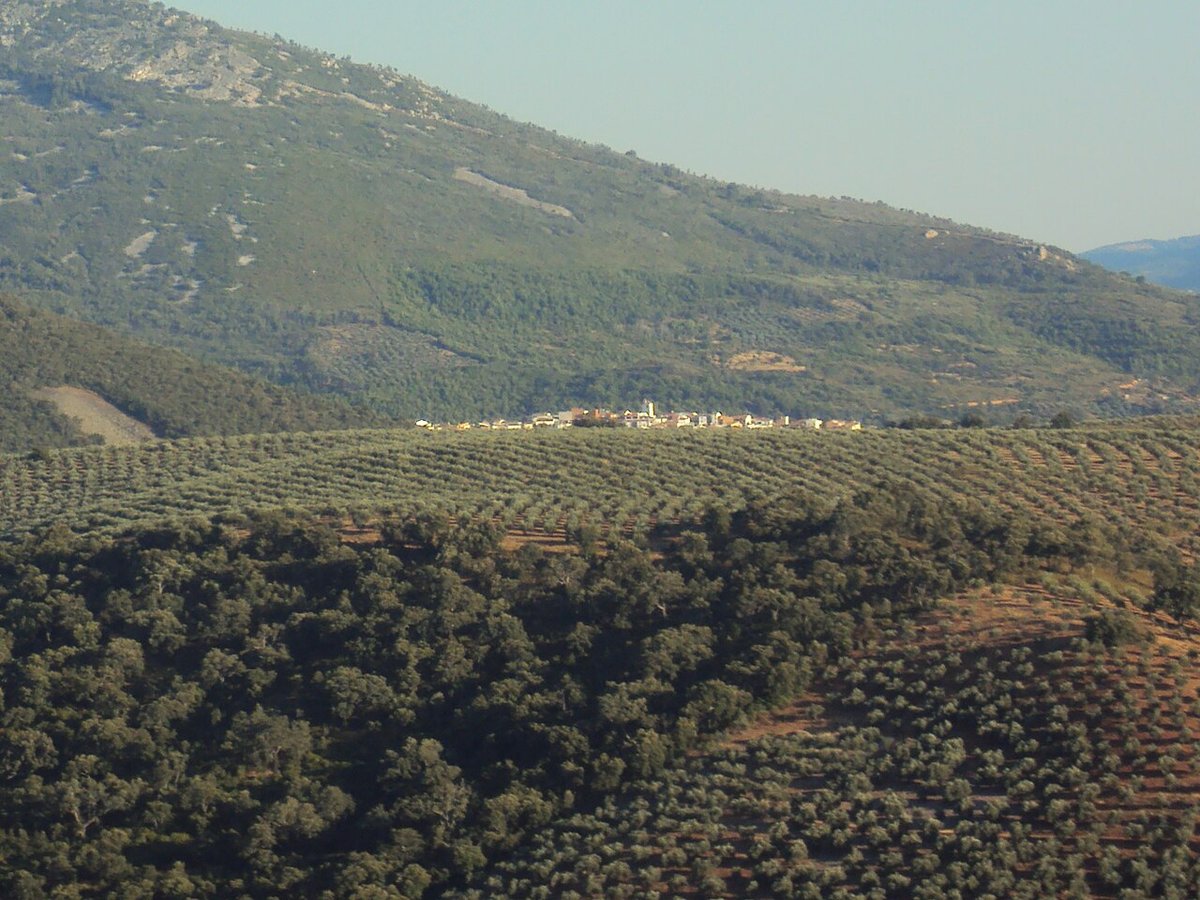
Valdelacasa de Tajo lies in the western part of the comarca, within what is known as the Jara cacereña. The terrain here does not rise dramatically. Instead, it rolls gently across a patchwork of holm oaks, brown soils and open plots of land. In the distance, the higher sierras that frame the comarca can be seen, but they do not dominate the immediate horizon.
This geography explains the traditional land use. The dehesa supports grazing livestock, alongside some cereal cultivation and small olive groves. Even today, stepping beyond the edge of the village brings you onto agricultural tracks and past stone enclosures that mark out scattered farms. These features are not decorative remnants. They are part of a working landscape that continues to function much as it has for generations.
The sense of space is noticeable. Fields are not tightly enclosed, and views stretch across low rises rather than being blocked by steep slopes. It is a landscape that reveals itself gradually rather than dramatically.
The church at the centre
At the heart of Valdelacasa de Tajo stands the parish church, dedicated to the Asunción. Its origins are usually placed in the 16th century, although the building seen today includes later alterations.
This is not a monumental church. Its form follows a common pattern found in many villages of the Jara: solid construction, compact volume and a close relationship with the central square. Its importance lies less in architectural detail and more in its role within the community. For centuries, it served as a focal point for gatherings, celebrations and shared moments in village life.
That central position still defines the layout of the settlement. The church anchors the space around it, and the surrounding streets lead naturally towards it.
Streets, houses and everyday structures
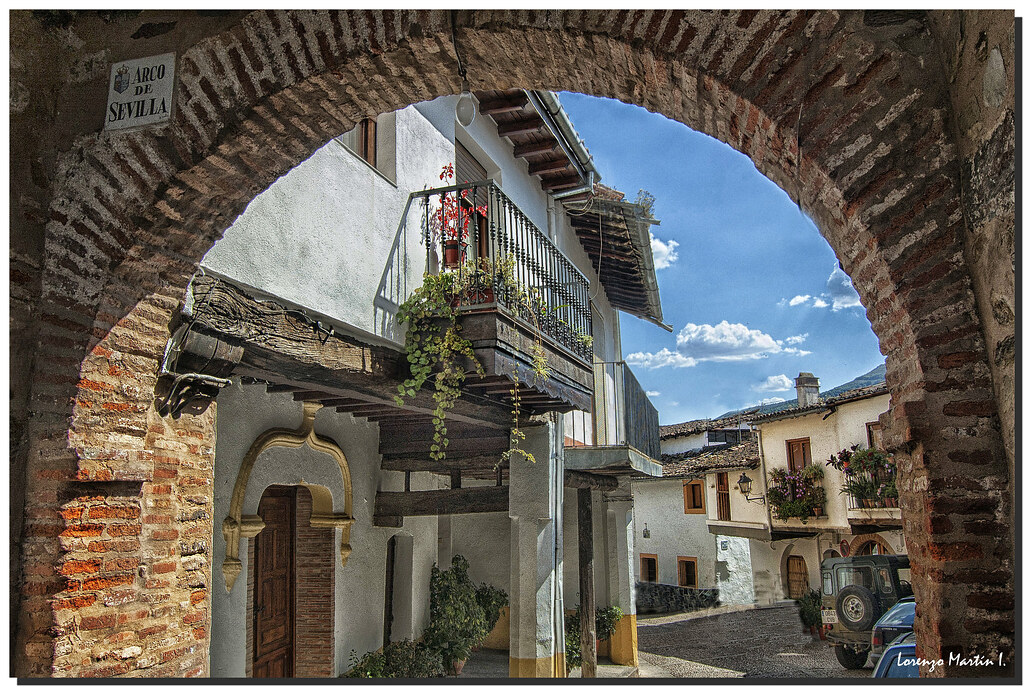
The layout of the village is straightforward. A handful of main streets organise a cluster of houses, most of them one or two storeys high. Whitewashed walls and roofs of curved terracotta tiles, often called teja árabe, give the buildings a consistent appearance.
Some houses still preserve elements of traditional rural architecture. Wide doorways allowed animals or carts to pass through. Small interior courtyards provided light and working space. Outbuildings were used to store tools or grain. In many cases, living quarters and work areas existed within the same structure, reflecting a way of life where home and labour were closely linked.
Public features such as washhouses and fountains remain scattered around the village. These are modest constructions, yet they offer insight into how daily routines once worked before running water reached individual homes. They mark places where practical tasks were carried out and where social interaction naturally followed.
The dehesa landscape
The dehesa dominates the surroundings of Valdelacasa de Tajo. Holm oaks and cork oaks are spaced across open pasture, creating a landscape that is both managed and natural in appearance. Dirt tracks connect different grazing areas and agricultural plots.
Livestock is a common sight. Sheep and pigs are often seen in nearby fields, reflecting the long-standing importance of animal husbandry in the local economy. Cereals such as wheat or barley appear in some plots, though farming has traditionally played a secondary role compared to livestock.
The paths that leave the village are not always signposted. Many are working routes rather than designated walking trails. Even so, walking along them offers a clear sense of how this part of Extremadura functions. Gentle hills, stone boundaries and active farms define the experience more than any single viewpoint or landmark.
Festivities and the yearly cycle
The festive calendar in Valdelacasa de Tajo follows patterns common to small villages across Extremadura. Celebrations in honour of the Virgen de la Asunción take place in summer, a time when many former residents return to the village. These gatherings reinforce ties between those who live there year-round and those who maintain a connection from elsewhere.
Winter brings a different kind of tradition. The matanza del cerdo, or pig slaughter, continues to be practised within families. It is not a public event or organised festival, but a domestic custom rooted in the agricultural calendar. It reflects a way of life where food production and seasonal cycles remain closely linked.
Religious events such as Semana Santa are observed in a simple manner. Participation is largely local, and the tone is modest rather than elaborate. These occasions emphasise continuity rather than spectacle.
When to go and getting around
Spring and autumn are usually the most comfortable times to explore the area. The countryside changes noticeably with the seasons, and temperatures are more suitable for walking along the dehesa tracks.
Summer brings intense daytime heat. Early morning and late afternoon offer more manageable conditions for being outdoors.
Anyone interested in exploring beyond the village centre should be aware that many paths are agricultural and not consistently marked. Carrying a map or asking locally can help when navigating the area. The lack of formal signage is part of the character of the place, where routes serve practical purposes rather than tourism.
Valdelacasa de Tajo does not present itself through major attractions or busy itineraries. Its appeal lies in the relationship between settlement and landscape, and in the continuity of rural life that still shapes both.