Full Article
about Xunqueira de Ambía
Hide article Read full article
In Xunqueira de Ambía, the first thing to sort out is the car. The road ends at a roundabout and from that point on almost everything is done on foot. If you park at the top, near the way out of the village, you will save yourself the uphill walk on the way back. By mid-morning there is usually space. After that it depends on the day and whether there are pilgrims passing through on the Camino.
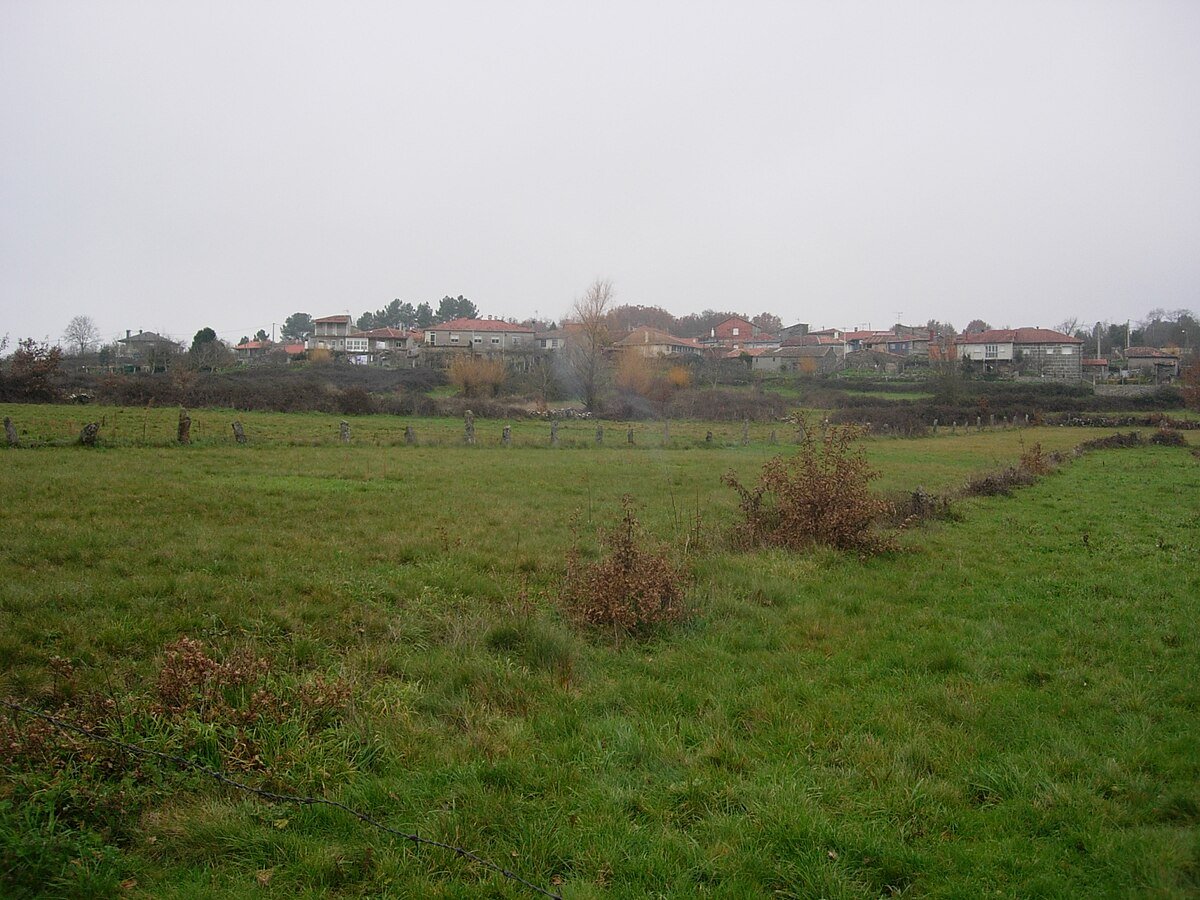
From there, the main street slopes down towards the river Arnoia. At that hour many shutters are still closed. This is a small place and it keeps its own pace.
The church that swallowed the village
The Colegiata de Santa María dominates the historic centre. It appears at the end of every street and from almost every corner. The rest of the village is made up of low houses, some of which have been closed for some time.
Its reddish brick tower rises above the valley floor. Inside there is a Baroque organ that is still used for concerts on certain occasions, usually in summer when the village fills up a little more.
Entry is generally free, though it is not always open. Sometimes you have to ask next door for someone to come and unlock it. If no one appears, the choice is to wait or move on and continue the visit elsewhere.
The cloister is the highlight. Bare stone, slightly leaning columns and a good deal of silence. There is a damp smell in the air, as in much of this part of Galicia. It feels cool even when the day outside is warm, and the sound of footsteps lingers longer than expected.
The scale of the Colegiata compared with the size of the village gives the impression that the building arrived first and everything else gathered around it later. Whether that is true or not, it sets the tone. Xunqueira de Ambía revolves around this church.
The river no one swims in
The Arnoia runs along the lower part of the village. A sign announces a riverside path of around two kilometres. The panel is quite worn and the path is not especially well maintained.
It works for a short walk. Little more.
In summer the water flows calmly, with a slightly greenish tone. In winter the colour shifts and the river spreads wider, taking up more space along its banks. Local people come down to stroll or walk the dog. There is no sense of a bathing spot or busy riverbank, just a stretch of water marking the edge of the village.
Pilgrims heading towards Ourense also pass through here. Many stop for a few minutes on the bridge, take off their rucksacks and rest before continuing. Xunqueira de Ambía lies on one of the Camino routes, and at certain times of year that passing movement is noticeable. At other times, the river path is quiet.
The walk does not demand much planning. It is simply a way to extend the visit, to see the Colegiata from below and to follow the curve of the valley for a while before turning back.
The castro few people visit
Just over a kilometre away stands the Castro de Avea. A castro is an ancient hilltop settlement, common in Galicia and dating back to pre-Roman times. To reach this one, you leave the car at the side of the road and follow a dirt track.
There are not many signs pointing the way. At the top, a hill opens up with good views over the valley. Among the scrub, a few remains of defensive walls can still be seen.
Those with an interest in early history may find the climb worthwhile. Anyone expecting detailed panels or explanations will not find them here. The site is largely left to its setting. The appeal lies in the location and in imagining what once stood on that height.
From up there, the relationship between the river, the village and the surrounding land becomes clearer. Xunqueira de Ambía looks small, almost contained within the curve of the Arnoia.
Eating in the village
The choice is limited. There are a couple of bars around the square and little else. Some days they open from the morning; on others it depends on how much movement there is in the village.
The usual offer is something simple: a bocadillo, a slice of tortilla or a set plate of the day when available. For greater variety, nearby villages provide more options.
In Xunqueira de Ambía, cañas rellenas are still prepared at certain times of the local calendar. These are small baked pastries filled with cream. They appear on specific dates rather than as an everyday item, tied to local celebrations and traditions.
Eating here follows the same rhythm as everything else. It depends on who is around, on the season and on whether there is an event bringing people back.
When to come
Summer changes the atmosphere. The festivities of the Colegiata take place then, and many residents who live elsewhere return for a few days. The square fills up and the village feels different during that period.
There is also a romería in September, a traditional pilgrimage-style gathering that draws people from the surrounding area. On those dates there is more movement in the streets and more conversation spilling out into the open.
For the rest of the year, Xunqueira de Ambía returns to its steady routine. It is a place that can be seen in an afternoon. Walk down to the Colegiata, spend some time by the river and, if a longer stretch appeals, head up to the castro. Afterwards, if there is time left, Allariz is about fifteen minutes away by car and has a livelier feel.
By late afternoon in Xunqueira de Ambía, most places close early. The slopes remain where they were at the start of the day, and the uphill walk back to the car is part of the visit.