Full Article
about Monfero
Hide article Read full article
A monastery that appears without warning
Any look at Monfero begins with its monastery. It shows up suddenly after a bend on the road that climbs from the Eume valley. There are no large signs, only a discreet turning. Then the façade of Santa María rises among chestnut trees as if it had been waiting there for centuries. In a sense, it has. The monastic community dates back to the Middle Ages, although much of what stands today belongs to later rebuilding, especially from the 17th century after a fire destroyed the earlier structure.
The building does not present a single moment in time. It is the result of successive phases, each one leaving traces that can still be read in the stone.
The time of the monks
The monastery was founded in the 12th century, when the monarchy was encouraging settlement and organisation in these inland areas. Cistercian monasteries served several purposes at once. They cultivated land, structured the territory and helped establish stable populations. Monfero soon became part of the Cistercian network, linked to the nearby monastery of Sobrado.
For centuries, the community controlled land, mills as well as parishes across much of what is now the Eume area. That influence is now mainly visible in the monastery’s structures. The main cloister, designed in a Renaissance style, began at the end of the 16th century and took a long time to complete. Its walls still include reused elements from earlier phases. Columns and blocks of stone belonged to the original Romanesque building. The whole complex reads as layers placed one over another.
Fire shaped several stages of the monastery’s history. Local tradition recalls that lightning struck the building more than once during the early modern period, forcing repeated rebuilding. It is one of those details often shared by residents when they talk about the place, part history and part memory passed on over time.
The Andrade family and memory in stone
Inside the church there are several tombs linked to the Andrade family, one of the most influential lineages in medieval Galicia. Some of its members chose this monastery as their burial place, which explains the presence of Gothic tombs with carved figures and coats of arms.
The Andrade held power across this stretch of northern Galicia. They built fortresses, took part in conflicts and maintained complex relations with the Crown. Their decision to be buried here reflects the weight the monastery once carried in the region.
On the façade there are also two female figures set into a niche. Popular tradition identifies one as a queen and the other as a religious figure connected to the monastery, although there is no firm certainty about who they represent. It remains one of those small mysteries that persist when written records are limited and explanations are handed down through generations.
The forest around Monfero
Monfero lies within the Fragas do Eume Natural Park, one of the best preserved Atlantic forests in the north-west of the Iberian Peninsula. The monastery cannot be separated from this setting. Constant humidity, the presence of laurels and oaks, and the nearby river all form part of the same landscape known to the monks.
Several paths begin at the monastery and lead into the forest. One of the most familiar climbs towards the area of the Virxe da Cela. There stands a small hermitage linked to a tradition of Marian apparitions that local memory places in the 15th century. Next to it a spring emerges that was long considered special, and even today some people collect water when they make the walk up.
The relationship between building and environment is immediate. The forest is not a backdrop but a continuation of the same space.
Everyday life in the municipality
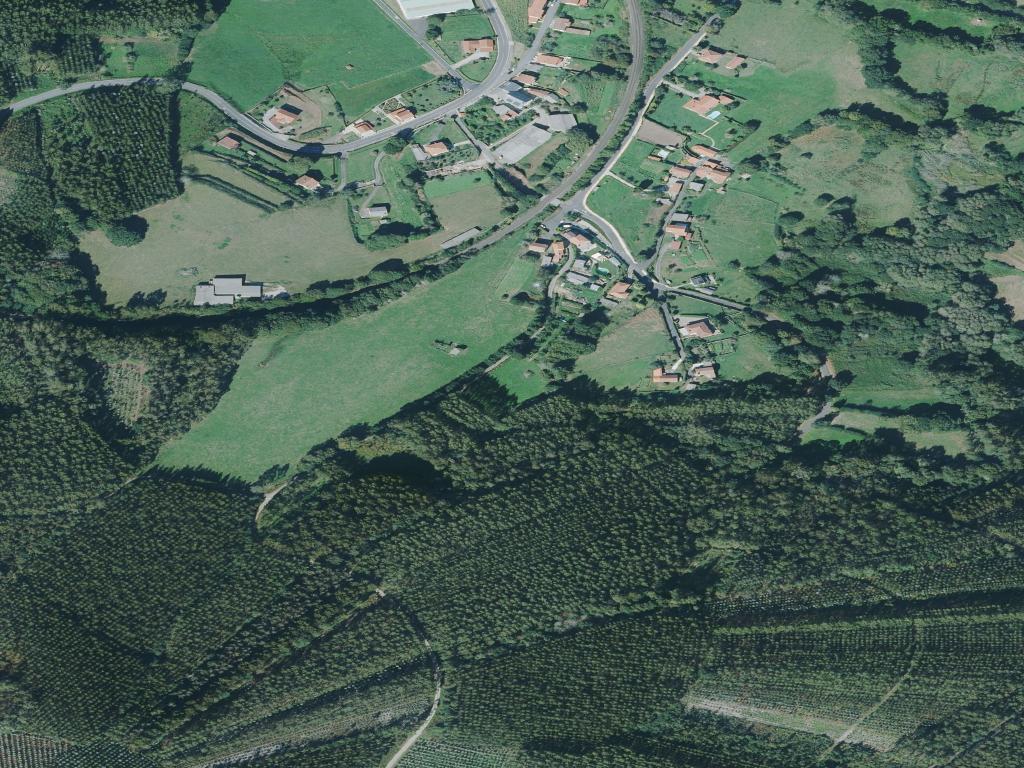
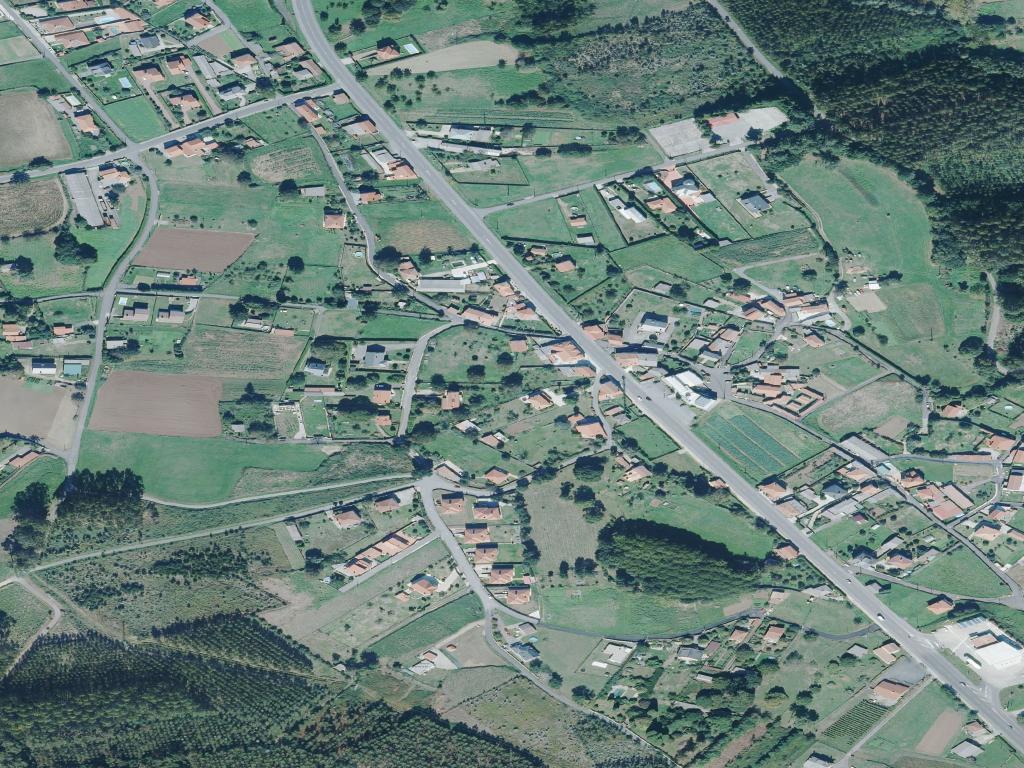
Monfero is a very dispersed municipality. Its parishes are spread across hills, meadows and small valleys. Daily life follows a calm rhythm, closely tied to the countryside.
In local bars around lunchtime, it is common to find dishes typical of the area. Caldo, empanada and meat raised in local homes appear regularly. Cow’s milk cheeses are also made in small family productions and are sometimes sold directly within the municipality when available.
Festivals retain a strongly local character. Corpus often brings together several parishes to prepare floral carpets. In summer, some patron saint celebrations draw back residents who live elsewhere and return for those days. These are gatherings centred on community rather than visitors.
Getting there and moving around
Monfero sits a short drive from Betanzos and from the coast at Pontedeume. The roads leading to the monastery pass through wooded areas and scattered villages, with some narrow stretches along the way.
The monastery is usually open at certain times of day, particularly when there is religious activity, although there is not always a clearly displayed timetable. If it is closed, a contact number linked to the parish sometimes appears on the noticeboard outside.
For walking, the surrounding area offers several straightforward paths that lead into the forest and connect with the wider landscape.