Full Article
about Portas
Hide article Read full article
A Place Between the Curves
Portas is the kind of village you can miss without realising. The road that links Caldas with Vilanova runs alongside it, and if your focus is on the bends and the traffic, Portas slips by somewhere off to the side, just a couple of curves away, unnoticed at 90 kilometres per hour.
It is not unattractive. It simply does not demand attention from the tarmac. Life here carries on slightly removed from the main flow, in the O Salnés valley of Galicia, where vineyards shape both the landscape and the rhythm of the year.
Sometimes it takes an unexpected reason to stop. A breakdown near Briallos is one such excuse. Pull over, step out, and the place that had been a blur from the driver’s seat starts to take form. Portas works like that. It reveals itself only when you slow down.
The Chimney That Stayed
The first thing that catches the eye as you enter the main settlement is an enormous industrial chimney. It rises in the middle of the village in a way that feels faintly surreal. This is not the sort of structure you expect among houses and vines.
The chimney belonged to a former sugar factory that operated here decades ago before closing. Rather than demolish it, the building was repurposed as a cultural space run by the town hall. The decision left Portas with a feature that feels oddly out of place, yet entirely its own.
Inside, there are rooms used for activities, and according to local accounts, a viewpoint was created within the chimney itself. A spiral staircase winds upwards for what feels like an eternity. At the top, the O Salnés valley opens out in full view: vineyards stretching across gentle slopes, scattered houses, and that intense Galician green that looks as though it has been rolled onto the land.
It is not a world-famous landmark. The appeal lies in the surprise. A vast industrial chimney in the middle of a rural valley of vines prompts a double take. What is this doing here? The answer is simple, and perhaps that makes it better. It stayed because the village chose to keep it.
A Mayor Before Women Could Vote
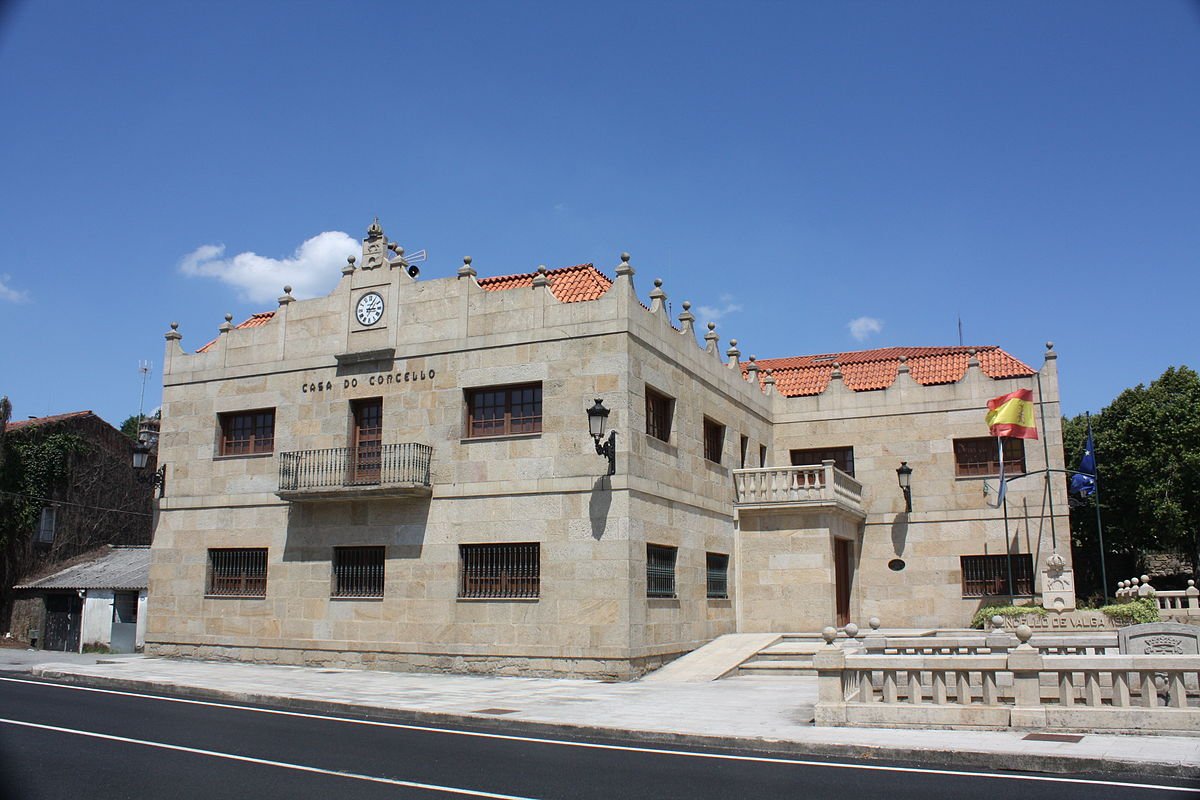
In the main square stands a bust of a woman with a serious expression. She is Concepción Pérez Iglesias, a local schoolteacher who became one of the first female mayors in Galicia during the 1920s. At that time, women in Spain did not yet have the right to vote.
Her story still circulates in the village. She was known as a woman of strong character who had to navigate local politics in a complicated era. The idea of a small Galician municipality being led by a schoolteacher, nearly a century ago, in what was still an overwhelmingly male political world, gives the square a different weight.
A plaque nearby sets the context. It is worth pausing to read it and reflect on the timing. Spain would not grant women the vote until years later. Portas, in its own modest way, was ahead of that curve.
The monument does not dominate the space, yet it shifts how you see it. This is not only a rural stop between Caldas and Vilanova. It is also the setting of a quiet historical anomaly.
The Castro Above the Umia
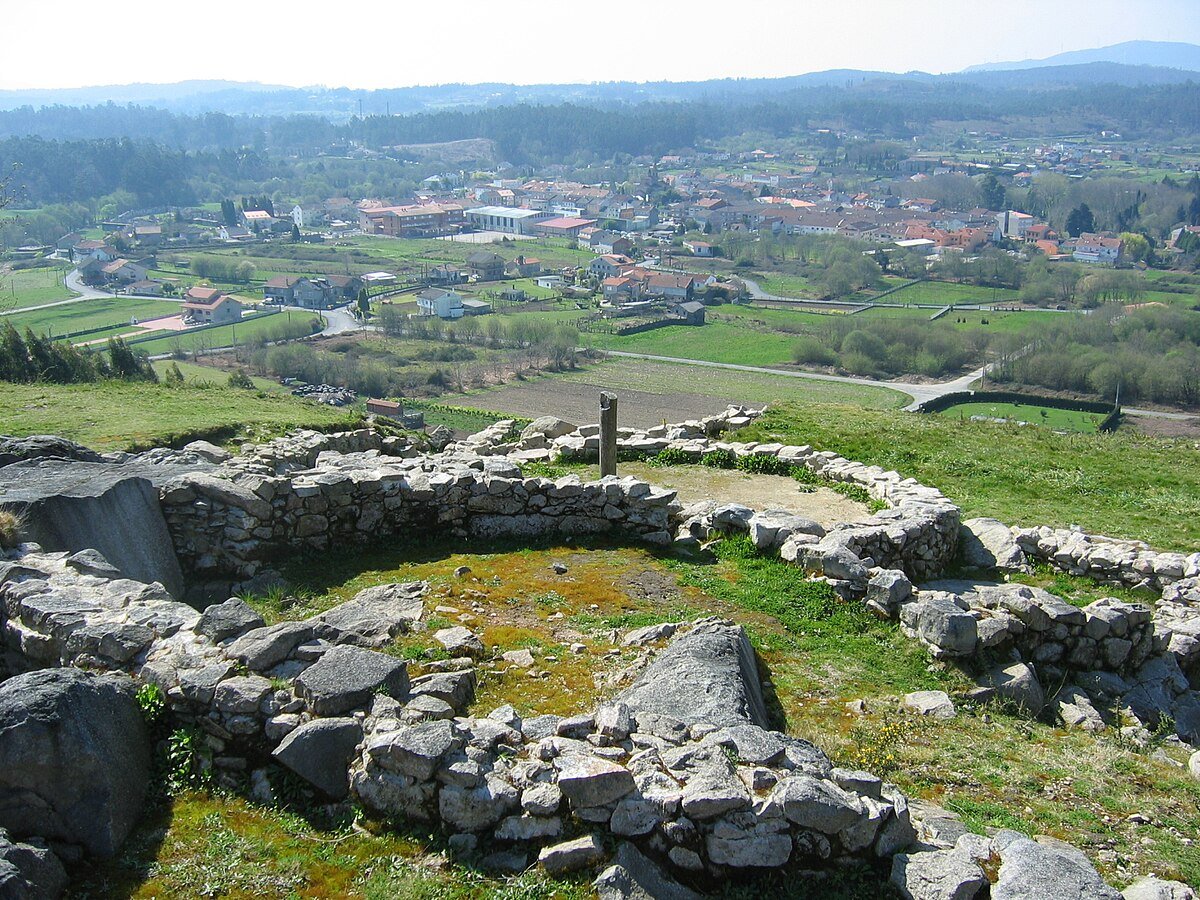
Around three kilometres away, in the direction of Rial, lies a pre-Roman castro. In Galicia, a castro refers to an ancient hillfort settlement, typically built in strategic positions long before Roman rule. The walk there is short and straightforward. In about twenty minutes, you reach the top.
Do not expect reconstructions or a polished archaeological park. The site is understated. You can make out the shapes of the terrain, some defensive ditches, and its commanding position above the Umia valley. There is an information panel, and little else.
That simplicity suits the place. The value of the castro lies in its location. Sit for a while and look across the valley. Centuries ago, someone chose this exact point for the same reason: to see who entered and who left. Today, the only movement comes from the wind or the occasional tractor in the distance.
The absence of heavy interpretation allows space for imagination. The outlines in the earth hint at a settlement that once watched over the Umia, long before roads connected Caldas and Vilanova.
When the Harvest Changes the Mood
Portas feels different if you arrive during the grape harvest. In this part of O Salnés, vineyards shape daily life. When it is time to gather the grapes, usually towards the end of September or the beginning of autumn depending on the year, the shift is noticeable.
Around those dates, the village tends to organise celebrations linked to the vendimia. There may be grape treading, fresh must, music, and a strong turnout from local residents. The atmosphere is closer to a community gathering than a staged tourist event. The wine still smells of newly crushed grapes, and children weave between the tables.
It is a reminder that this valley moves in cycles tied to the vines. The harvest is work, but it is also social, noisy and shared.
Is It Worth Stopping?
That depends on what you are looking for. If your idea of Galicia centres on postcard images of aligned hórreos, those traditional raised granaries, and stone streets arranged for the perfect photograph, there are other places along the ría that play that role more convincingly.
Portas operates differently. It is an ordinary village in many respects, with houses in varying states of repair, plots of vineyard, and daily routines unfolding without performance. Yet it also has that improbable chimney rising from the landscape, a viewpoint with an unexpected panorama, and the story of a teacher who stepped into political office before women could cast a ballot in Spain.
Stop for a short while. Walk around at an unhurried pace. Then continue towards the coast or back to Caldas. Later, if you spot another industrial chimney standing alone in a valley of vines, Portas may come to mind. Even those who once drove past without a second thought tend to remember it eventually.