Full Article
about Mazaricos
Hide article Read full article
Life set by cows and early mornings
The 3,731 residents of Mazaricos share their space with around 11,000 cows. That gives a fair idea of the pace here. Anyone expecting late-night bars or shops open at ten in the evening is looking in the wrong place. Night is lit by the glow of farm buildings, and silence is broken by a tractor starting up before dawn for milking. It may sound like a cliché, but it is very close to what happens on an ordinary day.
A valley shaped by milk
Mazaricos spreads across 12 parishes and roughly 190 square kilometres of valleys, chestnut groves and reservoirs. The road linking A Picota, the municipal centre, with the rest of the area winds gently through curves, meadows and the occasional unhurried cow crossing. After a short drive, it becomes clear what defines the landscape.
The local economy has revolved around milk for decades. Conversations often turn sooner to the price per litre than to the weather forecast, which is saying something in a place where rain is frequent.
Food reflects that rural life. Caldo gallego, a traditional Galician soup, often appears at gatherings and family celebrations. Its flavour comes from unto, a cured pork fat that adds depth and richness. Anyone expecting a light version may be in for a surprise.
Paths shaped by trade and habit
There are two main ways to approach Mazaricos. One follows the Costa da Morte, climbing up to Monte Aro, heading towards the fervenza do Ézaro and watching the river Xallas plunge straight into the sea. The other stays within the municipality, tracing the routes once used by fairs and muleteers moving goods between villages.
One of these is the Ruta das Feiras Vellas. It is not a demanding walk and still includes sections of old stone paving. The route recalls a time when people travelled between markets to sell livestock or exchange produce. Today there are no cattle changing hands along the path, but the rural atmosphere remains.
In Beba, a popular meal is often held under oak trees when spring arrives. Long tables are set out, wine is passed around, and traditional music appears without a formal stage or strict schedule. It is less an organised event and more a shared gathering that stretches into the afternoon.
Ruins that never quite fell silent
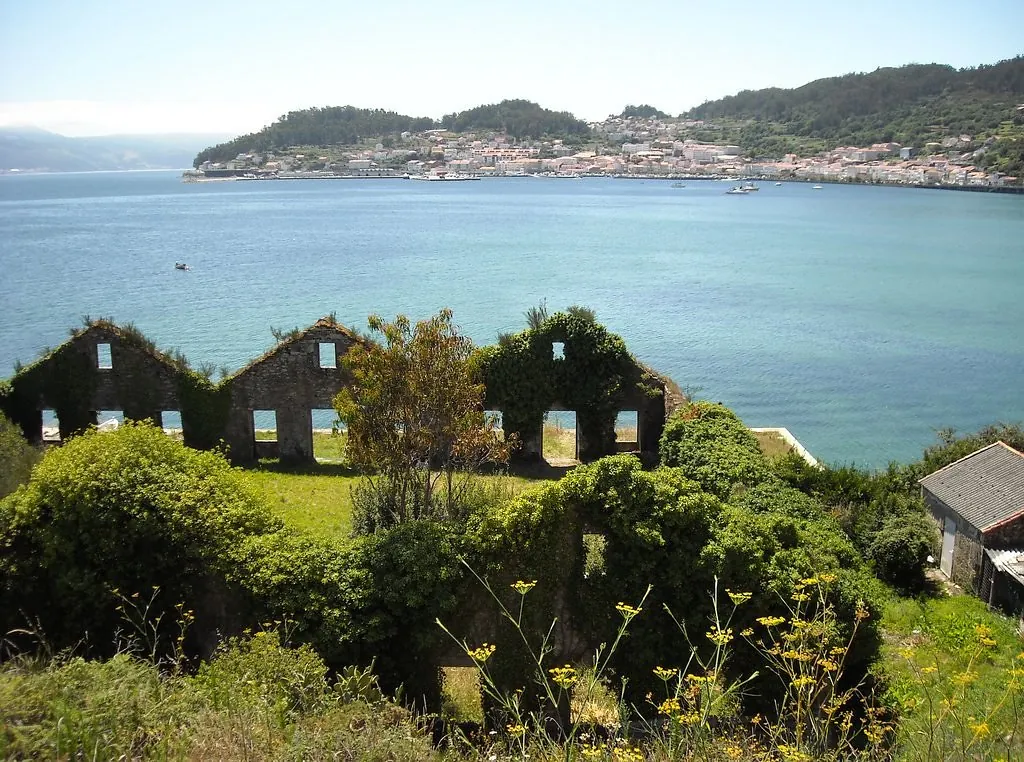
Among the most striking places are the remains of the church of Santa Baia de Chacín. The structure stands without a roof, grass growing between its stones, and the baptismal font still in place. Even in recent times, occasional masses continued to be held there.
According to locals, the scene was simple. Plastic chairs brought from home, a priest arriving from another parish, and neighbours gathering when the weather allowed. It felt less like a formal ceremony and more like a mix of tradition and quiet persistence, carrying on for as long as possible.
For those interested in archaeology, near Parxubeira there is a dolmen that can easily go unnoticed without context. At first glance it looks like a cluster of large stones. Once it becomes clear that people placed them there thousands of years ago, the setting takes on a different meaning. Surrounded by chestnut trees and with the sound of a nearby river, it is not difficult to see why the spot was chosen.
The cake that rarely waits
Before leaving, it is worth asking about the tarta de Mazaricos. It is not the familiar Tarta de Santiago marked with a cross. Instead, it is usually a sponge cake filled with cream and almond, prepared by some bakeries mainly at weekends.
There is one small issue: it sells out quickly. Mid-morning offers a better chance of finding it. Arriving after lunch often leads to a resigned “chegaches tarde”, Galician for “you came too late”.
If it is available, having a slice on the spot and saving another for later makes sense. After driving between the viewpoints from Corzón to Monte Aro, along narrow roads bordered by open fields and wide views, something sweet tends to feel well deserved.
Finding your way, slowly
Mazaricos is best approached without trying to see everything in a single morning. An early start up Monte Aro, when clouds are still lifting from the valley, can be followed by a visit to the fervenza do Ézaro to watch the Xallas drop towards the sea.
From A Picota, distances by car are not long, but the roads have their own rhythm: bends, small villages and the occasional tractor that makes it clear rushing is not particularly useful here.
If there is still time, near Hospital stands a sculpture of the Vákner, a creature from Galician mythology sometimes described as a kind of werewolf. Several metres tall, it appears suddenly by the roadside, adding an unexpected note to a landscape otherwise defined by fields, cattle and steady routines.