Full Article
about Crecente
Hide article Read full article
Getting your bearings in Crecente
Tourism in Crecente starts with something simple: a car and a bit of time. The municipality is large and its villages are scattered across the hills. It helps to park wherever you find space on higher ground and then walk for a while. Going down towards the Miño is easy enough; the return climb is another matter. There is no clear centre and no network of streets designed for strolling.
This is open countryside. Vineyards step down the slopes in terraces, patches of scrub fill the gaps, and houses sit on their own plots. Anyone who has travelled through inland Pontevedra or the south of Ourense will recognise the feel of the landscape straight away.
What to look for as you move around
The parish church of Santa María works more as a point of reference than as a destination in itself. It is simple, and that simplicity repeats across many of the small chapels and stone crosses scattered through the parishes. They belong to everyday life here rather than to a sightseeing circuit.
The defining feature is the vineyard-covered hillsides. They are easy to spot from minor roads and from a few higher viewpoints within the municipality. Often it is enough to pull over where the road widens slightly and look out across the valley for a minute.
Villages such as Filgueira and Ribas keep their traditional layout. Stone houses, raised granaries known as hórreos, and narrow paths threading between small plots of land are still part of daily use. There are no marked routes or explanatory panels. These are places where people live, so it makes sense to move with care and avoid entering enclosed private property.
Between vines and rural tracks
A network of small paths runs between vineyards and woodland. Some are agricultural tracks, others link one village to the next. Most are not signposted.
Walking here usually means joining short stretches together, losing your bearings a little, and then returning to the road. That is part of the experience. The scenery does not change dramatically from one turn to the next, yet the quiet is noticeable.
The area can also be explored by bike. The short climbs deserve respect. From a distance they look gentle, but they feel different once you are on them. When the ground is damp, surfaces can become quite slippery.
The Miño as a boundary
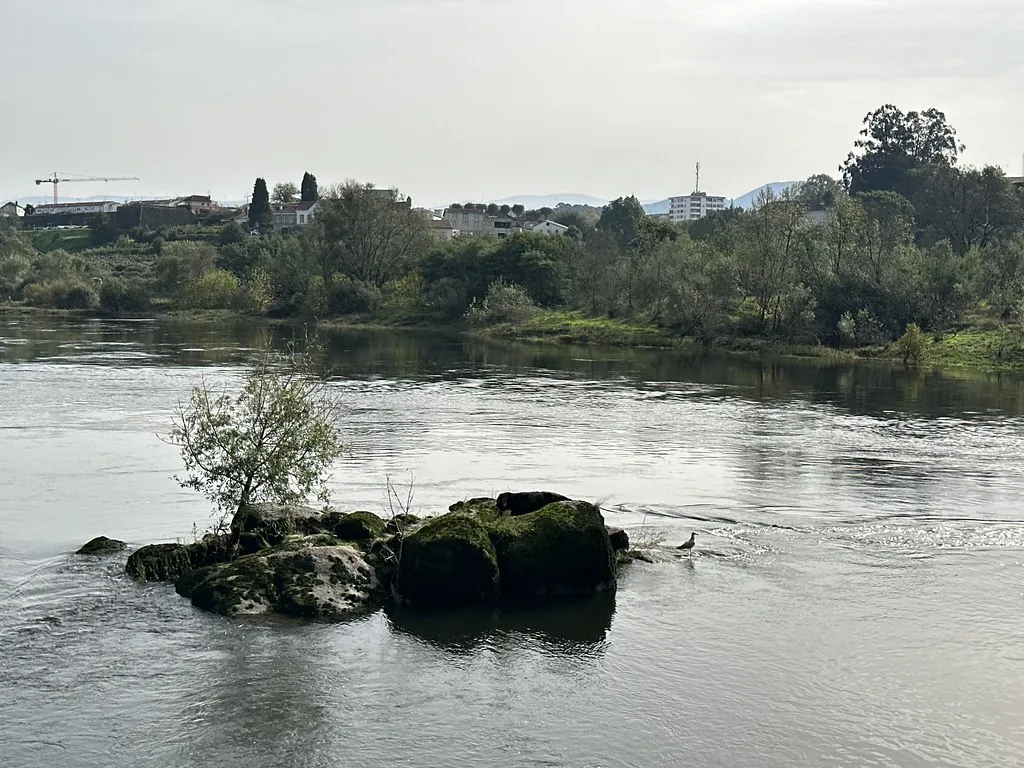
The River Miño marks the edge of the municipality. From higher ground, the terraced vineyards can be seen descending towards the water.
Reaching the riverbank takes patience. Slopes tend to be long, and the road winds as it drops. A common approach is to leave the car above and walk the final stretch down.
There is a simple river beach. It is neither large nor heavily equipped. It works as a place to pause by the water for a while, and little more.
If time is short
An hour or two is enough to get a feel for Crecente. Head to a higher road where the vineyard terraces are visible, then make your way down towards the river through a nearby village.
Large monuments and big squares are not part of the picture here. The interest lies in the landscape and in the small roads that cross the valley.
It also helps to look at the map in advance. Distances can be misleading. With bends and gradients, a short distance on paper can take longer than expected.
When to go
Spring and autumn tend to show the valley at its best. In spring everything turns a deep green. In autumn the vines change colour and the slopes gain contrast.
Summer brings strong sun on the hillsides. Early starts make walking more comfortable.
Rain quickly makes the ground slippery. Dirt tracks collect mud, and some inclines become trickier than they first appear from the car.