Full Article
about Ponteareas
Hide article Read full article
A town that smells of cloves
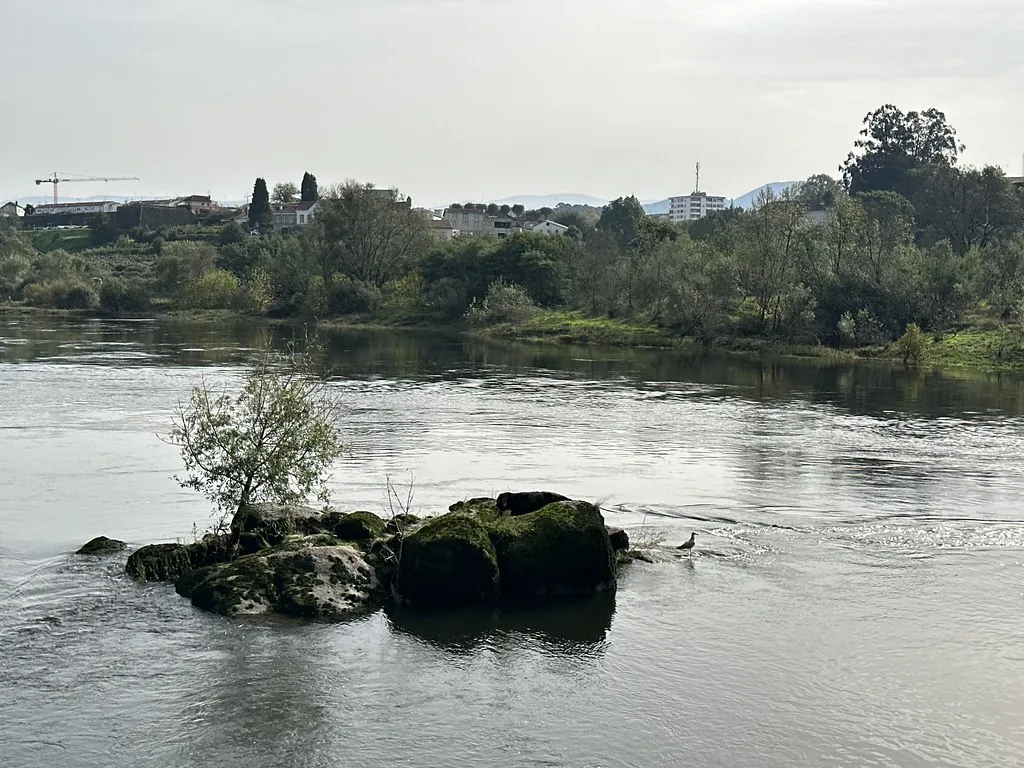
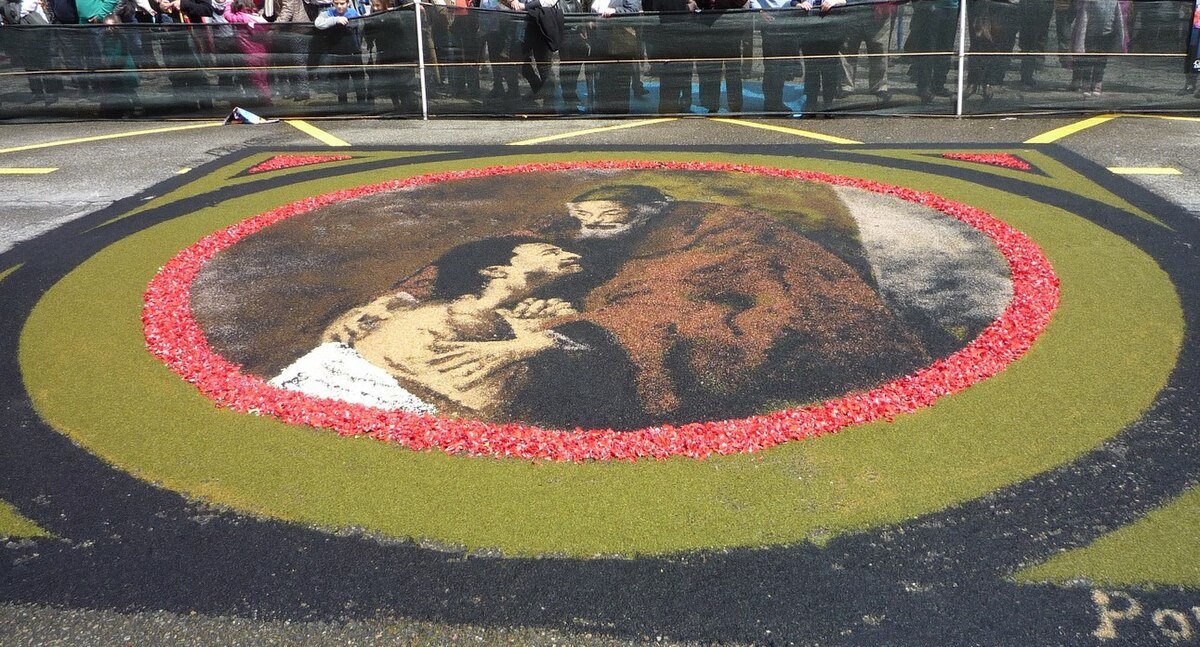
On Corpus Christi Sunday, Ponteareas smells of cloves. It is literal rather than poetic: thousands of flowers cover the streets for a few hours, between the morning mass and the passing of the procession. Then the carpets vanish and the town returns to its usual pace. That fleeting image, with the old quarter turned into a temporary mosaic beside the river Tea, explains why Ponteareas is so often mentioned when people talk about popular celebrations in Galicia.
The carpets are created the night before. Neighbours and local groups draw large designs directly on the ground using petals, leaves and coloured sawdust. By early morning the historic centre is fully covered in patterns that will last only a short time. The effect is striking and brief, rooted in a tradition that defines the town’s identity.
The bridge that gave it a name
The name Ponteareas is usually linked to an old crossing over the Tea and to the sand carried by the river. The town developed around this natural passage, a point between the inland areas of southern Galicia and the route towards Portugal.
The Puente de los Remedios still marks that entrance. It has been altered many times over the centuries, and some studies suggest that older materials were reused in its pillars, something fairly common in bridges across the north-west of the Iberian Peninsula. From here, the layout of the town becomes clear: streets rise from the river towards higher ground, where the church of San Miguel stands.
Ponteareas gained the status of villa in the Late Middle Ages, in a region contested by noble families. That past is reflected in a layout that is more practical than monumental. Many houses have ground floors used as cellars or storage spaces. Arcades line the main streets, offering shelter and continuity, and the Plaza Mayor remains the centre of daily life.
Hillforts, a castle and noble memory
A few kilometres from the centre lies the castro de Troña, set on a spur overlooking the Tea valley. It was part of the castro culture, with occupation lasting for centuries before the arrival of Rome. Today, a walking route circles part of the site and reveals remains of walls and defensive ditches, along with several circular dwellings reconstructed from archaeological work. From the top, the reason for choosing this location is obvious: the valley opens out completely below.
Further south stands the castle of Sobroso, built on another strategic point. The fortress played a role in medieval conflicts within the Kingdom of Galicia and, like many others, suffered damage during the Irmandiño revolts of the 15th century. What can be seen today is the result of later restoration, yet the defensive logic remains intact. From the main tower, the natural route between the inland Miño area and the coastal strip of Pontevedra is clearly visible.
In the same area there are several pazos linked to old noble families. One of them, the pazo de Canedo, is associated in local tradition with the family of Agustina Sarmiento, the child depicted in Velázquez’s painting Las Meninas. The building is still privately owned and barely visible from the road.
A calendar of festivals and food
The festive calendar in Ponteareas is shaped above all by Corpus Christi, recognised as a celebration of international interest. The floral carpets define the event, but they are part of a wider rhythm of local festivities throughout the year.
In September, the romería of the Virgen de los Remedios takes place, with a procession leading to the sanctuary beside the bridge. August brings the celebration of San Roque, which gathers many of the surrounding parishes. At the end of September, San Miguel closes the festive cycle.
The food associated with these occasions reflects the broader traditions of southern Galicia. Empanadas filled with seafood or meat appear regularly, while lacón con grelos becomes more common as colder weather arrives. In winter, sweets featuring chestnuts take on a prominent role.
Vineyards, rock carvings and the river
The municipality extends across several rural parishes that surround the town. A short distance from the centre, vineyards and small villages spread across the slopes of the valley. This area belongs to the subzone of O Condado within the Rías Baixas designation, where albariño is grown alongside other traditional grape varieties.
One of the better-known walks leads to the Pedra da Piconha, a natural viewpoint over the Miño valley reached via a forest track. The surrounding landscape also contains several petroglifos. Among the most frequently mentioned is Chan de Gándara, where figures carved into the rock are thought to be thousands of years old.
Closer to the town centre, the river Tea follows a path that is widely used by locals. In summer, some stretches of water become calmer, forming a small bathing area that tends to fill up later in the day. It is a simple place to spend time by the water without leaving the town.
Another quiet option is the forest park of Sobroso. Paths wind through pine and chestnut trees, with resting areas and open views across the valley. The atmosphere here contrasts with the busier moments of the festival calendar, offering a slower way to experience the surroundings.
Moving around at an easy pace
The centre of Ponteareas can be explored easily on foot. The Plaza Mayor with its arcades, the church of San Miguel and the area around the Puente de los Remedios bring together the key points of interest. Distances are short, and the layout still reflects the town’s origins as a place of passage by the river.