Full Article
about Salvaterra de Miño
Ocultar artículo Leer artículo completo
The castle tower appears first, not on a crag but at river level, looking across the Miño towards Portugal as if checking who’s crossing the bridge. From the battlements you can spit into another country—though the Guardia Civil prefer you don’t—and still be back in time for a glass of Albariño before lunch.
Salvaterra de Miño sits 25 minutes south-east of Vigo airport, low enough in the valley for Atlantic weather to roll straight up the river. That means mild winters, humid summers and the sort of spring mornings that smell of wet granite and orange blossom. Elevation is only 40 m above sea level, so forget the baked-plateau image of inland Spain; this is green, vine-country Galicia where rain arrives horizontally and locals keep a light jacket in the car year-round.
A morning loop that ends in another country
Park on Rúa do Progreso, the main drag lined with banks and bakeries, and the entire old quarter is walkable in twenty minutes. Stone houses the colour of weak tea lean towards narrow pavements; grander mansions carry coats-of-arms from the seventeenth century when the river was the only reliable road. The parish church of San Lorenzo hides a baroque retablo inside, but the real draw is the castle five minutes uphill. Admission is free, opening hours erratic—if the iron gate is locked, peer through the grille and you’ll still catch the view: Monção on the Portuguese bank, vineyards stitched across both slopes, and the international bridge that makes a mockery of passports.
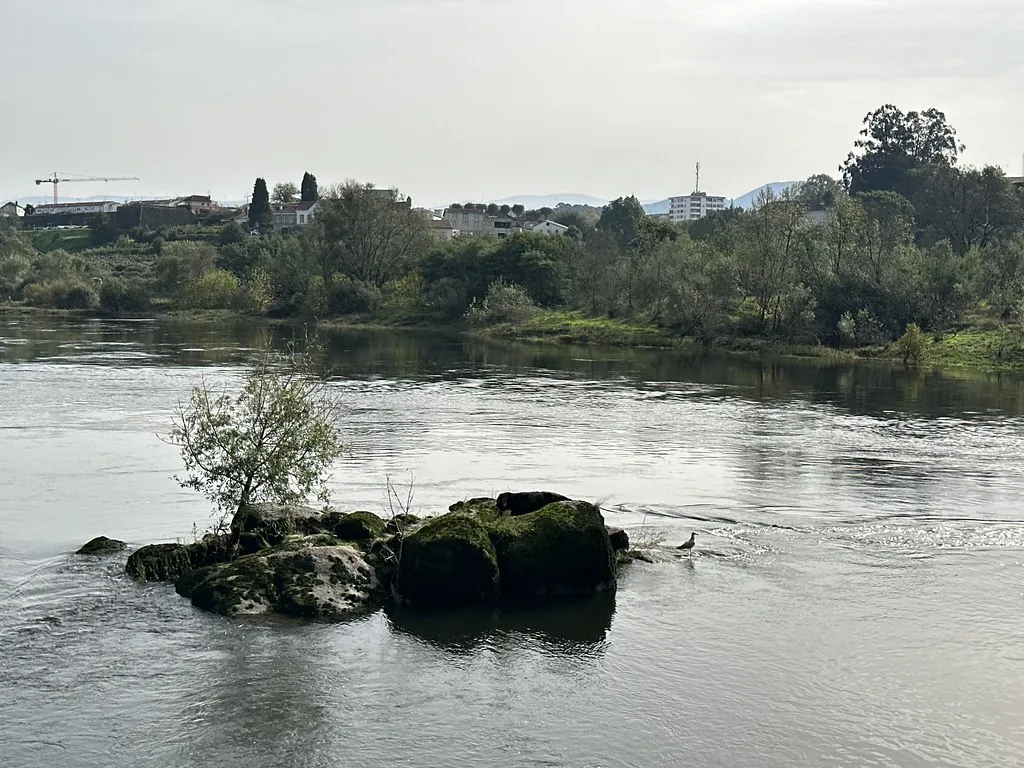
Descend the corkscrew lane to the paseo fluvial, a 3-kilometre boardwalk and dirt track that shadows the Miño downstream. Herons stand mid-stream like bored sentries; in July the water is low enough for teenagers to wade to miniature beaches. Cyclists share the path, but it’s wide enough for buggies and wheelchairs until the final 500 m where tree roots ripple the surface. Turn back at the old stone mill or continue to the Praia da Freixa, a manicured river-beach with picnic lawns and lifeguards in season—handy if the Atlantic coast is fogged in.
Crossing to Portugal is a pedestrian affair: stroll onto the iron bridge, show ID if officers ask, and you’re in Monção’s café-lined square in under ten minutes. British families use it as a cheap thrill (“We had breakfast in Spain, lunch in Portugal”) but remember Spanish mobile data vanishes halfway across; download offline maps before you start.
Falcons, vines and the smell of wet earth
The only attraction that regularly pops up on English-language forums is the Falcoaria de Salvaterra, a rehabilitation centre for raptors tucked behind the football pitch. Flying displays run at 11:30 and 17:00, avoiding the midday heat that sends the birds sulking into the shade. Guides speak serviceable English and let visitors glove-up for a barn owl selfie, but the serious business is conservation: injured peregrines recuperate in mews behind the arena. Adults €7, children €4; ring ahead in winter when staff numbers drop.
Wine is less showy but everywhere. Smallholdings of Albariño and Loureira grape press right up to the river, their trellises low enough for cyclists to swipe a bunch. The Fiesta do Viño do Condado lands each May (dates shift—check Facebook) and turns the sports pavilion into a tasting hall: five euros buys a glass and five tokens, enough to decide whether you prefer the citrus bite of young Albariño or the creamier barrel-aged version. British drinkers usually compare it to a peachier Sauvignon Blanc; locals pour it into white ceramic bowls because, they claim, the porcelain keeps temperature better than glass.
Food follows the river calendar. Between January and March restaurants advertise lamprea à la bordelesa, the jawless fish simmered in its own blood and red wine—think of it as Galicia’s answer to lamprey pie, minus the pastry. If that sounds medieval, order empanada gallega instead: a metre-wide pie sliced by weight, usually tuna or shredded chicken, sturdy enough for walking lunches. Octopus arrives plain—boiled, snipped with scissors, dusted with pimentón and coarse salt. The trick is to eat it while the paprika still crackles.
Where to stay and how not to get stuck
Accommodation clusters on the modern outskirts rather than within the walls. Salvaterra Country House offers three en-suite rooms and a pool 2 km uphill; owners Liz and Mark (ex-Brighton) provide a sat-nav reference because postcodes cover entire valleys. La Petite Maison is a two-bedroom cottage in a vineyard, 5 minutes by car, aimed at self-caterers who want darkness thick enough for star-counting. Both require wheels: the village taxi is one septuagenarian with a Seat Toledo who switches the meter off after 22:00.
Public transport exists but feels theoretical. A Monday-to-Friday bus links Vigo bus station at 09:15, returning at 18:30; miss it and a taxi costs €35. Car hire from Vigo airport is painless—take the AG-41 south, peel off at exit 3 and follow the N-120 until the river appears. Roads are single-lane for the final kilometre; wing mirrors brush the stone walls, but traffic is light and locals reverse courteously.
When to come, when to stay away
April–June delivers 22 °C afternoons and fields loud with frogs. September is warmer, quieter and grape-harvest purple. July and August climb to 30 °C but humidity from the river makes sheets feel damp; British visitors often retreat to the coast after two nights. Winter is mild—rarely below 5 °C—but Atlantic fronts turn lanes into streams and the castle path becomes a slide. If you must come in February, bring boots with tread and expect the falconry centre to close without notice.
The village makes no claim to be picturesque in the chocolate-box sense: half the centre is 1980s brick, satellite dishes sprout like mushrooms, and the weekly market sells cheap socks alongside chorizo. That honesty is part of the appeal. Salvaterra works best as a pause between Atlantic beaches and the Minho’s fortified towns, a place to walk an international bridge at sunset, glass in hand, while swallows stitch the sky above two countries at once. Stay a night, maybe two, then follow the river inland or west to the coast—just don’t forget your passport on the bedside table.