Full Article
about Carballeda de Avia
Ocultar artículo Leer artículo completo
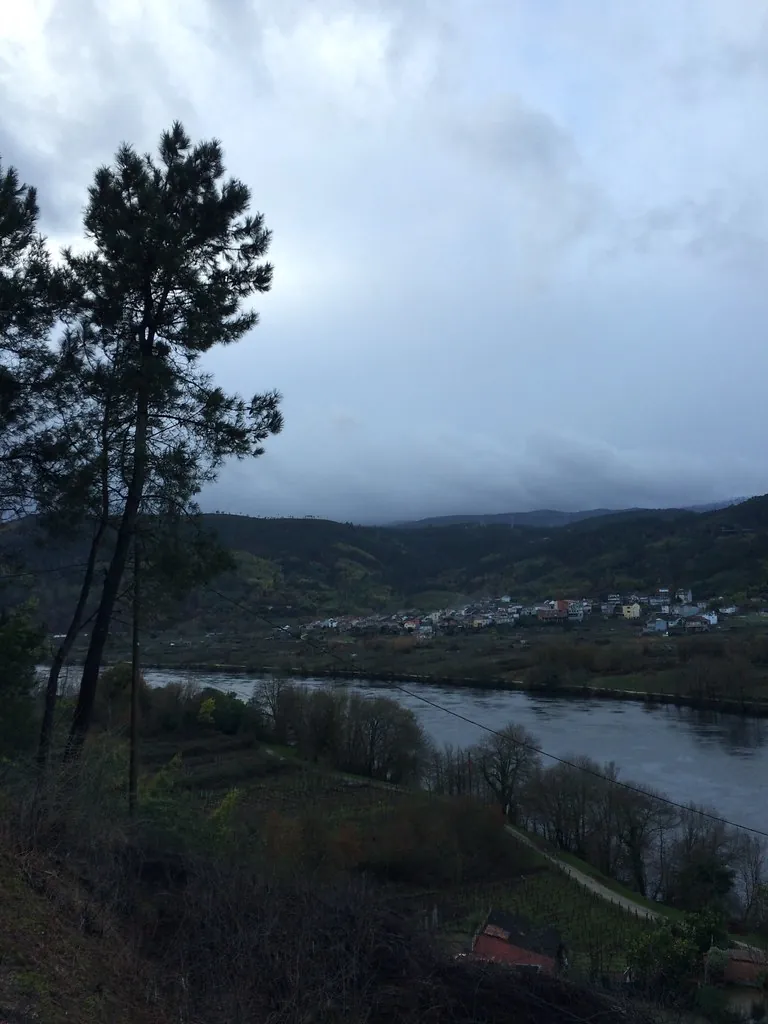
The stone church of San Martiño de Camporramiro appears suddenly around a hairpin bend, its Romanesque portal wedged between terraced vineyards that drop 300 metres to the Avia valley. At 420 metres above sea level, Carballeda de Avia isn't dramatically high—until you realise the road you've just climbed gains those metres in barely five kilometres of switchbacks tight enough to test British holidaymakers who last tackled corners like this in the Lake District.
A Parish That Refuses to Be a Town
Administratively it's a village of 1,200 souls. Functionally it's five hamlets—Camporramiro, A Mota, O Acevedo, O Pesqueiro and the eponymous Carballeda—strung along a ridge like beads on broken necklace wire. Each cluster has its own stone granaries, its own war memorial-sized crucifix, its own microclimate. Drive from one to the next and the temperature drops two degrees; the vines change from trellised overhead pergolas to waist-high granite posts; the dialect softens consonants you hadn't noticed were there.
This fragmentation explains why first-time visitors circle looking for "the centre" that doesn't exist. Park where the OU-401 widens opposite the agricultural co-op (free, no time limit) and walk. Within ten minutes you'll pass a pharmacy doubling as the village's only cashpoint, a bakery that sells out of empanada by 11 a.m., and a bar whose opening hours depend on whether María has driven her husband to the hospital in Ourense that morning. If both shutters are down, continue to Leiro four kilometres south—past the 12th-century cruceiro where locals still leave flowers on saints' days—for coffee and a tostada spread with mild tetilla cheese that even toddlers approve.
Walking Among Vertical Vines
The Ribeiro denomination stretches across three provinces, but its steepest vineyards are here. Stone walls barely a metre high create a topographical map you can read with your feet: each terrace adds another row of gneiss slabs prised from the soil itself. Waymarking is minimal—look for yellow arrows painted on electricity poles or the occasional wooden post with a grape-bunch symbol. The shortest loop, from Camporramiro down to the river and back, measures 4.3 km with 220 m of ascent. Trainers suffice in dry weather; after rain the clay subsoil clogs boot soles so thoroughly you gain an extra kilo per foot.
Spring brings blossom on the almond terraces and the chance to hear cuckoos echoing across the valley until late May. Autumn means purple-red dogwood berries and the smell of crushed grapes drifting from the cooperative press. Summer walkers should start early: by 1 p.m. the sun ricochets off schist and granite, creating a convection oven that sends temperatures ten degrees above the forecast for nearby Ourense. Winter has its own rewards—crystallised spider webs at dawn, whole hillsides visible through leafless vines—but daylight is scarce and the road from Ribadavia can ice over. Chains are rarely needed; common sense usually is.
Wine Without the Theatre
Forget cathedral-like bodegas and audio guides. Here you ring a mobile number scrawled on a corrugated-iron gate, wait while someone finishes spraying copper sulphate, then taste three wines in what was clearly the front room until recently. Adegas Rectoral de San Campio will sell you their latest white for €6 a bottle if you bring your own carrier; they prefer twenty-four hours' notice but often answer on the second ring. The current vintage smells of ripe pear and tastes faintly saline—perfect with scallop empanada eaten on the bonnet of your hire car while swifts scream overhead.
The local serve is the cunca: a shallow ceramic bowl held at thumb-and-finger pinch points. It looks precarious but survives centuries of tavern drops because the wide surface lets the wine breathe and cool simultaneously. Ask for "un pouquiño máis" and you'll receive a top-up measured in millimetres, not glugs. Driving limit is the standard Spanish 0.5 g/l, roughly one small cunca for an eleven-stone adult—plan accordingly.
When the Silence Breaks
Carballeda's population triples during the second weekend of September when the Festa do Viño Veixo honours wine pressed from 70-year-old vines. A marquee goes up on the football pitch; local bands play Galician folk-punk until 3 a.m.; someone inevitably attempts to teach foreigners the muiñeira dance. Accommodation within the parish sells out six months ahead—book in Ribadavia or accept a 40-minute night-time drive from Ourense.
The rest of the year silence is the default soundtrack, broken only by tractors hauling gondolas of grapes or, in November, shotgun echoes during the montería hunt. Mobile coverage is patchy on the valley floor: Vodafone disappears entirely opposite the abandoned school; EE holds one bar if you stand on the picnic table. Download offline maps before leaving the A-52.
What Can—and Does—Go Wrong
Monday remains the Galician sabbath. Both bar-restaurants close, the bakery operates on breakfast-only hours, and the pharmacy ATM often runs dry after the weekend pilgrimage to Ribadavia's supermarkets. Fill the tank on Sunday evening; the village garage hasn't accepted cards since the terminal broke in 2022 and the owner sees no urgency replacing it.
Road width is genuinely single-track between walls for long stretches. Meeting a grape-laden John Deere around a blind bend requires reverse skills to the nearest passing bay—usually twenty metres behind you. Flashing headlights mean "I'm coming through," not "after you." Politeness creates gridlock.
Rain transforms the clay into something resembling chocolate mousse. One heavy shower in October 2023 stranded a rented Fiat 500 on the gentlest incline outside A Mota; locals emerged with cardboard and cat litter to create traction. If the forecast shows orange alerts, postpone. The valley funnels weather systems straight from the Atlantic, turning harmless drizzle upstream into proper precipitation here.
Last Orders
Leave before dusk and you'll miss the moment the sun drops behind the Serra do Suído, flooding the terraces in rose-gold light that makes even the most jaded traveller reach for a camera. Stay too long and the return drive to Santiago airport becomes a stress-inducing negotiation of unlit curves with stone walls inches from your wing mirrors.
Carballeda de Avia doesn't do big reveals or Instagram moments. It offers instead a masterclass in scale: how small a community can be while still producing wine shipped to Madrid restaurants, how vertical land can be coaxed into agriculture without machines wider than a wheelbarrow, how quiet the world becomes when you stand between rows of vines at 9 a.m. with only a robin for company. Drive carefully, phone ahead, bring cash—and expect to explain to friends back home why you spent three days somewhere Google Street View hasn't bothered to map.