Full Article
about O Grove
Hide article Read full article
A strip of sand that changed everything
The isthmus of A Lanzada is barely two kilometres of sand, yet it altered the course of O Grove. Until the Middle Ages, this territory functioned as an island. Over time, shifting sands joined it to the mainland, and geography did the rest. In the 12th century the place passed into the hands of the monastery of San Martín Pinario in Santiago de Compostela, after Alfonso VII donated the island to the monastic community. What now feels like an open, seaside town shaped by its beaches once held a very specific economic role within the monastery’s possessions.
The island that resisted becoming mainland
At the southern tip lies the archaeological site of Adro Vello. Excavations have uncovered remains pointing to occupation from the castro period, along with later Roman and medieval structures. The setting explains why: a small tongue of land well positioned in front of the ría de Arousa, with abundant marine resources.
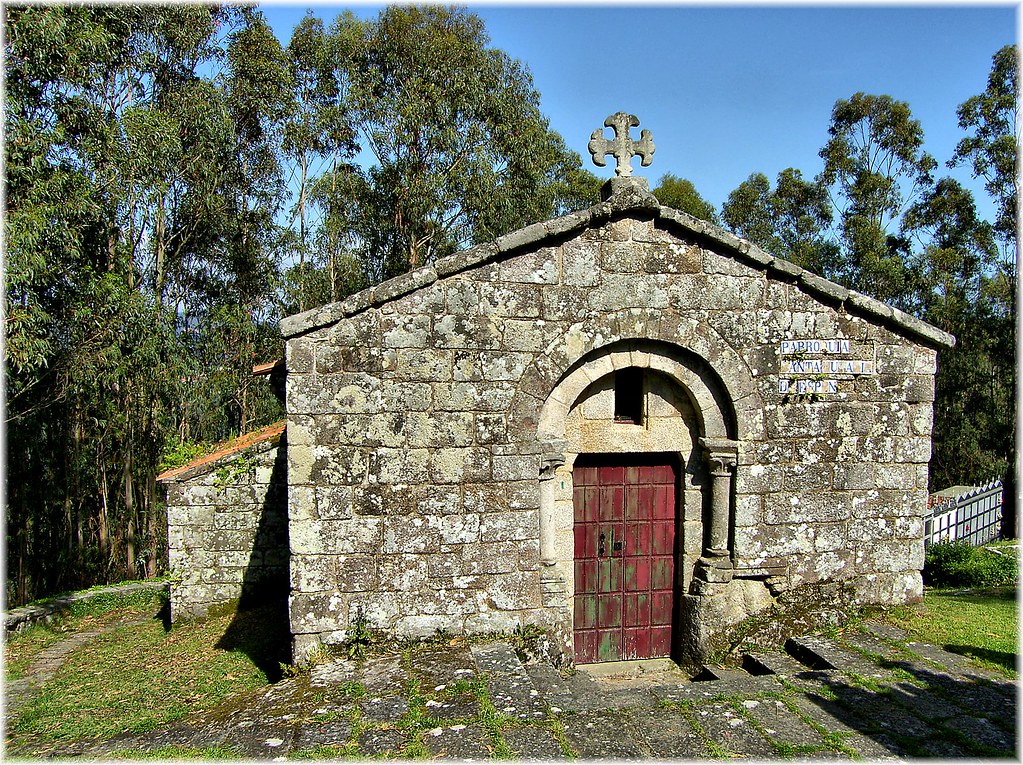
Classical sources mention the Grovii, an indigenous group often linked to the origin of the place name. Later, during the Middle Ages, monastic control organised much of the territory’s activity, from fishing and salt production to the use of small ports. Two Romanesque churches from that period still shape the local landscape, San Martín and San Vicente. They are restrained buildings, with thick masonry and semicircular apses, designed to withstand a harsh climate exposed to Atlantic winds.
In the 18th century, Catalan fishermen arrived with more efficient fishing methods and different types of nets from those traditionally used in the ría. In many parts of Galicia their arrival caused friction, and O Grove was no exception for a time. Eventually, both systems came to coexist in the same waters.
The water that cured a donkey
The most repeated story about the origin of the spa on A Toxa tells of a sick donkey that recovered after rolling in the island’s mud. It is hard to say how much is fact and how much is publicity, but by the late 19th century the mineral medicinal waters were already being used and the thermal complex began to take shape.
For decades it became a summer destination for the bourgeoisie of north-western Spain. Visitors arrived by boat from Vigo or other ports in the ría, spending time between baths and walks. Several representative buildings remain from that period, along with the small church covered in shells, built at the beginning of the 20th century.
The bridge connecting A Toxa with O Grove was constructed in the first third of the last century. Despite the short distance, the island retains a slightly separate atmosphere from the town’s main centre.
The ría that feeds the town
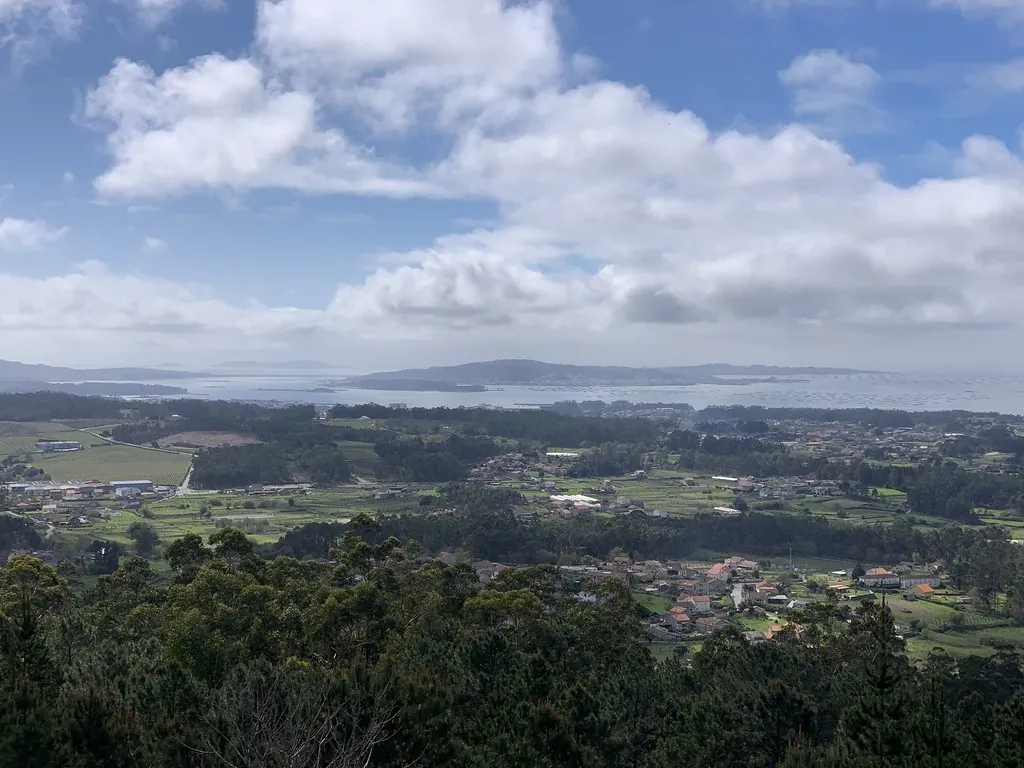
O Grove opens directly onto the ría de Arousa, the largest of Galicia’s rías. Much of the local economy revolves around shellfish and mussels grown on bateas, floating platforms anchored in the water. From a higher vantage point they are easy to spot: wooden structures lined up across the ría, suspended by long ropes where mussels grow.
One of the best places to understand the landscape is Monte Siradella, the highest point on the peninsula. From there the ría looks almost like an inland sea and, on clear days, several of the islands that close off the Atlantic horizon come into view.
On the western side of O Grove the coastline shifts completely. Cliffs appear, along with paths that run through pine woods exposed to the wind. On the opposite side lies A Lanzada, a long, open beach that connects with the neighbouring municipality of Sanxenxo. At one end stands the small hermitage of A Lanzada, linked to a very old pilgrimage. Popular tradition speaks of ritual bathing connected to fertility. The custom still survives, even if more out of habit than conviction.
When shellfish becomes a ritual
Every autumn O Grove hosts the Festa do Marisco, usually around 12 October. For several days the port and the town centre fill with stalls cooking produce from the ría: mussels, oysters, razor clams, scallops or spider crab, depending on the season. Rather than a staged event, it feels closer to a large shared meal that draws people from across Galicia.
For the rest of the year, shellfish is part of daily life. In local bakeries it is common to find empanadas filled with cockles or zamburiñas, and in many homes caldeirada remains a familiar way of preparing fish and seafood when the catch allows.
Getting there and timing it right
O Grove sits just under an hour by car from Santiago de Compostela. The usual route follows the Atlantic motorway before continuing towards the O Salnés peninsula along regional roads. There are also bus connections with several Galician cities, though moving around the peninsula is easier with a car.
In summer, visitor numbers rise sharply and parking in the centre can take time. Outside July and August the pace is calmer. Spring and the beginning of