Full Article
about Cervantes
Hide article Read full article
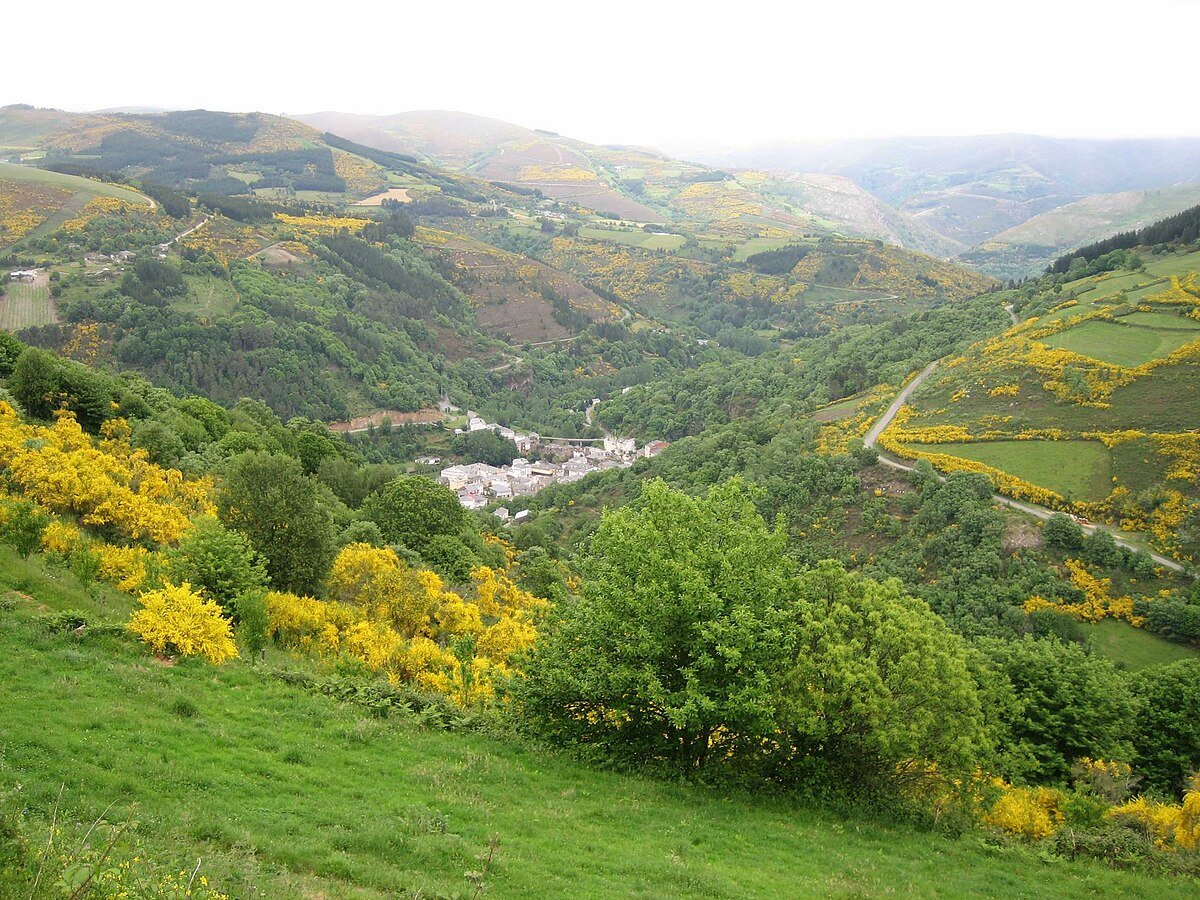
Morning sunlight slips low across the slate rooftops of Cervantes. It takes time to reach the bottom of the valley. At that hour the air carries the scent of damp grass and wood smoke drifting from a chimney. Park the car and walk for a few minutes and the sound of the engine fades quickly. What remains is the dry rustle of leaves underfoot and the brief call of a bird among oaks and chestnuts.
Cervantes lies in the comarca of Os Ancares, in Galicia, north-west Spain. It covers a wide area despite having very few residents. Villages are scattered across hillsides and meadows, linked by narrow roads that force drivers to slow down. There is no single centre where everything happens. The usual way to explore is to move from one small settlement to another, pausing at a bend in the road and watching how the forest changes with the hour. This is a place that makes more sense without haste.
Piornedo, stone walls and mountain memory
When Cervantes is mentioned, the name Piornedo almost always comes up. Several pallozas have been preserved here. These traditional mountain houses have a round or oval floor plan, thick stone walls and a thatched roof that looks like a frozen wave resting on top.
Inside, they help explain how people once lived in these highlands. Space was shared. The fire burned in the centre. There were areas to store grain and places for animals. Some pallozas can be visited at certain times of the year, although access varies. Even so, what tends to stay in the memory is walking through the small cluster of houses without a fixed route. Dark slate walls, low doorways and broom thatch that shifts in colour with the seasons define the scene.
Look up and the slopes of Os Ancares fill the background. In autumn the mountains turn red and yellow. In summer the dominant tone is the deep green of oak woodland.
Villages that barely appear from the road
The municipality is dotted with tiny settlements, some barely visible from the tarmac. Degrada, Vilarello and Campo da Auga are examples of this scattered pattern. A tight group of stone houses occupies a few metres, and then it is back to meadows and forest.
Many homes are only lived in at certain times of the year. Others remain inhabited all year round by very few people. Silence is the first thing most visitors notice. Now and then it is broken by a wooden door banging in the wind, or by water running through a fountain.
In the municipal capital, also called Cervantes, stand the parish church of Santa María and the town hall building. Everything is simple. Stone construction, thick walls and quiet streets where cars rarely pass.
Forests and paths between settlements
The forests in this part of Os Ancares mix oak, chestnut and some birch. In autumn the ground is covered with fallen leaves, split chestnuts and damp earth. In summer the shade remains dense and cool, even at midday.
Numerous paths connect nearby villages. Some were once used by neighbours or shepherds moving across the hills. Others now serve to reach meadows and vegetable plots. Signage is not always present. Anyone planning a longer walk is wise to carry a downloaded map or a GPS device, as relying on mobile coverage can be difficult in places.
The best view of the valley sometimes appears without warning. It might be a clearing between trees, a curve in the road or a hillside where the forest suddenly opens out. Morning fog is common and can soften the outlines of the mountains until the landscape is reduced to sound and moisture. On those days Cervantes feels smaller, quieter, almost enclosed by cloud.
Eating in Cervantes and what the land provides
Cooking here tends to follow the rhythm of the seasons. In private homes and in the few places that prepare food for others, dishes are substantial. Stews made with beef or pork are typical. When the cold sets in, a hot caldo is common. In autumn, chestnuts return to the table.
Local honey is easy to find. Mushrooms appear when the rains have been kind. Cheeses are made in small-scale productions, though not necessarily throughout the year. Availability changes with the season, so it makes sense to ask what is on offer at that moment rather than expecting a fixed menu.
This is food shaped by climate and altitude. Winters can be harsh in the higher areas, which explains the preference for warming dishes and ingredients that store well.
If time is short, and a few precautions
Some visitors drive straight to Piornedo, stroll among the pallozas and head back to the car. That offers a quick impression. Cervantes is better understood by following at least one secondary road and stepping into two or three additional villages. The distances are not great, yet the atmosphere shifts from one valley to the next.
Winter can make access to higher zones more complicated. Snow and ice are not unusual on certain days. Mobile phone coverage also fails in various parts of the municipality. Planning the route in advance and downloading maps reduces the need to depend on a signal that may disappear.
One simple detail changes the mood considerably: arriving early or visiting on a weekday. In the morning the valley is almost silent, with a cold light that lingers on the mountains before lifting. At that hour Cervantes reveals itself without filters. Stone, forest, smoke from a chimney, and the slow rhythm of a place that has never revolved around crowds.