Full Article
about Triacastela
Hide article Read full article
Triacastela works better as a stopping point than as a destination in its own right. Travellers who arrive by car usually leave it along the main street or in the spaces near the centre. There are not many spots, and when large numbers of pilgrims pass through, they fill quickly. The village itself is small enough to explore on foot in a short time.
Most people reach Triacastela along the Camino de Santiago, the historic pilgrimage route to Santiago de Compostela. They stretch their legs, look around briefly and then continue on their way.
Getting Around the Village
The centre is compact and almost everything lies within a few minutes’ walk. The simplest option is to leave the car at the entrance to the village and walk towards the square. Streets are short and close together, so there is little reason to move around in any other way.
In summer, activity begins early. By mid-morning there is already a steady flow of rucksacks and cars passing through. The rhythm of the day follows the Camino. Pilgrims set off in the morning and many pause here before choosing their onward route.
Triacastela does not demand much planning. Its scale makes orientation straightforward, and most visitors experience it as a natural break in a longer journey across Galicia.
Around the Main Square
The focal point of Triacastela is the church of Santiago, which stands opposite the square. It retains Romanesque elements, although the overall structure is simple rather than monumental. Expectations of a grand historic complex would be misplaced. The building reflects the modest character of the village.
Nearby, several stone houses with wooden balconies line the surrounding streets. They do not form a large old quarter. Instead, a handful of short lanes create a small cluster that can be covered quickly on foot. The impression is of a rural Galician settlement shaped by everyday life and the passage of travellers rather than by urban grandeur.
Walking further out towards the edges of the village, small chapels appear in the surrounding countryside. Among them are A Ponte and As Silgadas. They are scattered rather than grouped together, and reaching them involves following local paths. Their setting feels separate from the compact centre, reinforcing the sense that Triacastela sits between open valley and passing route.
The Valley and Nearby Walks
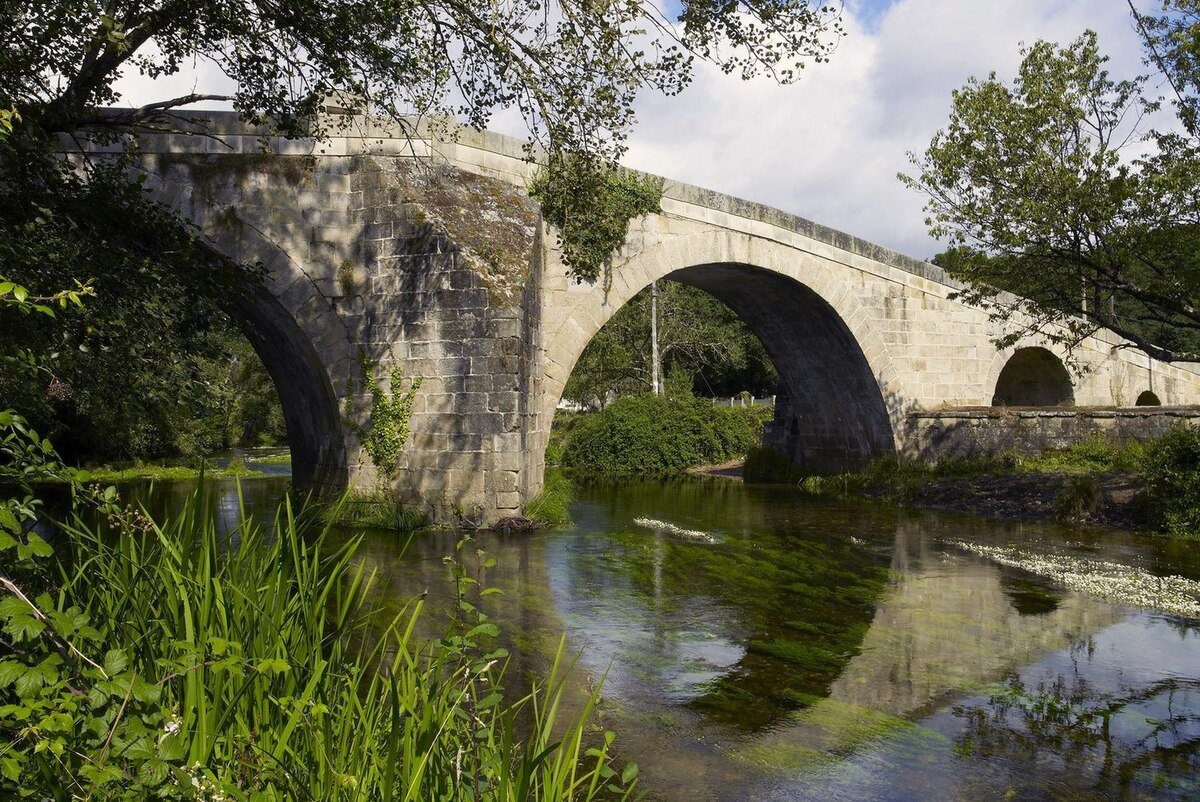
Landscape defines Triacastela more than architecture. The village lies in a valley of low mountains, with chestnut and oak trees marking the slopes. The river Oribio flows close to the settlement, adding to the rural character of the area.
From Triacastela, paths lead towards nearby villages such as Balsa, Lamas and Fontearcuda. These are ordinary rural routes without extensive signposting. It is sensible to pay attention to the way back, as mobile coverage fails in some stretches. The experience is that of open countryside rather than a structured network of marked trails.
One route often mentioned is the so-called route of the three castles. The name sounds more ambitious than the reality. No castles remain as such, only traces and a few elevated points that offer good views over the surrounding hills. The interest lies more in the perspective across the landscape than in surviving fortifications.
These walks suit those who want to extend their stop beyond the square and church. They do not present major landmarks or heavily developed visitor sites. Instead, they offer a sense of space, trees and river within a quiet valley.
Life Along the Camino
Triacastela lives from the Camino de Santiago. This long-distance pilgrimage route crosses northern Spain on its way to Santiago de Compostela, drawing walkers from across the world. The influence of the Camino is visible in the daily pace of the village.
In the morning, groups of pilgrims pass through, often pausing briefly before continuing towards Samos or towards San Xil. Triacastela sits at a point where the route divides, and that crossroads character shapes local activity. People arrive, rest for a while and then move on.
Not far away lies Castañeda, known for its old lime kilns. These kilns were linked to the construction of the cathedral of Santiago de Compostela. Today, only visible remains survive. They serve as a historical reference point for the area rather than as a developed attraction. Their presence connects this quiet valley to the larger story of the Camino and the building of the cathedral at its end.
Even with this historical background, Triacastela remains understated. The Camino gives it movement and purpose, yet the village does not transform into a major sightseeing stop. Its identity stays tied to passage and pause.
When to Come
Spring and autumn are usually the calmest times. The valley turns green and the flow of walkers decreases slightly compared with the height of summer. The atmosphere feels more open, with fewer rucksacks moving through the square.
Summer brings noticeably more activity from mid-morning onwards. Those seeking a quieter impression should arrive early in the day. As the hours pass, the number of pilgrims and vehicles increases.
A clear piece of advice applies here: do not come expecting a village packed with attractions. Triacastela makes more sense as a crossroads. You stop, walk for a while, and then continue your journey. That is the normal pattern here, shaped by the Camino, the valley and the steady rhythm of travellers passing through Galicia.