Full Article
about Castro Caldelas
Hide article Read full article
A hilltop above the valley
Castro Caldelas sits high on a rounded hill that overlooks the valley below, its outline still defined by the fortress that crowns it. This small town in the Terra de Caldelas, in the province of Ourense, has just over a thousand inhabitants. Its size is modest, but its layout is clear at first glance: streets that climb towards the castle and stone houses adjusted to a steady incline.
From here, the connection with the Ribeira Sacra becomes easier to grasp, even though the river Sil lies at some distance. The surrounding relief hints at the deep valleys that characterise that wider area of inland Galicia, shaped over centuries by the river and its tributaries.
The old quarter follows the logic of the terrain. Streets bend and adapt rather than forcing straight lines, leaning into the rock as they rise. Many houses face south towards the valley, something that becomes obvious when walking down from the fortress and noticing how façades open to the light. The stone construction, consistent throughout the historic centre, reinforces the sense that the town has grown in dialogue with its setting rather than against it.
The castle and the Plaza Mayor
The castle of Castro Caldelas was built in the 15th century under the control of the Ulloa family. Its position was strategic rather than decorative. From this height, it was possible to oversee the natural access routes into the comarca and the paths that connected with the valley of the Sil.
The structure has survived in good condition. Its walls and towers make its defensive purpose clear, more fortress than palace. From the top, the surrounding hills of the Terra de Caldelas come into view and, on clear days, part of the relief that signals the canyons of the Sil further on.
Inside, a small exhibition space usually introduces the local history. Opening hours vary depending on the season, so it is worth checking in advance.
Descending from the castle leads naturally to the Plaza Mayor. One side of the square is arcaded, providing shelter and framing what functions as the town’s meeting point. The houses around it retain carved lintels and coats of arms, reminders of the families who held influence here over the centuries. These details, easy to miss at first glance, add another layer to the story told by the stone façades.
Churches and traces of the past
Near the castle stands the church of Santa Isabel. Built in the 16th century and modified later, it presents a sober granite exterior. Baroque additions can be identified in certain decorative elements, reflecting changes made over time rather than a single architectural campaign. It is not a monumental church, yet it helps explain how the town evolved during the early modern period.
A little further away lies the church of San Xoán de Penedela, in the parish of the same name. The building has a distinctly rural character, in keeping with its surroundings. Like many small parish churches in Galicia, it is not always open.
Together, these churches underline the scale of Castro Caldelas. Religious architecture here does not overwhelm the town. Instead, it fits into the broader fabric of stone houses and narrow streets, marking stages in its development without dominating the skyline.
Paths through vineyards and chestnut groves
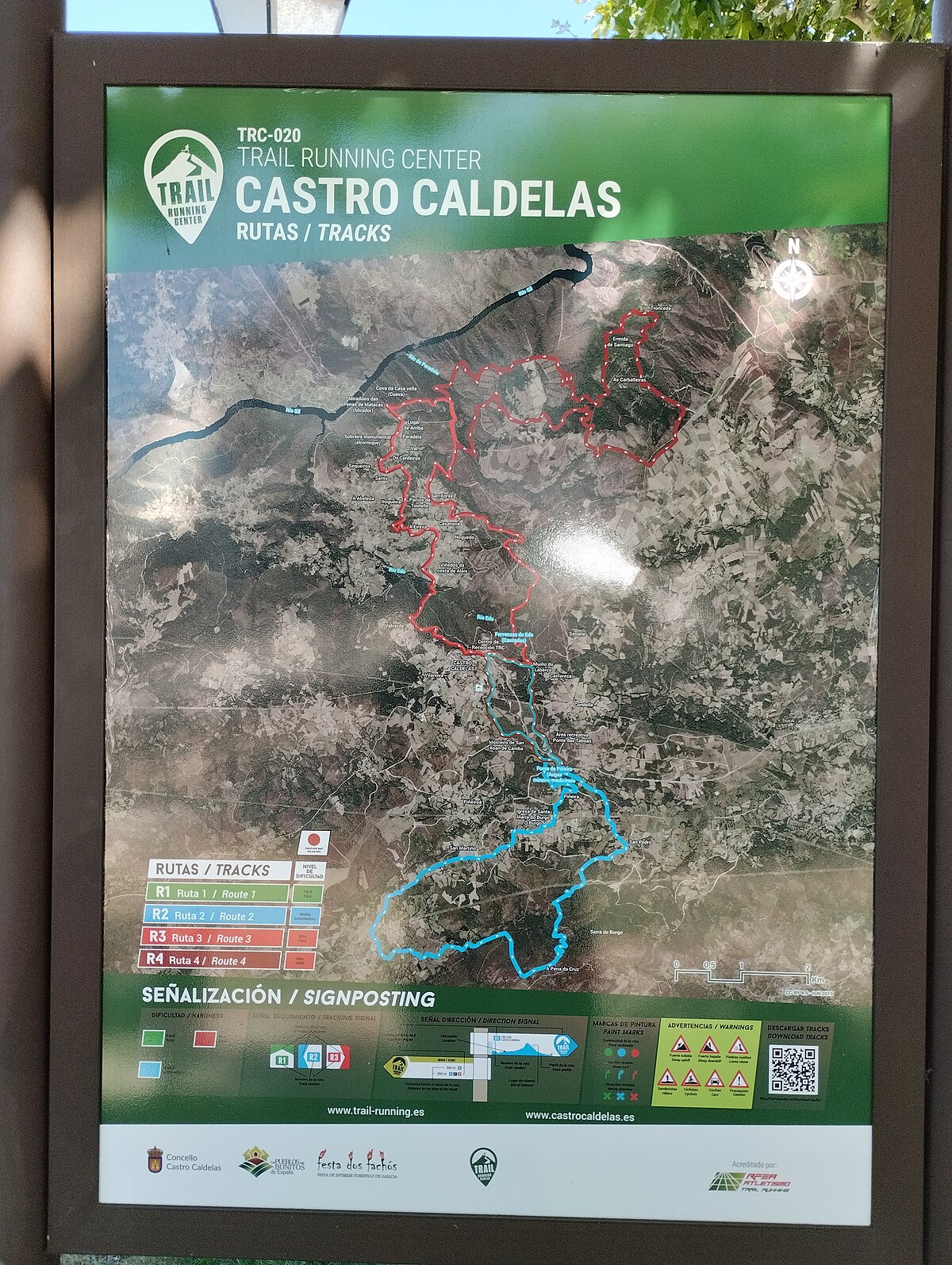
Beyond the compact centre, the immediate landscape combines terraced vineyards, chestnut groves and scrubland. Some paths begin within the town itself and climb to small elevations that offer wider views over the valley. Not all of these routes are signposted.
The agricultural character of the area remains visible. Vineyards are planted on slopes near the Sil, forming part of the Ribeira Sacra wine region, and chestnut trees occupy large swathes of land around the town.
In autumn, the surroundings change noticeably. Chestnut trees dominate the scene, and in nearby villages the smell of wood smoke is common. Winter brings different conditions. Fog can settle over the hillsides and reduce visibility for hours at a time, altering the perception of distances and softening the outlines of the terrain.
Anyone planning to explore these paths would do well to ask locally about ground conditions. After several days of rain, the soil often becomes slippery. Even within the town, the cobbled streets demand care when damp. Footwear matters more than it might seem at first.
Local produce and a brief route
The cuisine of the comarca revolves around simple, seasonal products. Chestnuts play a central role when autumn arrives, appearing in various preparations typical of inland Galicia. Wine from the Ribeira Sacra is also common, produced from vineyards planted on the steep slopes near the Sil. These are small-scale productions, closely tied to the agricultural rhythm of the area.
A short visit to Castro Caldelas can be comfortably completed in a limited amount of time. The usual route begins at the castle, then descends towards the Plaza Mayor before continuing through the streets of the old quarter. If open, the church of Santa Isabel fits naturally into the same walk.
It is worth adjusting expectations about the wider landscape. From within the town, the Ribeira Sacra can be sensed in the contours of the land and the direction of the valley. The dramatic canyons of the Sil, however, are better seen from viewpoints located some distance away, reached by car.
Castro Caldelas works well as a calm stop within the Terra de Caldelas. It is a small centre where history remains visible in stone, and where the surrounding territory opens out clearly once the climb to the castle has been made. The scale is human, the slopes constant, and the link between settlement and landscape easy to read.