Full Article
about Quintela de Leirado
Ocultar artículo Leer artículo completo
The cow has right of way. It’s written nowhere, but on the OU-540 the rule is understood: brake, wait, listen to the hooves clop past the dry-stone wall. Beyond the tarmac the land tips upward to 700 m and the valley floors are already in shadow though it’s only half past four. This is Quintela de Leirado, a scatter of hamlets that adds up to roughly 600 souls and zero traffic lights.
High ground, slow going
Altitude changes everything. Even in May the wind carries a nip that wouldn’t feel out of place on a Peak District ridge, and by November the fog pools so thick that the chestnut trees vanish one trunk at a time. The road from Ourense climbs 400 m in 25 km; add another 20 minutes if the previous night brought rain, because the bends gather tractor mud faster than the council can scrape it clear. In winter the pass is kept open, but locals still talk about February 2021 when snow pinned vehicles in the parish of San Cristovo for two days. Summer is kinder—long evenings, barley turning gold, the only hazard a loose sheepdog—but the thermometer can still drop to 8 °C after midnight, so pack a jumper even in July.
Walking tracks follow the old drove roads that linked winter and summer pastures. None are way-marked in English, yet the logic is simple: stay on the stony lane, descend when you see water, climb when you hit a chestnut hedge. A typical circuit from Vilariño de Castro to the abandoned mill and back takes 55 minutes, gains 90 m of height and passes four stone granaries on stilts—hórreos—each one padlocked against pine martens. The reward is a glass of well water so cold it makes the fillings sing.
What you’re actually looking at
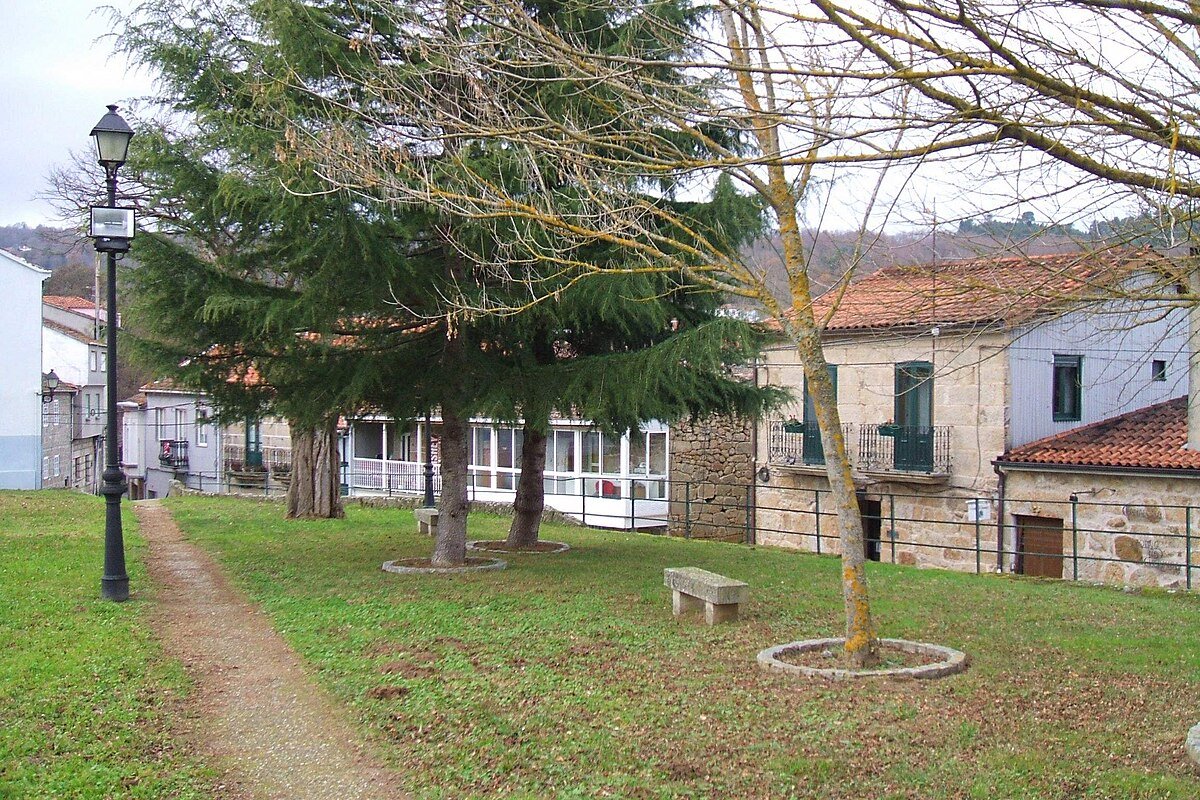
Forget postcard squares. The council has no centre, just a string of smallholdings separated by knee-high walls built from quartz and slate. The architecture is functional: a bread oven tacked onto the gable end, a stone cross (cruceiro) to bless the fields, a communal wash-house with a single cold tap. Nothing is fenced off, nothing is ticketed, and the only interpretive panel is a 1998 metal sign whose Galician text has rusted to abstraction.
The pleasure is cumulative. First you notice the hórreo vents shaped like tiny cathedral windows; then you clock that every barn door is painted the same ox-blood red to mask the soot from corn-drying fires. By the third hamlet you’re spotting maize cobs stored in old onion nets and wondering why British gardens never thought of growing kiwi vines up the pigsty wall. The churches unlock only for Sunday mass, but their porches are left open. Inside, the air smells of beeswax and last night’s incense; outside, the cemetery geraniums are watered in cut-down fizzy-drink bottles—a quiet recycling statement that puts Tesco’s plastic pledges to shame.
Eating (and drinking) like you mean it
There is one bar, A Devesa, on the verge where the OU-540 meets the road to Leirado. It opens at seven for the lorry drivers and shuts when the owner feels like it. A glass of Ribeiro wine costs €1.20, a plate of pimientos de Padrón €4, but if the fryer is already cleaned you’ll be offered cocido stew instead—take it. The nearest cash machine is 12 km away in Ramirás and the card reader fails whenever the router loses 4G, so bring coins.
For a sit-down meal, drive the 16 km to Celanova and book a table at O Quinteiro. Their caldo gallego is light enough for beginners—potato, turnip tops, a single slice of chorizo—yet it arrives in a bowl the size of a plant pot. The octopus is dispatched with scissors at the table; accept the paprika-stained potatoes and pay €14 for the privilege. Vegetarians can survive on empanada de zorza (spicy), though the pastry is glazed with egg, so vegans should ask for tetilla cheese on bread and hope the baker hasn’t run out.
When the weather turns
Rain arrives horizontally here, driven by a wind that the Romans called nabalus and locals still nickname “o aire do demo”. A morning that begins in sunshine can finish in cloudburst, so the car boot becomes a dumping ground for waterproofs, sun-hat and spare socks. Hiking boots with a decent tread are non-negotiable: farm tracks are surfaced with shale that polishes to marble under cattle hooves. In autumn the chestnut husks split and spill nuts onto the lane—beautiful, yet lethal under a damp sole.
If the day collapses entirely, divert to the monastery at Celanova. The cloister museum charges €3 and lets you dry out under 16th-century vaults while you learn how monks once traded Ribeiro wine for English wool. The Mozarabic chapel of San Miguel is barely five metres square, built in 933 AD when this region answered to the caliphate of Córdoba—proof that “remote” is a relative term.
The practical bit no one prints
Fly to Santiago de Compostela with Ryanair from Stansted or EasyJet from Gatwick; the single-terminal airport is 20 minutes faster to clear than Heathrow’s baggage hall. Pick up a hire car—pre-book, because summer queues stretch to the car park—and allow 1 h 45 min on the AP-53 and OU-540. Petrol stations south of Ourense close on Sunday afternoons; fill up before the final 40 km. There is no accommodation inside Quintela itself. Sleep at Hotel Celanova (two-star, €55 a night, Wi-Fi patchy) or upgrade to Pazo de Castrelos, a manor house with stone gargoyles and a pool that looks onto vineyards.
Public transport exists on paper: a Monday-to-Friday bus from Ourense at 14:15, returning 07:10 next day. Miss it and a taxi costs €55. Mobile coverage drops to E in the valley floor; download the map of “A Limia – A Baixa Limia” on Google Maps before you set off. Finally, cows have right of way—did we mention that?—and they refuse to hurry for anyone, British passport or not.