Full Article
about Verea
Hide article Read full article
An Unhurried Landscape
By mid-afternoon, when the sun begins to dip behind the hills of the Terra de Celanova, the air in Verea carries the scent of damp earth and wet granite. Between chestnut trees and dry-stone walls, light filters through in thin bands, revealing paths that seem to have been there for centuries. Tourism in Verea does not follow a marked route or rely on explanatory panels every few metres. Movement here is guided by observation: an old wooden door, a spring still running, a path slipping down between meadows.
This municipality in the south of the province of Ourense is spread across small villages, separated by vegetable plots, scrubland and fields enclosed by stone walls. There are no large monumental complexes or a defined historic centre to head towards. What emerges instead is quieter: parishes where daily life still revolves around the land, livestock and chestnut trees.
Stone Churches and Rural Architecture
Exploring Verea at a slow pace means moving from parish to parish, Berredo, Queguas, Traspielas, either by car or on foot in short stretches. The rural churches sometimes preserve elements of Romanesque origin or older pieces reused in later renovations.
In Berredo, for instance, the church holds onto details of carefully worked stone with a restraint that fits the surroundings. There are no grand entrances or elaborate sculptures. Instead, simple capitals, thick walls and a bell tower that rises just enough to be seen from nearby fields.
Nearby, cruceiros, traditional Galician stone crosses, often appear, along with smaller crosses worn down by time. Some lean slightly, others are covered in grey and yellow lichen. They feel less like monuments and more like markers within the landscape.
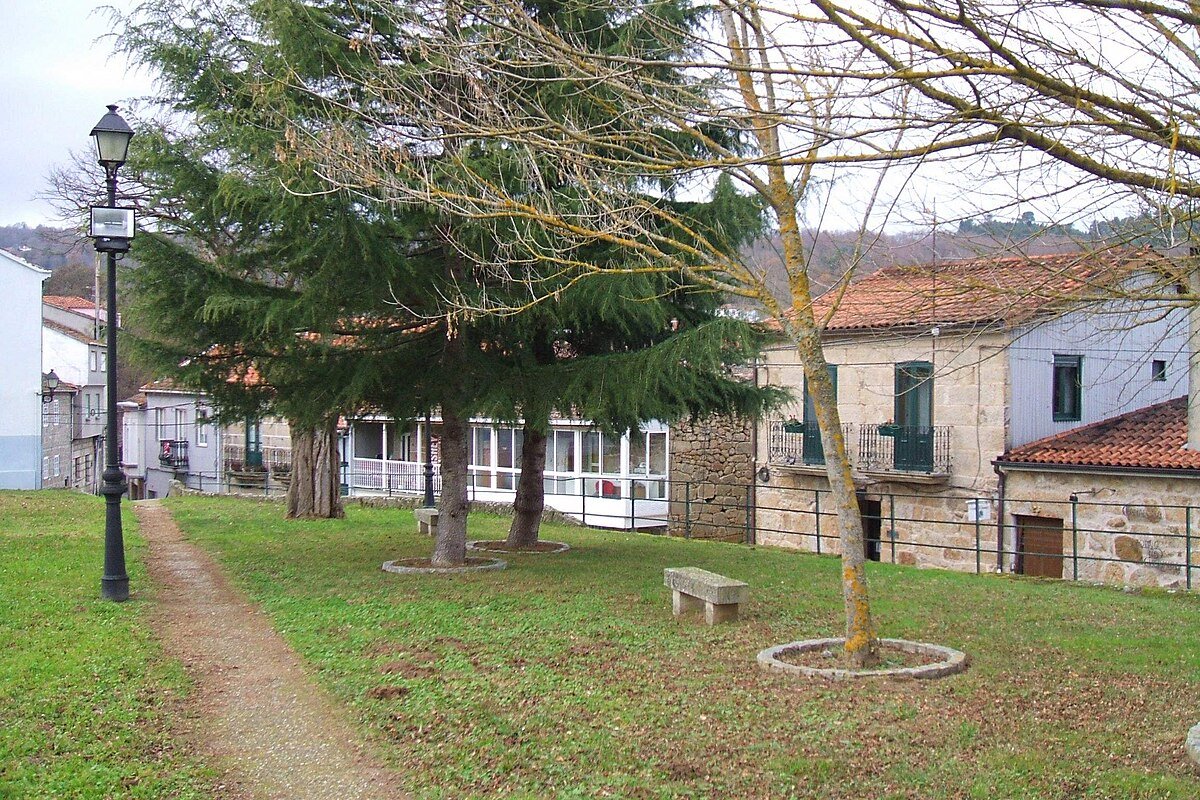
The houses follow the same practical logic: solid granite walls, small windows designed to retain warmth and roofs of dark slate. In many courtyards, hórreos can still be seen, raised granaries set on pillars to keep stored grain dry in a climate where moisture is never far away.
Paths That Link the Villages
There is no single promenade or main walk in Verea. The best way to understand the area is to follow a corredoira, a traditional sunken path running between stone walls that connects fields and villages.
Between Vilar de Paio and Lamoso, for example, you come across fountains with spouts of cold water that run throughout the year. Beside them are often stone washing places where someone may still be rinsing clothes or filling buckets. The sound of water striking the basin is constant, and when the wind moves through the chestnut trees, it blends with the dry rustle of fallen leaves.
These rural paths link one village to another with very little signage. Many sections are made of earth or loose stone, so it makes sense to walk slowly and wear shoes with good grip, especially after several days of rain.
The seasons shift the experience noticeably. In spring, the edges of the paths fill with tall grass and wildflowers. In autumn, chestnut trees leave the ground covered with split husks and brown leaves that crackle underfoot.
A Simple Way to Spend the Day
Time in Verea tends to follow a simple rhythm. The usual approach is to park in one of the villages and walk for a while without a fixed plan. Within minutes, enclosed vegetable plots appear behind uneven stone walls, along with small meadows where chickens wander freely and wooden balconies that still support the galleries of some houses.
If a church happens to be open, which depends very much on the day, it is worth stepping inside briefly. Interiors are often dim, with the smell of wax and fairly understated altarpieces. What stands out most is the quiet.
It is also worth noticing the small open spaces in front of many churches: a fountain, a stone bench, two or three houses gathered around. These are still places where people come together in the late afternoon.
Common Missteps
One of the most frequent mistakes is trying to locate a single “centre” of the municipality. Verea works differently. The area is divided into many small villages, and its interest lies precisely in that scattered pattern.
Another is driving down any track without thinking about how to get back out. Some are narrow and do not always leave much room to turn around easily. It can be more practical to leave the car at the entrance to a village and continue on foot for a few minutes.
After several days of rain, dirt paths can become quite slippery. Simple walking boots make a noticeable difference.
When to Go
Spring and autumn are usually the most rewarding times to walk around Verea. The light softens as it passes through the trees, and the landscape shifts in colour.
In summer, the heat can build up in more open areas around midday, although early mornings remain calm. In winter, low fog often settles over the valleys. On some days, the surrounding hills barely appear, and everything is wrapped in a quiet grey.
Rain is never unusual here. When it comes, paths quickly fill with puddles and mud, becoming part of the experience rather than an interruption.