Full Article
about Ribeira de Piquín
Hide article Read full article
When the GPS gives up
You know you're getting somewhere when your phone's map app just sort of sighs and shows a blank patch. That's the general area of Ribeira de Piquín. You follow the road signs to Chao de Pousadoiro, which is listed as the capital. It's basically a junction with a town hall and a couple of buildings. That should tell you what kind of place this is.
Ribeira de Piquín is one of those Galician mountain municipalities where people are counted in the hundreds but spread out over kilometres. Five hundred and something souls, scattered. A house here, a barn there, a small cluster of roofs down in the valley. You drive for stretches and see more cows than cars.
It recalibrates your sense of quiet. The first night, the silence feels heavy, like something you could bump into. By the second, it just feels like silence.
Everything is slate and wet green. The rain comes often, leaving the roofs shining. There are beech woods and oak groves around the meadows. Nothing is staged for you. It's just life happening: an old car piled with firewood puttering past, smoke from a chimney in the evening.
A memento mori over the door
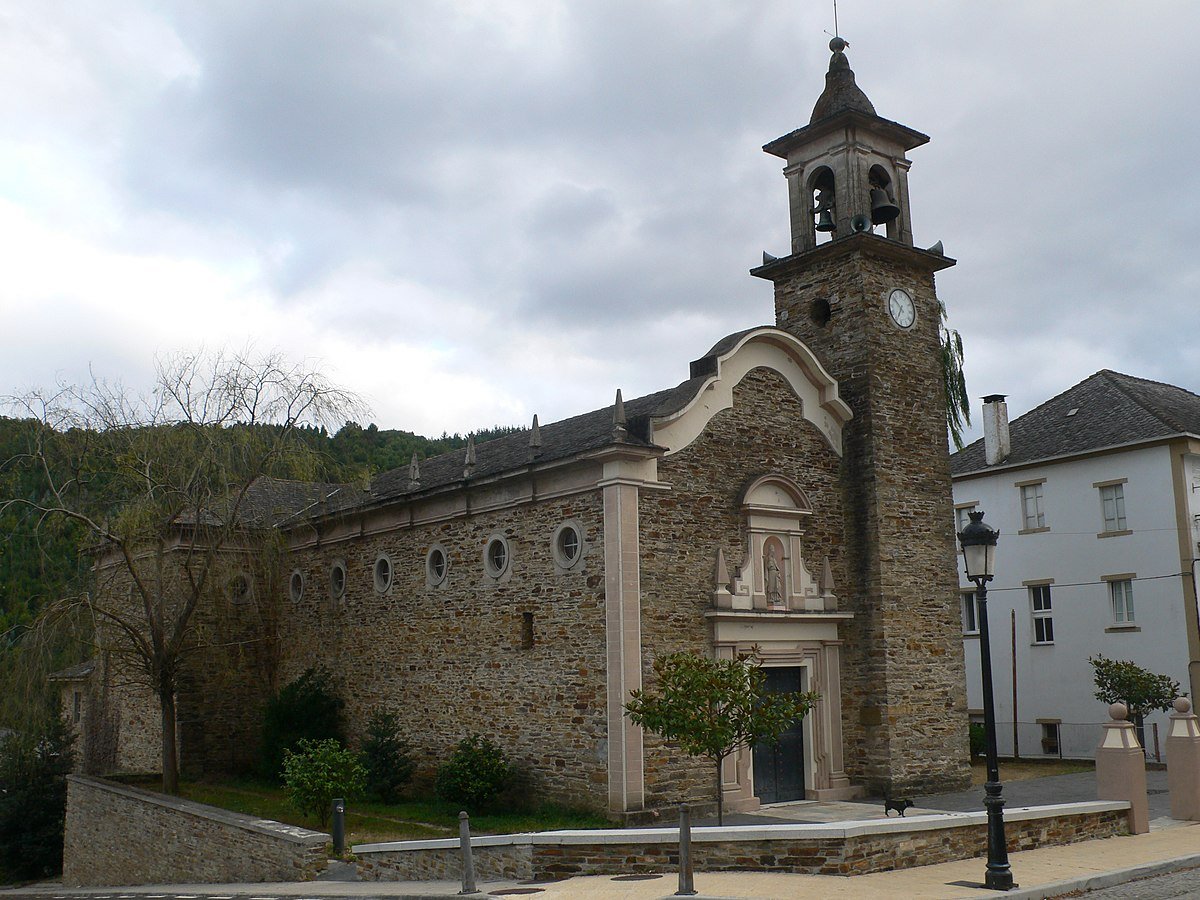
The church of San Xoán de Baos doesn't look like much from the road. Stone walls, a simple porch. Look up as you go in, though. Carved right into the archway are several human skulls.
They're medieval, from what people say around here. The local explanation isn't some complex legend. It was just a blunt reminder for folks coming to mass that time passes quickly. No mystery, just stone-cut fact.
Over in Vilarpescozo, they point out a house where Juan Antonio Lombardero was born. An 18th-century clockmaker from these hills who figured out how to make church bells ring the hour by themselves. That's the story they tell, anyway.
These aren't major attractions. They're more like quiet footnotes you stumble across if you're paying attention.
The river sets the pace
If you do anything here, it should involve walking alongside or above the River Eo. It's the spine of the place.
The most popular route goes to Fervenza dos Portelos. You walk through damp, mossy woodland until you hear it before you see it. The waterfall drops into a pool so cold it makes your teeth ache if you even think about swimming.
For a wider view, take the path up towards Pena de Millares. It winds through oaks and open hillside until the whole Eo valley unfolds below you, the river a thin green line far down.
Or just keep it simple and follow an old track by the water to an abandoned mill. The grinding stone is still there, covered in lichen. It’s one of those places that shows how daily life here used to turn on water and grain.
Honestly, sometimes the best plan is no plan at all. Just pick a path by the Eo and walk until you feel like turning back. The sound of water is your constant companion.
Walking here isn't about conquering a trail or bagging a summit photo. It's about settling into a slower rhythm where noticing things—the way light hits wet ferns, the call of a bird you don't recognise—becomes the main event.
Smoke season
Come in autumn and you'll smell woodsmoke everywhere. This is magosto time, when people gather around fires to roast chestnuts and share chorizo and wine from last year's harvest.
The food follows what's nearby and in season. The cheese is usually cow's milk, straightforward and mild. You'll see filloas on menus; they're like thin pancakes, often served with coffee as something sweet after a meal. It’s not uncommon to get talking to someone who’s just picked vegetables from their garden. Don't be surprised if they hand you a couple of potatoes or some berzas greens before you part ways. It’s that kind of place. Nothing is performed. You eat what the land is doing right now.
Letting go of the clock
Trying to "do" Ribeira de Piquín in three hours misses the point entirely. Sure, you can see the skulls at San Xoán, walk to Portelos waterfall, and drive through the main hamlets in an afternoon. But the feeling of the place won't sink in. This area works on you slowly. Walk, stop, stare at a stream, drive five minutes, do it again. Wear proper shoes. Accept that your phone will be useless in half the valleys. That’s part of it. Ribeira de Piquín doesn't offer excitement or charm. It offers room to breathe, and the steady, unhurried sound of water moving through stone