Full Article
about Melide
Ocultar artículo Leer artículo completo
The moment the Camino Primitivo merges with the Camino Francés, rucksacks stack three-deep outside Bar Rosendo and the air fills with the smell of paprika and olive oil. This is Melide at midday: a market town that suddenly discovers it has two high streets instead of one, both of them hungry. Pilgrims who have walked alone for days find themselves queuing for lunch behind German students, Korean retirees and the local dentist catching up on gossip. Nobody simply passes through; the octopus won’t let them.
A Town That Predates the Backpack
Forget the hiking poles for a minute. Long before Melide became the official halfway snack stop on the French Route, it was a medieval crossroads where salt cod, linen and silver changed hands under the arcades of Praza do Convento. Those same granite columns now shelter café tables and the occasional dripping rucksack, but the commercial instinct hasn’t changed. Thursday is still market day: the narrow main street turns into a slow-moving scrum of vegetable crates, wellington boots and carrier bags recalling every UK supermarket logo. If you arrive by car, ditch it on the ring road; the one-way system was designed by someone who clearly enjoyed mazes.
Start instead at the fourteenth-century Cruceiro do Hospital, directly opposite the chapel of San Roque. Guidebooks call it a wayside cross; up close it’s a comic-strip stone Bible, every station of the passion carved small enough to fit a pilgrim’s palm. The sculpture faces two directions – front for sinners approaching town, rear for those hurrying away – and both sets of expressions are surprisingly frank. Five minutes here teaches more medieval body language than a week of museums.
Churches, Bridges and the Pleasure of Closed Doors
A two-minute shuffle along the arcades brings you to the church of San Pedro, rebuilt so often that the tower wears Romanesque trousers beneath a Baroque hat. The interior is refreshingly plain: no gold leaf, just thick walls that smell of damp stone and candle smoke. Keep going to the Iglesia de Sancti Spiritus, founded in 1340 as part of a pilgrims’ hostel. The Gothic doorway is usually open until 13:00; inside, worn tomb slabs tilt like faulty floorboards and swallows nest in the rib-vaulting. If the door is locked, don’t despair – the keyholder lives opposite, expects visitors, and will wander over still wiping lunch from his chin.
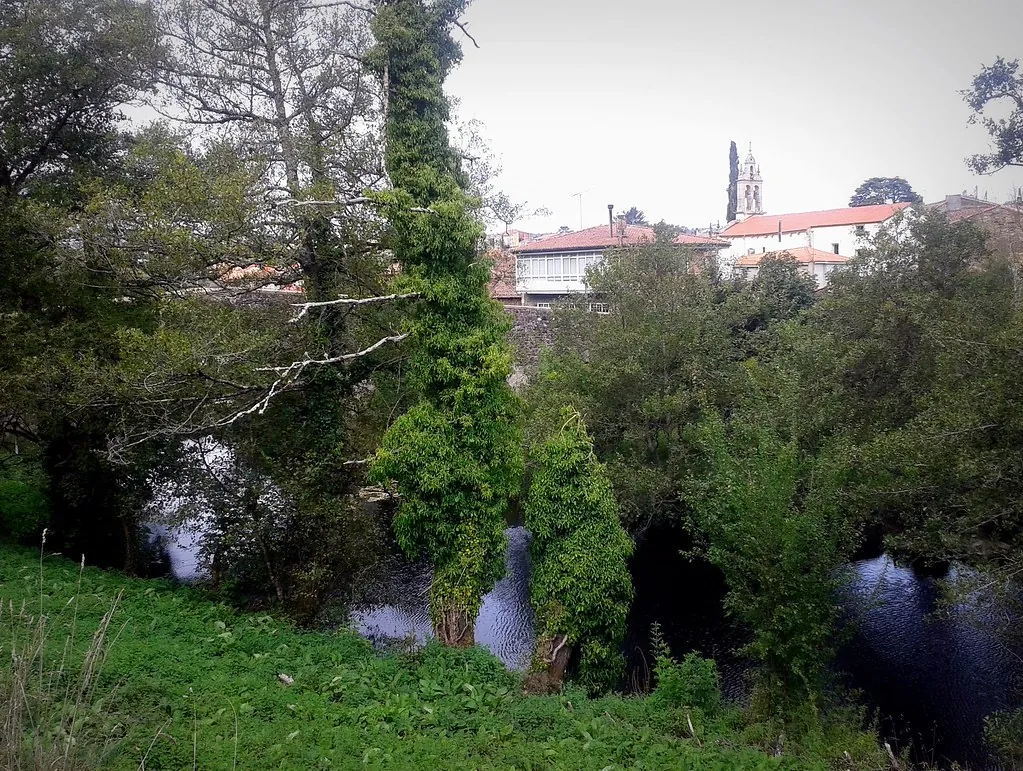
Better still, walk the extra kilometre to the medieval bridge at Furelos. Most hikers march straight across, eyes fixed on Santiago, yet the view downstream is the sort that ends up on postcards if the sun behaves. The river pools under the arch just deep enough for a summer swim; a small noticeboard updates bathers on water quality, and after heavy Galician rain the red “no bañar” sign appears as reliably as umbrellas in Newcastle.
Lunch Is Not a Shortcut
You can’t leave without trying pulpo á feira. Purists head to Pulpería a Garnacha, where the octopus arrives in plastic buckets at 09:00 and is simmered outdoors in copper cauldrons big enough to bath a toddler. Order “un plato para compartir” (about €12) and watch the cook snip tentacles with shears, flick on smoked paprika and pour olive oil from a height that would worry health-and-safety. The texture surprises first-timers – closer to roast chicken than calamari – and the accompanying cachelos (boiled potatoes) mop up the scarlet oil like edible kitchen roll. Locals drink Ribeiro white from porcelain bowls; the flavour is sharp enough to make English Sauvignon taste flabby.
If tentacles remain a psychological hurdle, the bakery on Rúa de San Pedro sells empanada gallega by the slice. The tuna-and-pepper version resembles a Cornish pasty that’s been on a sun holiday: flakier pastry, milder seasoning, no swede in sight. Finish with melindres, small doughnuts that taste of lemon zest and Saturday childhoods. They cost 30 cents each; resistance is futile.
When the Crowds Go Home
Between 15:00 and 18:00 Melide exhales. The day-trippers board coaches, shopkeepers pull metal shutters halfway down and the town remembers it only has 7,500 residents. Use the lull for the Museo da Terra, one floor up from the tourist office. The collection is provincial in the best sense: stone tools from local hillforts, a Victorian loom still threaded, black-and-white film of women washing clothes in the Furelos. Labels are in Galician and Spanish, but the caretaker enjoys testing his English and will follow you round pointing out prehistoric earrings that look suspiciously like modern scaffolding clamps.
Outside again, pick up the Ruta dos Muíños, a 4 km loop that follows a stream past six derelict watermills. The path starts behind the football pitch; after rain it becomes a mud slide worthy of Glastonbury, so borrow a stick from the hedge if you didn’t bring poles. The mills themselves are slowly being swallowed by brambles and ivy, but one still contains its grindstone, split clean in half like a biscuit. You’ll meet more dogs than people, and the only soundtrack is running water and the occasional cowbell.
Practical Notes for the Time-Pressed
The municipal albergue fills by mid-afternoon in summer; bottom bunks go first, so arrive before 14:00 or prepare for the top deck. Private hostels charge €12–15 and include a disposable sheet set that feels like hospital bedding. Need clean clothes? The public launderet behind San Pedro takes €1 coins only and locks its doors at 20:00 on the dot – no exceptions, even if you’ve just spent ten minutes deciphering the Spanish instructions.
Free Wi-Fi exists on Praza do Convento but vanishes at the first corner; UK mobiles drift between 3G and “no service” thanks to granite walls and Galician weather. Download offline maps while you still have signal in Arzúa. If you’re driving, avoid the underground car park under the new health centre; height clearance is 1.90 m and the ramps shave roof boxes for sport. Street parking on the ring road is free and safe, though Saturday night bagpipe rehearsals may continue past midnight.
Last Orders
Stay for the evening if you can. When the streetlights come on, octopus-scented steam hangs under the arcades and every bar seems to have acquired a piper. The music is less Celtic mist, more village wedding: reedy, cheerful, impossible to ignore. By 22:00 the square fills with families pushing prams and pilgrims reluctant to book tomorrow’s bed, all of them arguing over which pulpería invented the recipe. Close the night with a queimada – Galician coffee laced with orujo and lemon peel – and remember that Santiago is still 55 km away. One more plate of tentacles won’t delay you that much.