Full Article
about Sobrado
Ocultar artículo Leer artículo completo
The baroque towers of Sobrado Abbey appear long before you reach the village, rising suddenly from a landscape of cow pastures and eucalyptus. First-time drivers often brake instinctively, wondering how such an extravagant pile of stone ended up beside a petrol station on the N-547. That visual mismatch sets the tone for a place that is neither picture-postcard nor forgettable, but something more interesting: a working monastery that happens to share a postcode with a garage, two bars and a Día supermarket.
The Abbey That Ate the Map
The Cistercian monks arrived in the twelfth century and never really left. Their abbey—rebuilt in sweeping eighteenth-century style—still governs daily rhythms. Gates open at seven for Mass; by one o’clock the church is locked again while the brothers eat. Afternoon visiting starts at half-past four, but only if you arrive punctually for the €5 guided tour (cash only, exact change welcome). Turn up at five and you’ll find the gift-shop door bolted, with nothing to do except photograph the façade and wonder why the Lonely Planet sounded so enthusiastic.
Inside, the contrast is immediate: gilt altarpieces gleam under bare electric bulbs, while the cloister smells of damp stone and incense. A lay guide ushers visitors through the monks’ chapter house, still scorched from a 1950s chimney fire, then into the kitchen where a single nineteenth-century coal range fed three hundred brothers during the abbey’s temporary stint as a seminary. You emerge an hour later blinking at the traffic, half-expecting a robed figure to stride across the forecourt. Instead, a lorry driver is hosing diesel off his wheels beside the BP pumps.
A Municipality Without a Middle
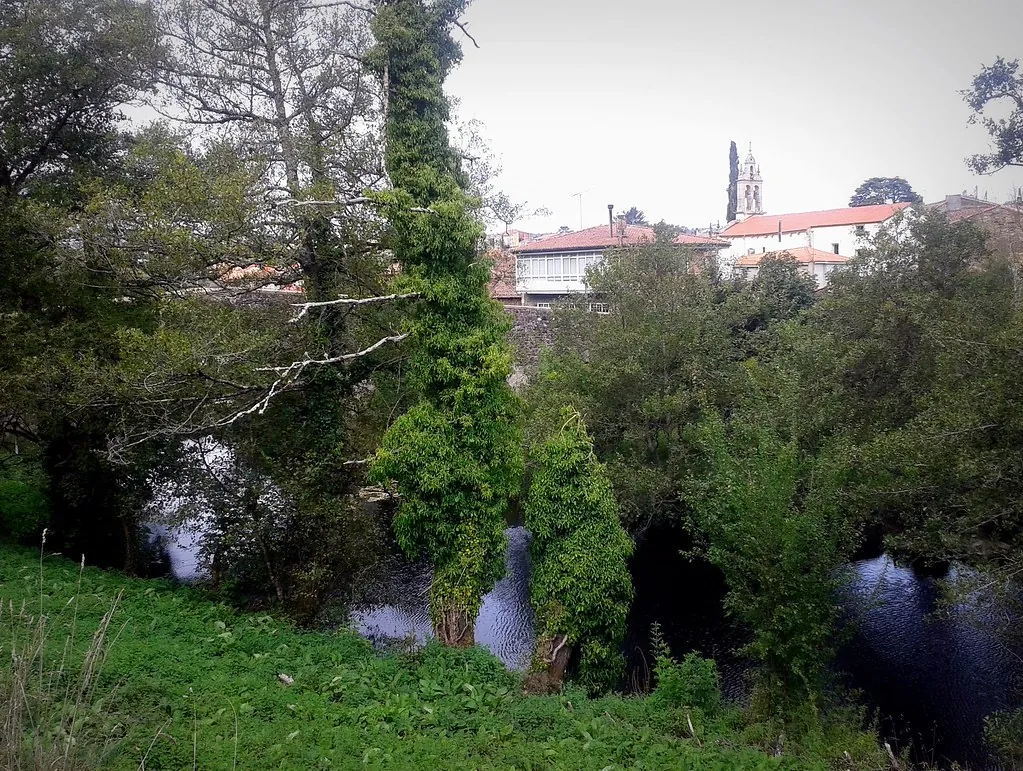
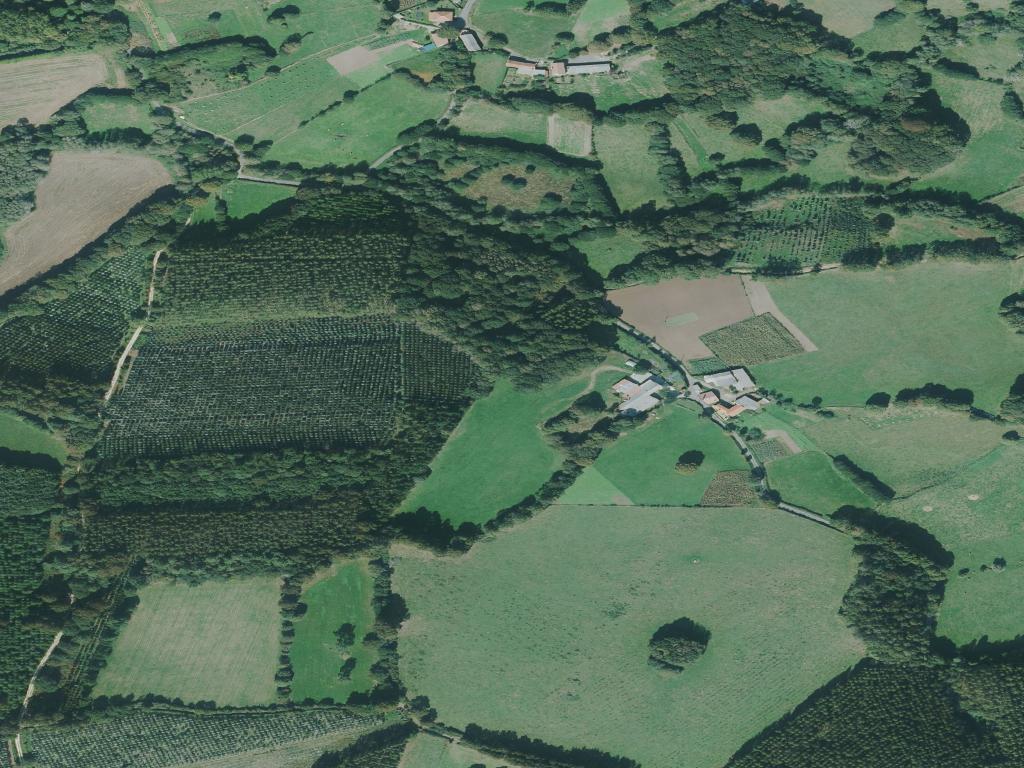
Administratively, Sobrado is a scatter of hamlets stretching over forty square kilometres. Geographically, it’s a bowl of green grazings ringed by low, oak-covered ridges. Neither description helps the casual visitor. The council has installed a modern albergue for Camino Inglés pilgrims, but the village centre—if the junction by the garage qualifies—can be walked in five minutes. Houses face the road, not each other; there’s no plaza with plane trees and a café terrace. What you get instead is a sequence of roadside clues: a stone granary balanced on stilts, a wayside cross smothered in lichen, a woman in overalls hosing down her dairy parlour at dusk.
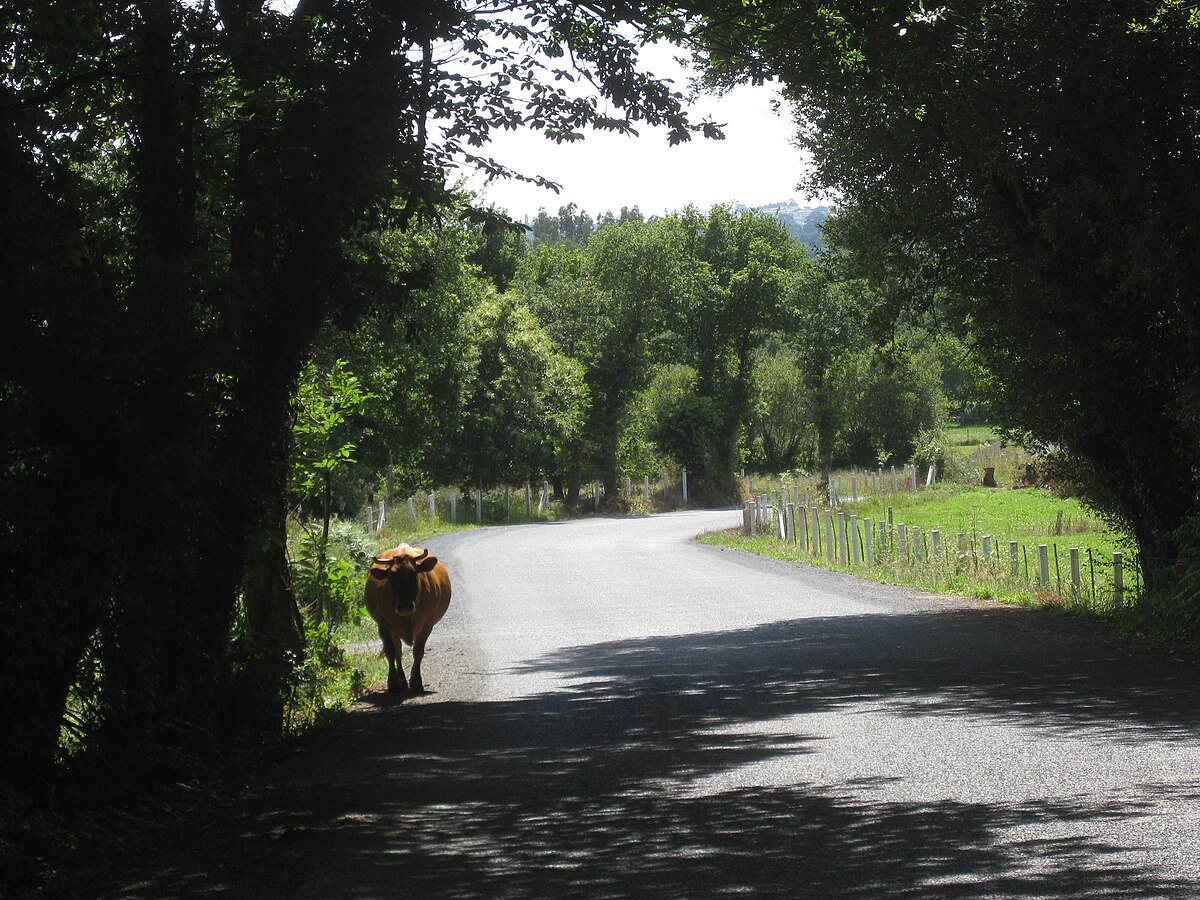
To understand the place you have to drive, or at least cycle, the minor lanes that peel off the main road. Three kilometres north, the hamlet of A Gouxa keeps a medieval dovecote intact, its conical roof repaired with corrugated iron. Southwards, a farm track leads to the abandoned village of Foxo, where brambles swallow collapsed slate roofs and a stone font still holds rainwater—baptismal leftovers from a chapel that vanished centuries ago. These fragments aren’t curated; they’re simply still there, provided you’re willing to look.
Eating (and Not Eating)
Food choices mirror the population curve: slim. The Día supermarket shuts for siesta at two, reopening at five just as the monastery locks up for the night. Stock up before lunch or you’ll be surviving on monastery cheese and the packet of almonds you meant to save for the Camino. Bar O Abrigo, on the roundabout, serves the only evening menu. Pulpo arrives Thursdays to Sundays, simmered in copper cauldrons and dusted with pimentón—tender enough to convert declared octopus-haters. House wine is Mencía, lighter than Rioja and easier on the head if you’re walking next day. Order before nine; the cook goes home at half-past, regardless of how many tables are still chewing.
Pilgrims with tighter budgets buy the abbey’s Trappist cheese, a firm cows-milk round that travels well and smells faintly of barn. Pair it with the monks’ dark honey, sold in unlabelled jars that leak slightly in a rucksack. The combination tastes of heather and wet slate, a flavour you’ll either hoard or swap in the next albergue for a packet of British digestive biscuits.
When to Come, When to Skip
April–May turns the surrounding meadows into a paint-chart of greens: new grass, fresh oak, the yellow-green of young gorse. Showers sweep through on Atlantic fronts, but the monastery porch gives adequate shelter while you wait for the church to reopen. September repeats the colour palette with gold instead of green; mornings smell of cut hay and fermenting chestnuts. Both seasons suit gentle hiking—old drove roads link the hamlets without climbing higher than 400 m, so you’re unlikely to meet anyone except a farmer on a quad bike checking his calves.
Summer brings heat and tour buses. Coaches disgorge cruise-ship passengers doing “rural Galicia” between Santiago and the coast; the abbey’s gift shop runs out of chilled lemonade by eleven. August 15 is the patronal fiesta: brass bands, bumper cars, and a procession where the statue of the Virgin is carried through a cloud of diesel from the funfair generators. Authentic, yes; peaceful, no.
Winter is honest rain. The monastery stays open, but lanes turn to chocolate pudding and the albergue heating rattles like a cement mixer. Come prepared with waterproof boots and a tolerance for dripstone silence. On the plus side, you’ll have the cloister to yourself, and the monks’ Gregorian chant carries clearly through bare stone when only six people occupy the nave.
The Practical Bit, All in One Place
Cash: nearest ATM is eighteen kilometres back in Arzúa—fill your wallet before you arrive.
Beds: public albergue (€8) fills by early afternoon May–September; private Albergue Camino Real usually has space until four.
Timetable: abbey tour starts at 16:00 sharp; church alone opens 07:00–13:00 and 16:30–20:00.
Transport: three daily Monbus services from Santiago (50 min), but the last bus leaves at 19:00—miss it and you’re sleeping whether you planned to or not.
Leaving Without a Postcard
Sobrado refuses to deliver the tidy rural fantasy many travellers carry. There is no quaint main square, no artisan ice-cream parlour, no hilltop viewpoint with a wrought-iron bench. What it does offer is the shock of a baroque abbey beside a petrol forecourt, the quiet clank of milk tanks at dawn, and the realisation that Galician country life continues whether or not you stop to photograph it. Drive away and the towers shrink in the rear-view mirror, looking suddenly fragile against a sky full of weather. You may not have fallen in love, but you’ll remember the place longer than any chocolate-box village you ticked off on the way.