Full Article
about Santa Comba
Ocultar artículo Leer artículo completo
The morning market spreads across Praza do Concello like a living ledger of the week’s needs: sacks of grelos, wedges of cows-milk cheese wrapped in cloth, and a stall that sells both mobile-phone cases and home-grown eggs. Nobody is posing for photographs. By 11 a.m. the bars have filled with men in overalls discussing tractor parts over short black coffees that cost €1.10. This is Santa Comba, an inland service town of 5,000 souls where tourism is tolerated but never choreographed.
A Town That Refuses to Be a Postcard
Guidebooks sometimes call Santa Comba a “gateway to the Xallas valley”, yet the phrase makes it sound ornamental. The place works: it has a courthouse, a branch of Gadis supermarket, and a driving-school car that clutches the hill outside the health centre every afternoon. The architecture is stone plus concrete, old plus 1970s, tidy plus still-being-finished. Expect no gingerbread arcades; expect instead a functioning high street where granite houses have plastic roller shutters half-way down their ground-floor windows because the shop inside once changed shape.
What saves the town from dullness is movement. Farmers drive in from the surrounding parishes—Ribeira, Pousada, Rocha—park their pickups on the sloping plaza, and unload sacks of feed while exchanging gossip in Galician so fast it sounds like rain on a tin roof. If you stand still for five minutes you will be offered directions, usually by someone who begins with “Mira, se queres…” and ends by drawing a map on the back of a receipt.
Leave the Centre, Find the Place
The parish church of Santa Columba stands at the top of the hill, its Romanesque belly swallowed by later additions. Inside, the air smells of candle wax and floor polish; outside, a 19th-century stone cross shows apostles whose noses have been rubbed smooth by curious fingers. You can see both in twenty minutes, and if that is all you see you will leave disappointed.
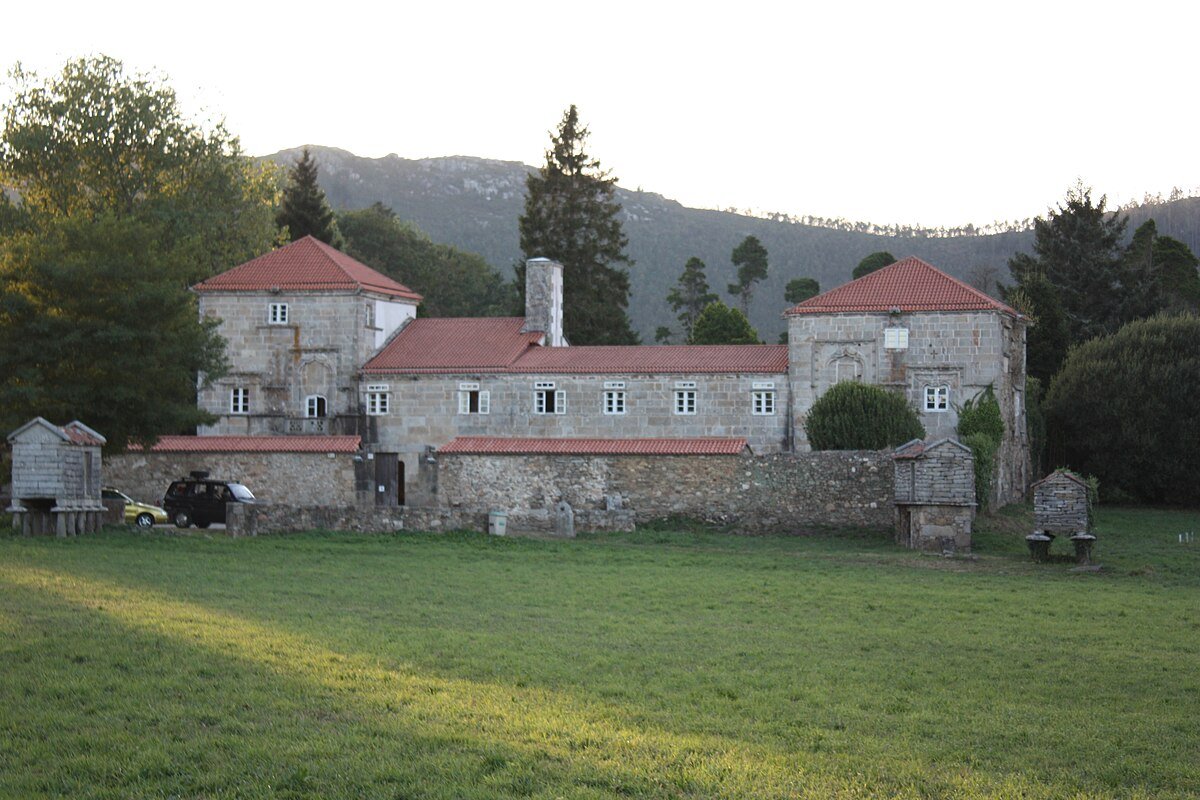
The trick is to treat the town as a hub, not a destination. Within ten minutes’ drive the lanes narrow, eucalyptus gives way to oak, and every second bend reveals a stone granary on stilts—hórreo—its length measured in “covas”, the number of pairs of oxen that could stand underneath. Stop at the hamlet of Sete Pías: a tiny chapel, a communal wash-house fed by a spring, and an elderly woman who will insist you take three cucumbers from her garden because “they’re only going to seed”.
The Xallas river, the only river in Europe that empties into the sea via a waterfall (the famous Fervenza do Ezaro is 25 km west), slides lazily here. A five-minute stroll on an unofficial path south of the N-550 brings you to a bend where kingfishers flash orange and blue. There is no car park, no ticket booth, just a wooden bench placed by someone who obviously understood the value of sitting still.
When the Land Tips Upwards
Santa Comba sits at 260 m above sea level, high enough for Atlantic weather to collide with mountain air. In April gorse flames yellow on the ridges while mist pools in the valley bottoms; October smells of damp bark and wood smoke. Winter can bring sudden frosts that blacken the potato fields, and when the wind swings north-east the temperature drops five degrees in an hour. If you plan to walk, pack a fleece even in July.
The terrain is gentle by Alpine standards but sneaky: a lane that looks flat can deliver a 10 % kick for 400 m, enough to turn casual cyclists the colour of supermarket chorizo. Mountain-bike tyres cope; road bikes don’t. The council has painted zero way-marks, so download the free Galician-government 1:25,000 map layer before you set out. A rewarding half-day loop starts at the church in Ribeira, climbs through pine, then drops to the river at A Carba where an abandoned water-mill still has its grindstone in situ. Total distance: 12 km; total cafés en route: none—bring a banana and humility.
Eating Without the Coast Mark-Up
Forget seafood platters: inland Galicia does greens, pork and chestnuts. In November every bar suddenly advertises “magosto” on a blackboard: roast chestnuts, slabs of cured pancetta, and young red wine poured from a cask that sits on the counter like a fat, contented cat. The set-price menú del día (weekdays €11–€13) starts with caldo gallego, a broth thick with potato, turnip tops and white beans, then moves to pork shoulder roasted until the rind shatters. Vegetarians get tortilla, eggs scrambled with grelos, and the resigned sympathy of the waiter.
The Saturday-morning market sells fruit you have probably never cooked with: tiny acidic apples called “peros” and berzas, cabbages so dark they look navy. If you are self-catering, the Supermercado Día on Rúa Alcalde Xosé Eiroa stocks local tetilla cheese for €9 a kilo—half the airport price—and will vacuum-pack it for the flight home.
Getting There, Staying There
Santiago de Compostela airport (SCQ) is 62 km east, A Coruña (LCG) 58 km north-east. Ryanair flies Stansted–Santiago daily in summer; otherwise connect via Madrid. Hire cars live in the terminal; reserve automatics early because the fleet is mostly manual. The last 20 km to Santa Comba twist through hamlets where the national speed limit feels theoretical—expect to brake for stray dogs and tractors backing out of barns.
Accommodation is thin. The functional Hotel Santa Comba has 18 rooms opposite the bus station, doubles €55–€65, Wi-Fi patchy on the third floor. For something quieter, drive 20 minutes to Casa Rural Outeiro de Cerdeira, a converted stone farmhouse with wood-burning stove and views across fields where horses wear bells that chime in B-flat. Budget travellers sometimes stay in Santiago or A Coruña and day-trip; the drive is doable but petrol costs soon erase the hotel saving.
The Honest Verdict
Come here if you want to watch Galicia being itself rather than performing itself. The reward is conversations in bars, sudden views of oak woods, and the smell of eucalyptus after rain. The trade-off is zero Instagram moments: no Michelin stars, no sunset kayak tours, no white-washed hill-top perfection. On grey February afternoons the town can feel like the set of a film that never started shooting. Return in May, when the gorse is luminous and the air tastes of cut grass, and the same streets feel quietly alive.
Leave the checklist mentality at home. Pick a parish road, walk until your shoes are dusty, then sit on a wall and listen to the river. Somewhere a cockerel will crow, a tractor will cough into life, and you will understand why the locals smile politely when visitors ask, “But what is there to see?”