Full Article
about Vimianzo
Hide article Read full article
The castle of Vimianzo defines the centre of the town in a very literal way. It does not sit on top of a hill or watch over a distant valley. Instead, it appears suddenly between houses, just a few steps from the main square. The fortress began to take shape in the Middle Ages, when this part of the Terra de Soneira lay on the natural route between the coast at Camariñas and the inland road leading towards Santiago.
For centuries it functioned as a point of territorial control. Today it still sets the pace of local life, physically and symbolically at the heart of the town.
The Castle and the Irmandiño Memory
In the mid fifteenth century the Irmandiño revolts shook much of Galicia. These uprisings were directed against feudal lords, and many fortresses were attacked or destroyed. Vimianzo was one of the places where the stronghold ended up in the hands of the rebels. The current castle carries that memory of conflict, which runs through the history of the wider comarca.
The building visible today combines different periods. The medieval structure remained, but at the end of the nineteenth century the complex was remodelled by Evaristo Martelo Paumán. He was an owner linked to American emigration who wanted to turn the fortress into a residence. That intervention explains why the castle feels partly like an inhabited palace as well as a defensive structure.
Inside, some rooms are used to present traditional trades. One of the best known is bobbin lace, or encaje de bolillos, closely associated with this stretch of coast between Vimianzo and Camariñas. Rather than a staged performance, it is sometimes simply people working as they have done here for generations. The link between craft and daily life remains visible.
Megaliths in the Open Hills
The municipality of Vimianzo contains several of the best known dolmens on the Costa da Morte. Most stand in open hills covered with heather, pines and eucalyptus, and they are not always marked by large information panels. Reaching them often means stepping into a landscape that feels largely unchanged.
One of the most visited is Pedra da Arca, a few kilometres from the town centre. It is a well preserved megalithic chamber formed by large upright slabs with a capstone that still rests in place. As with many prehistoric monuments in Galicia, the original mound has almost disappeared. What remains visible is the stone structure itself.
At dusk, as the light drops over the hillside, the relationship between these sites and their surroundings becomes clear. They are not isolated relics set apart from everything else. They form part of the relief and sit naturally within it.
Water and Mills in the Town Centre
Water powered much of the local economy for centuries. Documents from the eighteenth century already mention several mills operating in the area.
One survives within the urban centre itself, beside a small watercourse that runs through the town. It is a hydraulic mill restored some years ago and, on certain occasions, it is set in motion again to demonstrate how grain was ground. When it operates, the sound of the turning stone and the smell of freshly milled flour fill the space.
It does not feel like a sealed museum installation. It resembles what it always was: a village mill tied to everyday needs and rhythms.
The Valley of Ozón and Its Hórreo
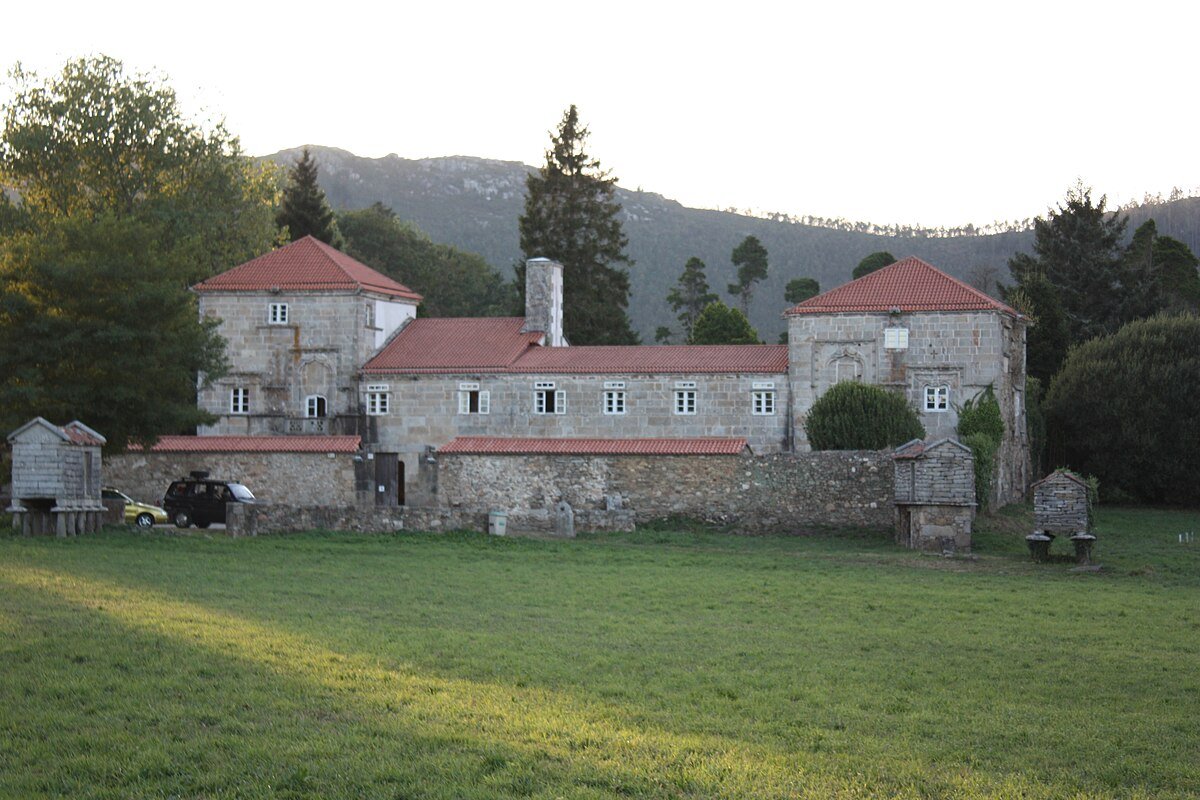
A few kilometres away lies the parish of Ozón. Here stands one of the longest hórreos in Galicia. A hórreo is a traditional raised granary, built to protect grain from damp and animals. This example belongs to the former monastic complex of San Martiño de Ozón, founded in the Middle Ages and heavily transformed in later centuries.
The structure impresses through its length and through the repetition of its stone supports, aligned like a small rural colonnade. For a long time it was used to store grain connected to the monastery and to the surrounding agricultural work. In Galicia these constructions were not decorative features but essential infrastructure for preserving cereal in a humid climate.
The setting still retains much of the valley’s rural scale. Meadows stretch between small plots and narrow lanes, with the monastery complex and the hórreo anchoring the scene.
The Asalto ao Castelo
Every summer the town recreates the Irmandiño revolt in an event known as the Asalto ao Castelo. Over several days the historic centre fills with residents dressed in clothing inspired by the period, and scenes are staged that depict the clashes between the rebels and the defenders of the fortress.
It is less a formal parade and more an intense popular re enactment. The castle and the main square become a stage for simulated combat and episodes that recall the historical uprising. It is one of the times of year when Vimianzo draws its largest crowds, and the memory of the fifteenth century briefly returns to the streets.
Getting Around Vimianzo
The town itself is easy to explore on foot. From the Praza do Concello the castle is reached in a couple of minutes, and the mill is also close by.
To visit the dolmens or head out to Ozón, travelling by car is the most practical option, as they are scattered across the municipal territory. The landscape alternates between small villages and open valleys, with stretches of low scrub in between.
For those interested in walking, Monte Faro lies relatively near the urban centre and offers views over the comarca from above. Closed footwear is advisable, as many paths are made of earth or loose stone.
Vimianzo is best understood by moving through the municipality rather than focusing on a single monument. The castle, the megaliths, the mill and the valley of Ozón form part of the same landscape, where medieval conflict, prehistoric remains and rural work continue to shape the identity of this corner of Galicia.