Full Article
about Zas
Hide article Read full article
Tourism in Zas often begins in Brandomil. Here the river Xallas widens slightly before continuing towards the Atlantic, and spanning it stands a stone bridge that for centuries controlled passage through the valley. The structure seen today is usually dated to the early modern period, probably the 17th century, when the routes to Fisterra carried more traffic than might be imagined now.
No one pays tolls any longer, and there are no lines of pack animals waiting to cross. The bridge still fulfils its original purpose, linking two banks in a place where landscape and history sit visibly one on top of the other.
A Landscape Older Than the Settlements
Zas occupies an inland stretch of the Terra de Soneira, between low sierras that separate this district from Santiago and lands that already look towards the Costa da Morte. There are no dramatic peaks, but there is a network of damp valleys and gentle rises. That terrain helps explain why the municipality contains numerous megalithic remains.
The Arca de Piosa, in the parish of Muiño, is the best known. It is a passage grave built around five thousand years ago. The chamber survives in good condition and retains several of the large slabs that once covered it. Access is simple but discreet: a dirt track between pines and scrub, with little signage to guide the way.
Inside, light barely enters and the stone is often damp. A torch is useful, and careful footing is advisable. The atmosphere is direct and unembellished, a reminder that this territory was organised and marked long before the present villages took shape.
Brandomil and the Roman West
Today Brandomil is a small village. In Roman times, however, it was a significant settlement. Excavations and scattered finds, including roof tiles, pottery fragments and the occasional coin, indicate mining activity and a small inhabited nucleus linked to those workings. It is not entirely clear to what extent it functioned as a fully fledged town, but it was one of the westernmost Roman enclaves in inland Galicia.
Over the centuries the settlement contracted. The present church occupies a central position, and nearby stand several traditional houses, a communal hórreo and traces of older constructions incorporated into later dwellings. A hórreo is a raised granary typical of Galicia, designed to keep grain dry and away from animals. In Brandomil, as elsewhere in the comarca, these structures are part of the everyday architectural language.
Walking through the village makes a wider pattern visible. Across the Terra de Soneira there are hamlets that once held more inhabitants than they do today. Many houses remain carefully maintained, yet the number of permanent residents is small. The river Xallas, meanwhile, continues to set the rhythm of the place, just as it did when mining and river crossings defined its importance.
Torres do Allo: From Strong House to Pazo
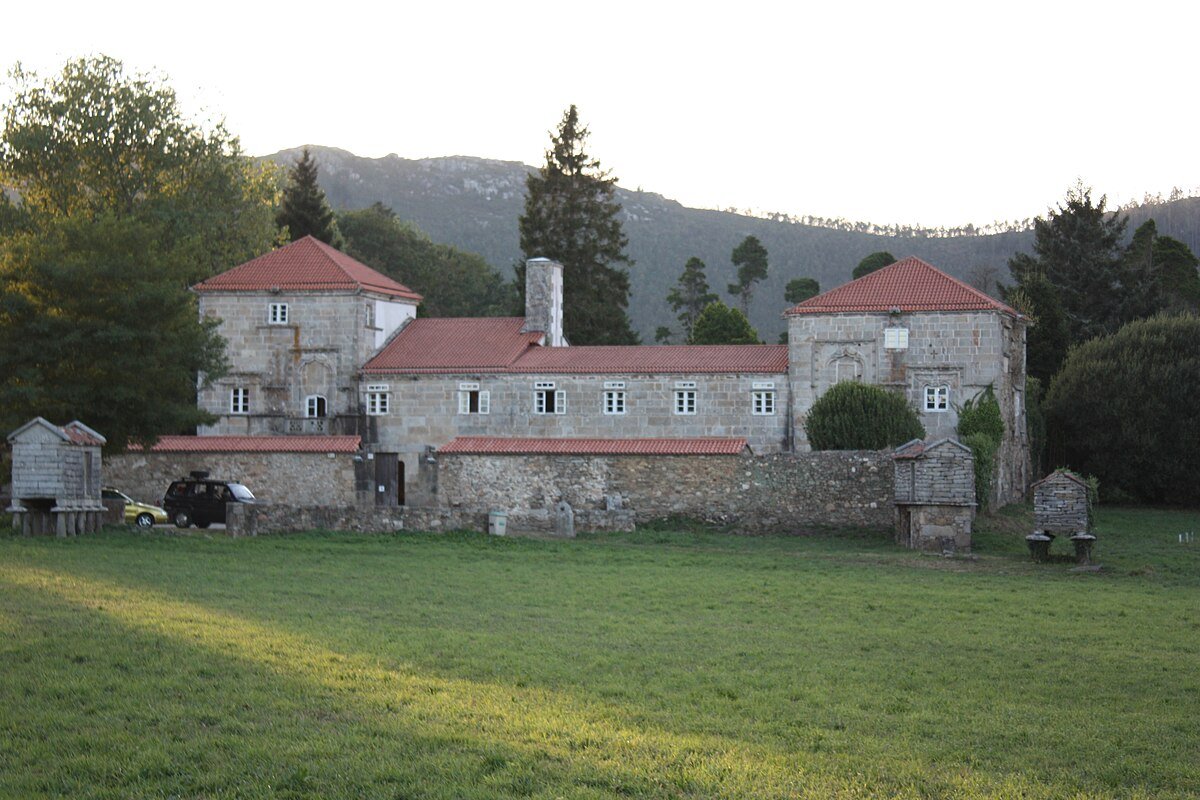
A short drive away stands one of the municipality’s most recognisable historic buildings: the Pazo das Torres do Allo. Its origins lie at the end of the 15th century and are linked to a hidalgo family that controlled land and routes in the area. A hidalgo was a member of the lesser nobility, often rural landowners whose influence rested on property and local power.
The complex preserves features of a medieval strong house, including robust walls, corner towers and heraldic shields. At the same time, it anticipates the model of the Galician pazo that would later become established. A pazo is a manor house associated with agricultural estates and local authority. The building was not conceived as a fortress designed to withstand prolonged sieges. It was a seigneurial residence that also asserted ownership and status.
Today the Pazo das Torres do Allo has been restored and usually functions as a cultural space and interpretation centre devoted to the pazo itself and to local history. Its surroundings of farmland and small wooded areas clarify its logic. This was a residence directly tied to the agricultural exploitation of the territory, embedded in fields that sustained both the household and its influence.
The Carballeira and the Story of Flax
In the municipal capital there is a broad carballeira, a grove of oak trees, where gatherings and popular festivities have traditionally taken place. It is here that the Festa da Carballeira has been held for decades, a festival centred on folk and traditional music that draws audiences from across Galicia.
During the same weekend there is usually activity at the Museo Vivente do Lino. This “Living Museum of Flax” occupies a restored farmhouse and focuses on a crop that was once fundamental to many villages in the comarca. Before cotton and industrial textiles became widespread, flax shaped much of the agricultural calendar. Sowing, pulling up the plants, breaking the stalks, combing the fibres and finally spinning them formed a sequence of tasks integrated into rural life.
The demonstrations at the museum present this process step by step, using traditional tools and offering clear explanations of how the work was organised within households. It is a reminder that agriculture here was not limited to food production. Textiles were part of the domestic economy, and knowledge passed down within families structured both labour and time.
Getting Around and Choosing the Moment
Zas is best explored by car. Villages and points of interest are dispersed, and although public transport exists, services are limited and tend to depend on regional routes.
From Santiago or A Coruña the usual approach follows the road towards Fisterra, turning off later in the direction of Santa Comba and the Terra de Soneira. The landscape shifts gradually along the way: more meadows, more scrubland and villages set at a noticeable distance from one another.
Spring and early summer are often good times to walk in the area. The tracks leading to mámoas, prehistoric burial mounds, and to small rural nuclei remain dirt roads or traditional paths. Comfortable footwear is advisable, and it is sensible not to assume that services will be open in every parish, especially on weekdays.
Zas does not present itself through a single monument or a concentrated historic centre. Its interest lies in the way elements are spread across the territory: a Roman footprint by the Xallas, a megalithic chamber hidden among pines, a manor house rooted in farmland, an oak grove that fills with music. The result is a place best understood slowly, with attention to how land, water and settlement have shaped one another over time.