Full Article
about San Xoán de Río
Hide article Read full article
Arriving Where the Road Slows Down
Reaching San Xoán de Río can feel like a mild act of faith. The road winds through the interior of Ourense, curve after curve, chestnut trees closing in at the sides, and there is often a moment when it seems the satnav has made a mistake. The village does not appear dramatically on the horizon. It simply arrives, quietly, as if it has been there all along and sees no reason to announce itself.
San Xoán de Río sits in the Terra de Trives, close to the mountains of the Serra de San Mamede. This is inland Galicia, far from the coast and its busier routes. There are no grand monuments or squares lined with terraces. The place feels more like visiting the home village of a family that has lived here for generations.
Stone houses with thick walls line the lanes. Wooden galleries, known locally as corredores, face the street. Hórreos, the raised granaries typical of Galicia, stand on pillars beside homes. Stone crosses called cruceiros mark paths that are still in use today. Nothing feels arranged for visitors. Agriculture remains part of everyday life, and it shows. Fields are worked because they need to be, not as a backdrop.
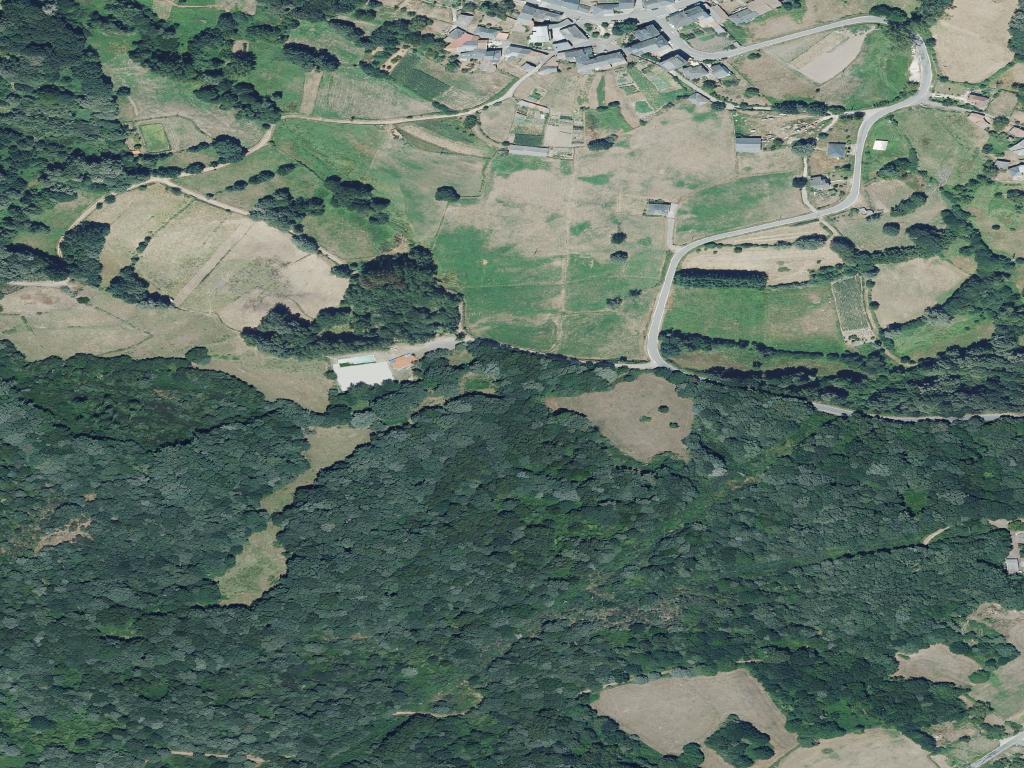
The settlements are scattered. A short drive of two minutes can take you from one hamlet to the next. Many of them look much as they did decades ago. The overall impression is not of a single compact village, but of a patchwork spread across the hills.
A Landscape of Small Discoveries
San Xoán de Río does not compete with towns that boast a clearly defined historic centre. Everything here is more dispersed, like a puzzle with spaces between the pieces.
The parish church of San Xoán, which gives the municipality its name, stands in a simple setting. Built from local stone, it is surrounded by houses and carries the quiet atmosphere typical of rural Galician churches. Silence is common. In the same nucleus there is also a small chapel dedicated to San Pedro. At first glance it appears modest. A closer look reveals details carved into the stone that have been there for decades.
Much of the interest lies in walking without a strict plan. Rural lanes connect houses, fountains still pour water into small troughs, and cruceiros continue to signal old routes. The hórreos lined up beside homes speak volumes about how people once lived here and, in some cases, still do. Some have marks or inscriptions carved into the wood. They resemble the dates scratched into an old table in a grandparent’s house, small traces of time left in plain sight.
The landscape shifts noticeably with the seasons. In spring, chestnut trees burst into leaf with such force that the hills seem to switch on. Summer brings dense shade beneath their branches, welcome during a walk. Autumn covers the ground with chestnuts and reddish leaves. Winter introduces a different scene: smoke rising from chimneys, scattered across the slopes on cold afternoons.
Rain is frequent in this part of Galicia. When it falls, the small rivers that descend from the mountains gather speed. The effect is not dramatic, yet the constant sound of running water accompanies a walk and fills the background. On dry days, rocks along the banks become visible and quiet corners emerge beside the water.
Moving Through the Hills
On a map, San Xoán de Río may look straightforward to explore. In practice, it requires patience. The regional roads wind through the terrain. Ten kilometres here do not feel like ten kilometres on a motorway. Each bend demands attention, and progress is steady rather than swift.
Tracks and paths lead from the main nucleus towards nearby hamlets such as A Portela, A Valladares and O Pedregal. The distances are short, though some stretches involve noticeable slopes. Walks often pass through dense soutos, traditional chestnut groves, or follow fields enclosed by stone walls.
Signposts are not always clear. A map or GPS can help, and asking a local remains a reliable option. Directions here might sound like “follow that path and turn after the big chestnut tree”. Surprisingly, this tends to work.
Autumn introduces another feature typical of inland Ourense: wild mushrooms. Many people head out to collect them, though knowledge is important. Not everything that looks edible is safe, and some areas belong to private land. The same applies to chestnuts. Even if the ground seems covered, many fall within clearly delimited properties.
Local cooking matches expectations for inland Galicia. Dishes are simple and substantial. Beef from the area appears when available. Traditional cured sausages are common. Thick honey often accompanies bread or fresh cheese. In colder months, grelos, caldo gallego and hearty cocidos take centre stage. The style is direct rather than elaborate. The feeling is closer to eating in someone’s home than sampling a refined menu.
What You Might Not Expect
San Xoán de Río can be disconcerting for anyone arriving with a checklist. It does not operate as a place where sights are ticked off one by one. The experience resembles a long walk through a collection of villages more than a conventional visit to a single town.
At certain moments, it may seem that everything has already been seen. Then the road curves, another small settlement appears, and the car stops again. The rhythm repeats itself.
Distances can be deceptive. Fifteen kilometres may take half an hour. The delay does not stem from poor roads but from the terrain, which demands a slower pace. The sensation is similar to moving through an old house full of corridors. The destination is reached eventually, though not in a straight line.
San Xoán de Río rewards those who accept this tempo. There are no headline attractions or tightly packed streets. Instead, there is space, continuity and the sense that daily life has not been rearranged for outside eyes. The appeal lies in the accumulation of small details: a fountain still in use, a cruceiro at a crossroads, smoke rising in winter, chestnuts underfoot in autumn.
In the Terra de Trives, beside the Serra de San Mamede, this quiet pattern continues much as it has for years. Visitors do not so much arrive at a spectacle as step into a landscape that carries on regardless.