Full Article
about Palas de Rei
Hide article Read full article
Dawn on the Camino
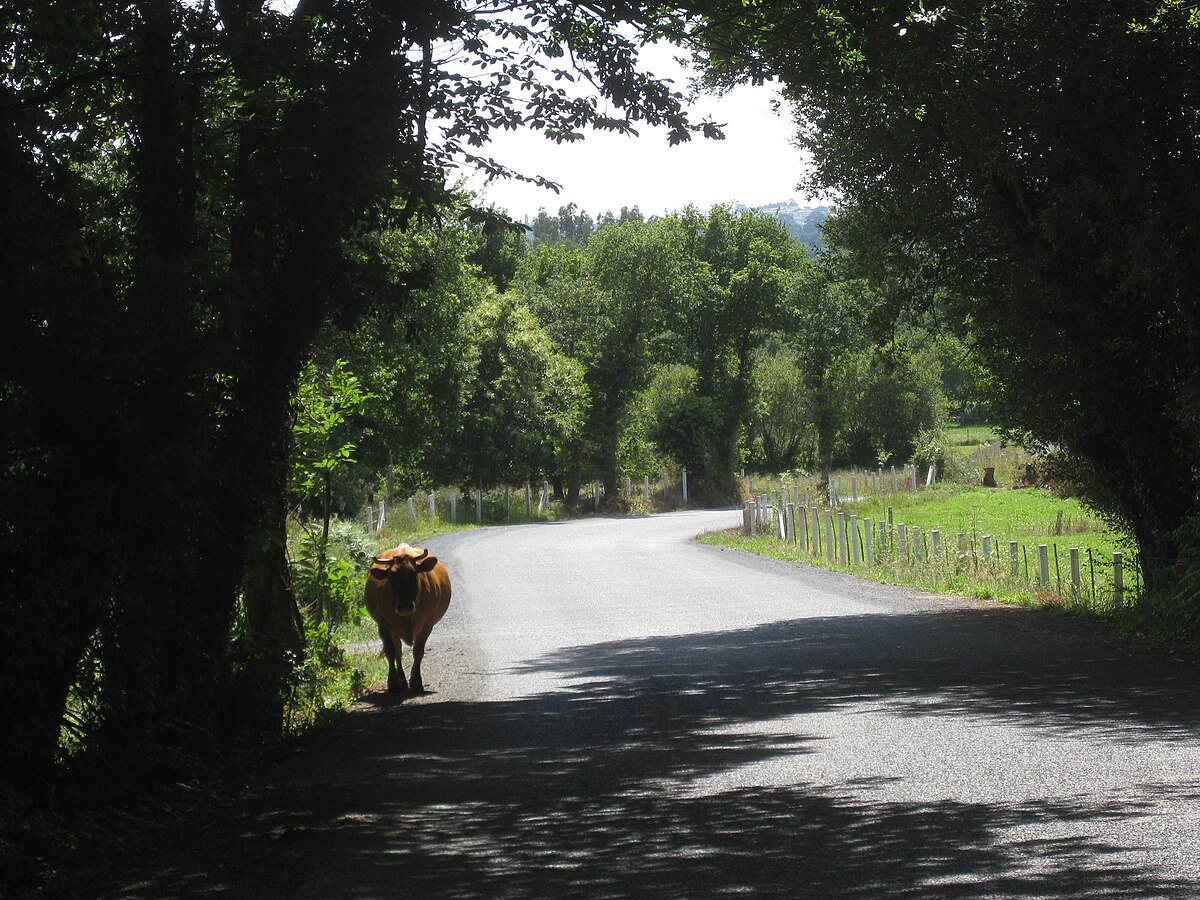
In Palas de Rei, cows make more noise than dogs. At half past six in the morning, the bells around their necks carry through the mist, mixing with the steady tap of walking sticks as pilgrims cross the town. The air smells of warm milk and freshly baked bread. Praza Maior is still half asleep, shutters down, a delivery van edging slowly past.
This small town in Galicia sits on the French Way of the Camino de Santiago, the historic pilgrimage route to Santiago de Compostela. Each day, walkers arrive from Portomarín and set off again towards Arzúa. Backpacks lean against stone façades, walking poles rest by doorways, and conversation hums along A Rúa do Medio, the street that channels most of the foot traffic. The houses are built from grey stone, with slate roofs that catch the light once the morning damp begins to lift.
Palas de Rei is compact. The centre can be covered in a matter of minutes. Yet its name hints at something grander than the quiet streets suggest.
The Palace That Disappeared
The toponym Palas de Rei comes from the Latin Palatium Regis, the royal palace. Local tradition links it to the Visigoth king Witiza, who is said to have had a residence here centuries ago. No visible stone remains of that palace today. What survives are old references and the echo of the name itself.
There is something fitting about that absence. Palas de Rei feels more like a crossroads than a monument. People pass through, rest briefly, and move on. The Camino shapes the daily rhythm, especially in summer, when a steady current of walkers fills the main street.
Beyond the urban centre, the surrounding landscape opens into pasture. This is A Ulloa, a comarca of rolling fields and scattered woods. Early in the day, it is common to see lorries collecting milk from local farms. Dairy farming is central to life here, and it leads directly to one of the area’s best-known products.
Much of the milk becomes Arzúa‑Ulloa cheese, which has its own denominación, a protected designation of origin in Spain. These are soft cheeses with a thin rind and a fresh, milky aroma. They are usually matured for a short time, keeping a gentle texture and a mild flavour. Each year the comarca holds a festival dedicated to this cheese, rotating between different towns in the area.
Pambre: The Castle That Survived
Around four kilometres from the town centre, Castelo de Pambre rises among oaks and meadows. Its silhouette is compact and largely intact. Built in the 14th century by the Ulloa family, it is often described as one of the few Galician fortresses that was not destroyed during the Irmandiño revolts, a series of 15th-century uprisings in which many castles across Galicia were torn down.
The setting feels secluded. The keep dominates the valley of the River Pambre, where green plots are divided by low walls and patches of woodland muffle most sounds except the wind. On damp days the stone darkens and carries the scent of moss.
Close to the castle, the river forms spots where people head to cool off in summer. Even in August, the water runs cold. Moss covers the stones on the riverbed, and they can be slippery underfoot, so care is needed when stepping in.
Back in town, the Camino continues to define the pace of life. August brings a near constant flow of backpacks along the main street. In winter the atmosphere changes markedly: fewer pilgrims, shorter days, shutters dropping early in the evening. September is often a balanced time to pass through. Morning mist still hangs low, the countryside keeps its deep green after summer, and the heaviest rush of walkers has eased.
Vilar de Donas: Knights in Stone and Paint
About ten minutes away by car lies Vilar de Donas. From the outside, the church appears sober and almost rural in character. Step inside, and the impression shifts.
Within are the tombs of knights of the Order of Santiago, the military and religious order founded in the 12th century to protect pilgrims and defend Christian territories. Medieval wall paintings line the interior walls, preserved better than one might expect in such a small and quiet place.
Some of the reds in the painted robes remain strikingly vivid. When light filters through the high windows, dust hangs in the air. The silence feels dense, and footsteps echo against the vaulting above. It is a space that invites stillness rather than spectacle.
Pulpo and the Roads Beyond
A few kilometres away, Melide has enjoyed a reputation for pulpo, octopus, for decades. Yet the preparation is similar in many nearby villages. The octopus is boiled, cut into pieces over a wooden plate, then dressed with paprika and olive oil. If the oil is slightly warm and the octopus is not overcooked, the dish needs little else.
This simple cooking reflects the broader character of the area. Pastureland stretches in all directions. The economy revolves around what the fields provide. Food here is direct, shaped by milk, livestock and long-standing habits rather than elaborate presentation.
For those arriving by car, it is usually easiest to leave it in the larger areas near the main road or the bus station and explore on foot. The centre has narrow streets and turns that can confuse satnav systems.
Just outside town, the bridge of Ferreira spans the river. It is associated with the ancient Roman route that once linked Lugo with the coast. The water flows calmly between alders, and the stones of the bridge have been smoothed by centuries of footsteps. At sunset, as light drops and shadows lengthen across the surface, the scene carries a quiet reminder that this has long been a crossing point.
Long before the current tide of backpacks and yellow arrows marking the Camino. Long before the palace that no one can now point to on a map.