Full Article
about Portomarín
Ocultar artículo Leer artículo completo
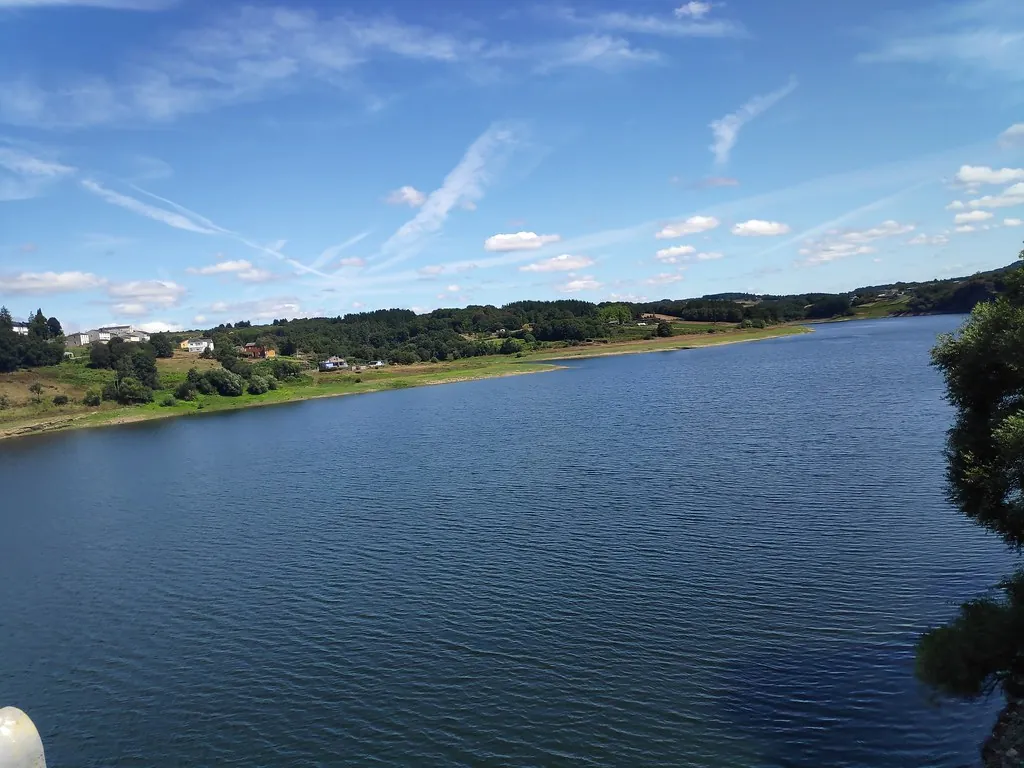
The first thing that strikes you is the staircase. Forty-odd stone steps rise straight from the modern bridge, wide enough for three pilgrims abreast, steep enough to make quad muscles tremble after a 22-kilometre approach from Sarria. At the top waits Portomarín, a place that shouldn’t exist in its current form – and wouldn’t, had the Río Miño not been dammed in the 1960s to create the vast Embalse de Belesar. The old medieval settlement still sits down there somewhere, drowned under thirty metres of water, while its replacement perches on a manufactured terrace above.
A Church Reassembled Stone by Stone
Portomarín’s calling card is the fortress-church of San Nicolás, rebuilt block by block like a giant 3-D puzzle. Builders numbered each ashlar with chisel marks before the flood, hauled them uphill, then slotted them back together. The result looks more castle than chapel: crenellated parapets, a single rosette window, walls thick enough to shrug off 12th-century arrows. Inside, the priest still stamps Credenciales at 19:00; even agnostic visitors queue for the ink blot that proves they’ve reached kilometre 94 of the Camino Francés. Light a candle if you wish – proceeds go toward keeping the roof on a building that was never meant to live at this altitude.
Walk round the outside and you’ll spot the masons’ coded scratches: Roman numerals, arrows, the occasional games-board grid. They read like assembly instructions for flat-pack furniture, only the Allen key weighed three tonnes. When the reservoir drops – usually late summer – you can compare the real thing with the ghost footings that sometimes emerge on the exposed mudflats. Expect waist-high walls rather than Atlantis; still, it’s eerie to picnic above the outline of streets where people listened to the same church bells only sixty years ago.
One Street, Two Bars, Zero Medieval Cobbles
Forget arcaded plaças and shadowy lanes. Portomarín’s centre is a single 300-metre strip officially called Avenida de Sarria, though nobody uses the name. Pilgrims call it “Supermarket Row”: Gadis on the left for €1.20 cans of Estrella, Farmacia on the right for Compeed, then a run of cafés whose terraces fill by 11 a.m. with boots airing in the sun. The architecture is 1960s municipal utilitarian – think poured concrete and ceramic shop signs – but the people-watching is first-rate. Watch for the ritual swapping of horror stories: blister drainage techniques, bed-bug sightings, the German who walked in flip-flops.
Food is pilgrim-priced and portioned. Menu del Día runs €11–12 almost everywhere; expect Galician soup, grilled pork, and a plastic cup of wine that punches above its weight. Vegetarians survive on empanada de zorza (tofu version) at Café Bar Central, while the brave order pulpo at Mesón do Loyo – purple tentacles dressed in paprika and rock salt, chewier than calamari, tastier than it photographs.
Water Levels Dictate the View
The embalse is Portomarín’s front garden and its mood ring. After spring rains the lake laps the retaining wall, turning the town into a minor fjord and sending reflections of San Nicolás skywards. By August the level can fall four metres, exposing a beige bathtub ring and the odd half-submerged arch of the old bridge. Kayaks and pedalos appear on good weekends, rented by a shack whose opening hours are posted on Facebook the night before. Don’t bank on it; do bring binoculars instead – grebes and cormorants fish the channels when humans give up.
A 4-kilometre circuit tracks the shoreline west, then cuts inland through eucalyptus plantations. It’s level, shade-less, and takes ninety minutes at British Sunday-walk pace. Cyclists use it as a warm-down; hikers can extend another 6 km to the hamlet of Gonzar where a stone cruciero marks what used to be the main road before the valley flooded. Turn back when the reservoir glints silver through the tree trunks – the Camino proper heads north tomorrow.
Timing the Stop
Portomarín works best as a single-night halt, not a base camp. Beds number roughly one per inhabitant, so advance booking is wise at Easter and throughout May–September. Albergue municipal (donation, 80 beds) opens at 13:00 and fills by 15:00; private options such as Ultreia or Ferramenteiro charge €12–14 and throw in a disposable sheet. If you arrive after 16:00 and everything’s full, the nearest village with spare mattresses is Palas de Rei, 18 km away – too far for legs that have already done Sarria to Portomarín in a day.
Rain doesn’t ruin the town, but it strips away the postcard effect. Terraces empty, the lake path turns slick clay, and the only shelter is inside the church or the supermarket aisle. Pack a cagoule and expect to drink your coffee standing at the bar like the locals.
Cash, Blisters and Other British Concerns
The lone cash machine beside the church enjoys random siestas and runs dry every Sunday once the weekenders arrive. Withdraw euros in Sarria or Lugo if you need them. Plasters and poles are cheaper here than in the UK, but selection is limited – think one brand, two sizes. The farmacista speaks enough English to diagnose “ampolla” (blister) and will sell you a compeed multipack for €5.90.
Mobile signal is excellent; water fountains labelled “agua potable” are safe, though taste heavily of minerals. Washing: Huellas Albergue lets non-guests use its machines for €3 before 17:00; otherwise sink-washing in the plaza bathrooms is tolerated as long as you don’t monopolise the only plug.
Leaving Town
Morning exit offers two routes. The left fork drops to a medieval bridge (sometimes visible, sometimes not) then climbs sharply through oak woods. The right “variante suave” stays on tarmac an extra 400 m but saves the knees; British walking groups with an average age over sixty swear by it. Both rejoin at Hospital da Cruz, 6 km on, where a café serves tortilla thick as a paperback and coffee strong enough to restart a heart.
Portomarín won’t swallow a long weekend. Half a day’s wandering, a night’s sleep, and most pilgrims are ready to push east towards Melide and its octopus pans. Yet the place stays in the mind precisely because it is provisional: a town re-lifted like a chess piece, dependent on water engineers and walker footfall. Come back in twenty years and the reservoir may be lower, the church even higher above the waterline, the staircase still demanding its toll of calf muscles. That, at least, shows no sign of shifting.