Full Article
about O Porriño
Hide article Read full article
At eight in the morning in O Porriño, the stonemason’s workshop already smells of wet stone. Water runs over newly cut blocks of granite, leaving dark streaks across the pale pink surface. In the corner, a man smooths a slab with slow, almost hypnotic movements. Each pass of the disc against the stone sounds like a long whisper. This is one of the village’s usual sounds: less the sharp crack you might expect from a quarry, more the steady friction of tool against granite.
O Porriño, in the province of Pontevedra, is not a place that turns its back on industry when visitors arrive. The stone is still here, in the air and underfoot.
The colour that comes out of the ground
Rosa Porriño is not a shade from a paint chart. It is the granite that has travelled far from this corner of Galicia, appearing on façades in Madrid and in buildings raised across the Atlantic during the years when many Galicians emigrated. In the municipality, granite is not decorative. For decades it has meant work, landscape and a certain way of being.
The quarries of Monte Castelo have been open for a long time and continue to mark the skyline with their straight cuts. Walking through this area shifts your sense of scale. The stone walls rise almost vertically, showing the lines of extraction as if someone had drawn layers across a vast block. The geometry is blunt and clear.
A signposted route runs through part of these workings, stretching for several kilometres. In summer it is best tackled early in the day. Granite reflects light fiercely and the heat lingers between the stone walls. In some spots the pink turns almost white under the sun, yet the surface remains cool to the touch.
If you happen to pass an active quarry while work is under way, you may see how a block is cut. There are no explanatory panels or staged displays. It is simply people at work, carrying on with a trade that has shaped the town for generations.
The architect who never forgot his station
Antonio Palacios, the architect who designed Madrid’s former Palacio de Comunicaciones, was born in O Porriño in 1874. His presence is most visible in the town’s railway station. The building appears suddenly among industrial streets and low warehouses, its pale stone façade and careful proportions setting it apart.
It is a small station, almost discreet, yet recognisable if you know other works by Palacios. There is a play of volumes, attention to detail in the stone, and a sense of solemnity in what is, after all, an everyday building. Many pilgrims walking the Portuguese Way to Santiago de Compostela pass along the platform without knowing who designed it.
Inside, there is usually little noise. A traveller waiting for a train to Vigo or Redondela, the hum of machines, the clock on the wall keeping a calm rhythm that feels detached from the traffic on the nearby road. The station does not compete with the industrial surroundings. It sits within them, quietly distinct.
When the river became a table
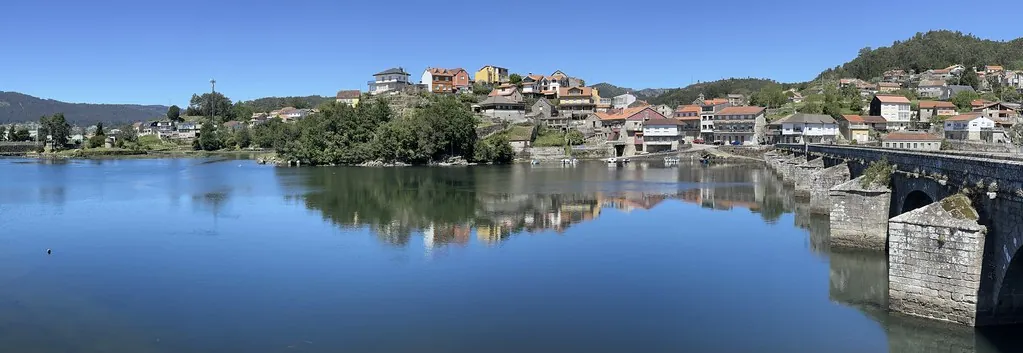
In spring, the River Louro often carries the smell of lamprea, or lamprey. Near the medieval bridge, stalls and long tables are set up when the season arrives. People from the surrounding area come to taste it, either baked into empanada or stewed. The filling is dark and dense, with a strong flavour that brings together river and smoke.
Lamprea appears only for a few weeks each year. The rest of the time, the Louro flows slowly between poplars, vegetable plots and a handful of factories that lean towards its banks. A path follows the river in the direction of Tui. It is fairly flat and easy to follow, a quieter alternative to the main pilgrim route.
Many walkers continue along the more direct variant of the Camino towards the next stage. The riverside path remains calmer. Among the reeds, herons are often visible. If the water is still and you pause for a while, splashes sometimes break the silence from within the vegetation.
The Louro does not dominate the town in an obvious way. Instead, it edges it, offering a different pace a short distance from roads and workshops.
The festival where stone dresses up as food
At the beginning of July, O Porriño usually celebrates the Festa do Granito. Part of the event takes place in former quarry areas, where long tables are set up and the atmosphere draws in people from the town and nearby villages.
There are stonemasonry demonstrations, with chisels striking in front of onlookers and the inevitable comparisons over who handles the mallet best. The stone that, for most of the year, is simply a trade becomes a stage for a few hours. Dust rises with each blow and settles again on boots and tabletops.
The celebration also brings out the San Blas almond cake, traditionally prepared in February for that feast day. It is dense, with a centre more moist than the edges, and is usually cut into generous slices. People eat it standing up, leaning against any available table or even a nearby block of granite.
As the sun drops over the quarry, the colour shifts once more. The pink turns golden and a fine veil of stone dust hangs briefly in the air before disappearing.
Getting there, and when to think twice
O Porriño lies on the natural route between Tui and Vigo, and directly on the Portuguese Way towards Santiago. Trains connect it with Vigo on short, fairly frequent journeys. By car, it is quickly reached via the motorway or the national road.
Those looking for quiet may prefer to avoid some of the busier days in August, when traffic and industrial activity are more noticeable. This is not a town that pauses for tourism. Work continues, lorries pass, and the rhythm of the quarries and workshops carries on regardless of who is walking through.
Spring is often a good time to walk beside the Louro and coincide with lamprea season. In autumn, when chestnuts begin to appear, the air shifts again and the granite takes on a different tone under softer light.
O Porriño does not reinvent itself for visitors. It remains what it has long been: a place where stone comes out of the ground pink, where trains stop briefly on their way to larger cities, and where the river occasionally turns into a table for a few weeks each year.