Full Article
about Soutomaior
Hide article Read full article
A castle that almost hides in its own garden
There is a moment, just after crossing Ponte Sampaio by car, when you glance up towards the hills and spot the castle. From a distance it looks like something lifted from a storybook. Once you arrive, the impression shifts. Rather than a fortress with gardens attached, it feels more like an enormous garden with a castle placed in the middle.
That contrast sums up tourism in Soutomaior rather well.
The Castillo de Soutomaior dates back to the Middle Ages and for centuries was linked to Pedro Madruga, one of those Galician historical figures surrounded by more stories than certainties. From time to time, theories even surface connecting him to Christopher Columbus. Yes, the long-running debate over whether Columbus might have been Galician still reappears now and then.
The building itself has weight and presence, but it is the grounds that tend to stop people in their tracks. Behind the castle stretch several hectares filled with camellias. A remarkable number of them. If you visit when they are in bloom, usually between late winter and early spring, the walk feels like a catalogue of varieties: white, pink, deep red, some impressively large, others more understated.
Inside the castle another figure stands out: María Vinyals, who lived here in the early 20th century. A writer and a woman ahead of her time in many respects, she transformed the castle for a period into a place that was unusual for the era, with social initiatives and even a sanatorium. It adds an unexpected chapter to what might otherwise be a straightforward medieval fortress story.
Arcade and its oyster tradition
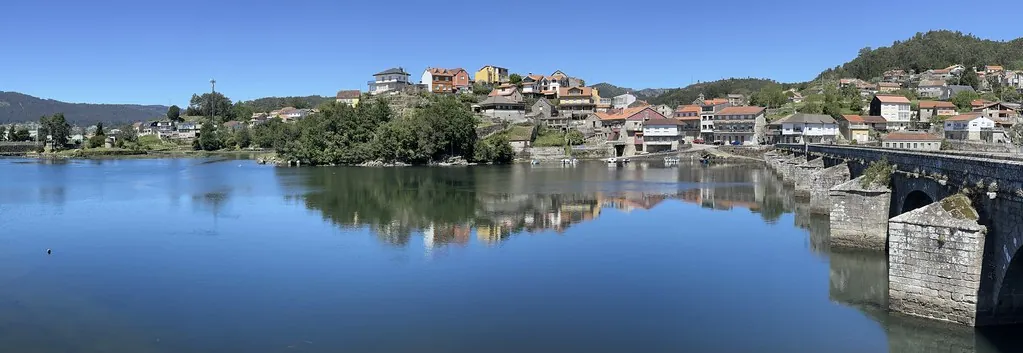
Arcade, one of the parishes within the municipality, is closely tied to the ría, the coastal inlet that shapes much of Galicia’s shoreline. Its identity is strongly connected to oysters. They have been farmed and eaten here for centuries and remain an important part of local life.
The oysters from this area are known for the particular mix of salt water and fresh water created by the mouths of several rivers. The result is a milder flavour than in other coastal areas, something oyster enthusiasts often remark on when they try them here.
Each spring the well-known festival dedicated to this mollusc takes place. During those days Arcade becomes noticeably busier and the atmosphere shifts completely. Stalls appear, people gather to taste oysters, and the streets fill with movement. Anyone seeking the quiet, everyday version of the village might prefer to avoid that weekend. Those who enjoy a fair-like atmosphere may find it the perfect moment to see Arcade at its liveliest.
There is a practical detail worth noting. The Monday after the festival the pace drops dramatically. It is the kind of day when the village seems to be recovering.
The Verdugo river and the afternoon walk
The River Verdugo, a name that tends to surprise first-time visitors, runs through the municipality. In summer it becomes one of the places most used by local residents.
There is a river beach that draws plenty of people when the heat sets in. Families arrive with cool boxes, teenagers jump into the water, dogs are walked along the banks. It is a scene repeated in many Galician towns once July comes around.
From this area a simple riverside path follows the course of the Verdugo. It is not demanding and is usually taken at an easy pace, more about stretching your legs than serious exercise. Along the way there are several historic bridges and shaded spots where it is easy to pause for a while.
It makes for a classic unhurried plan: a walk, some time by the water, then heading back.
Choosing your moment
August can bring a very different side of Soutomaior. During the fiestas of the Divino Salvador the municipality fills up, music carries on into the night and the general atmosphere becomes lively. For anyone who enjoys traditional local festivals, they have their appeal. For visitors in search of silence and slow strolls, August is unlikely to be the best choice.
Spring changes the mood again. The castle’s camellias are in bloom and the rush of peak weekends has not fully arrived. Between March and April the overall feel is more relaxed.
Around the same time Corpus Christi is often celebrated with floral carpets laid out along some streets. These are compositions created with petals and other natural materials. They do not last long, but while they are in place they draw plenty of attention.
Keeping expectations in check
Soutomaior does not compete with monumental cities or major seaside destinations. That may be part of its appeal.
People tend to come here for three or four specific reasons: the castle and its gardens, the setting along the river, the oyster tradition in Arcade, and a village rhythm that still feels largely intact.
It works well as a long half-day outing. A calm visit to the castle, a short trip down to Arcade, a gentle riverside walk, and that is about it.
The experience is satisfying precisely because it does not try to be more than it is. Soutomaior offers a handful of clear highlights and a steady pace. When the visit ends, the impression it leaves is simple and positive, without ever feeling overdone.