Full Article
about Ajamil de Cameros
Small mountain village in the Camero Viejo; perfect for unplugging amid nature and enjoying the high-country scenery.
Hide article Read full article
A Village on the Southern Slopes of Cameros
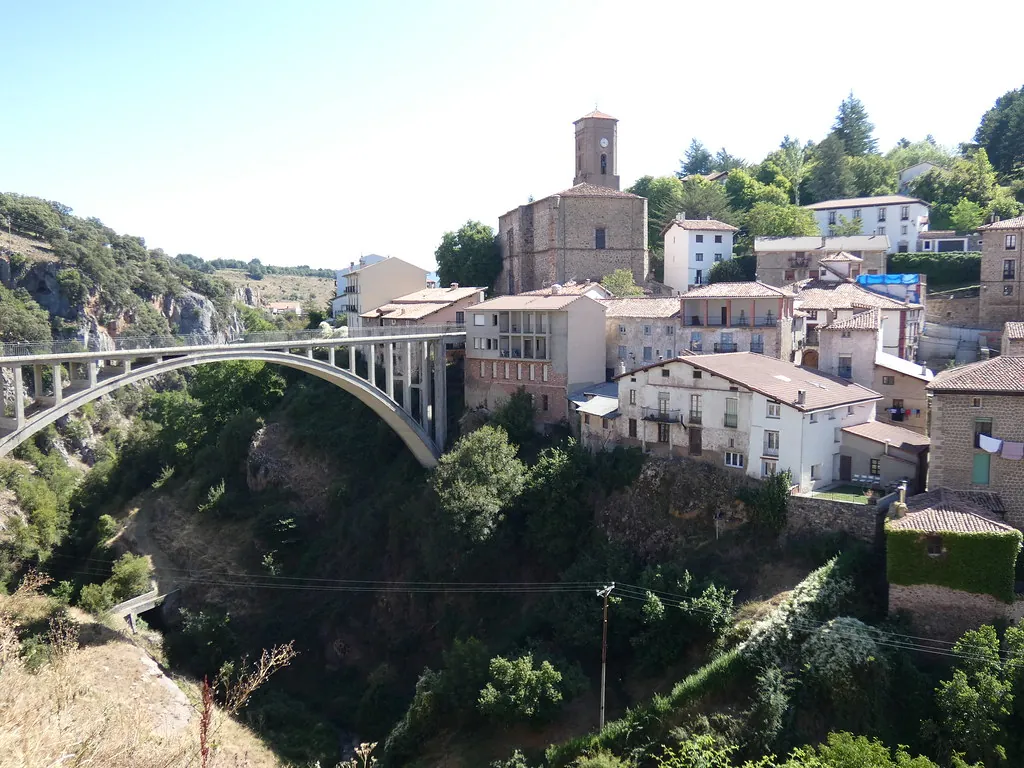
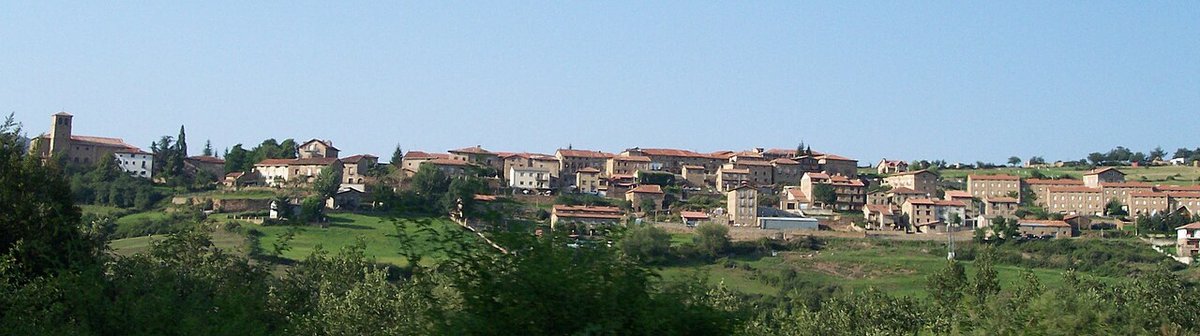
Tourism in Ajamil de Cameros is closely tied to its geography. The village stands on the southern side of the Sierra de Cameros, at over 1,000 metres above sea level, in a mid-mountain landscape where farming and livestock have shaped daily life for centuries. The terrain came first here, and the buildings followed. Houses spread across the hillside according to the natural slope, without a rigid street grid or planned layout.
For much of the Early Modern period and into the 19th century, many villages in Cameros relied on transhumant livestock farming, the seasonal movement of herds between summer and winter pastures. Traces of that past remain visible in Ajamil’s domestic architecture. Wide entranceways, attached animal pens and haylofts were all integrated into the home itself. With fewer than a hundred inhabitants today, Ajamil still reflects the logic of a mountain livestock village.
At the centre stands the parish church of the Asunción. It is a simple stone building with a bell gable, in keeping with the size of the settlement. Its interest lies less in architectural grandeur and more in what it represents. The presence of a parish church of this scale suggests that the village once had a larger population and greater activity, something common across the wider comarca of Cameros.
The overall appearance of the village is restrained. There are no imposing façades or elaborate decorative details. Stone and wood dominate, and the pitched roofs are designed to cope with the harsh winters typical of the sierra.
Walking Through Ajamil
Ajamil is not a place defined by individual monuments. Its value lies in the ensemble: a small mountain village where traditional architecture can still be read without major recent alterations.
The church marks the central point. From there, the main street descends, adapting to the slope of the hillside. As it winds down, stone houses come into view, many with broad doorways and adjoining agricultural spaces. Orientation often takes advantage of sunlight, a practical decision in a high-altitude setting where winters are long.
It is worth pausing to observe how closely the houses relate to the land beneath them. Some seem almost anchored into the hillside. The irregularity of the streets is not decorative but functional, responding to gradients and the natural shape of the terrain.
At the edge of the built-up area, the village opens towards the valley. From certain points, there are clear views over the landscape of Cameros: wooded slopes and meadows that for centuries served as grazing land. The connection between settlement and pasture is direct and easy to understand on the ground.
A walk through the centre does not take long. In around half an hour, it is possible to explore at a relaxed pace, stopping to look at architectural details and to notice how closely houses, barns and the hillside are intertwined.
Paths and the Sierra de Cebollera
Ajamil lies within the area influenced by the Sierra de Cebollera, although the most common access points to the natural park are found in other nearby villages. Even so, rural tracks begin within the municipality itself, offering the chance to walk through the immediate surroundings of Cameros.
These are mid-mountain routes: forestry tracks, old livestock paths and trails that climb towards slightly higher elevations. The landscape alternates between oak woods, mountain scrub and pastureland. The character of the terrain changes with height, but the overall sense remains one of open space shaped by human use.
Walking at a steady pace increases the chances of encountering wildlife. Roe deer are sometimes visible, and forest birds can often be heard among the trees. Early morning and late afternoon tend to be the quietest times in the hills.
In autumn, the mountains of Cameros attract those interested in wild mushrooms. Anyone collecting them should be aware that local regulations often govern mushroom picking in many areas, and it is important to respect those rules.
Practical Considerations
Ajamil functions more as a stopping point or a peaceful base for exploring Cameros than as a destination for a long stay. The village is small, and everyday life remains connected to rural work.
A simple plan is to park at the entrance, explore the centre on foot and then continue towards other villages in the sierra or along one of the nearby mountain routes. Distances within the village are short, but the slopes are noticeable.
Streets can be steep, and the ground is uneven in places. Sturdy footwear is advisable for walking both within the village and in the surrounding countryside.
Winter brings additional considerations. Ice or snow on the secondary roads of the sierra is not unusual. Before travelling up to Cameros, it is sensible to check the weather forecast and the condition of the roads. Conditions can change quickly at this altitude.
When to Go and How to Reach Ajamil
Spring and autumn are often the most pleasant seasons for exploring the area. During these months, the landscape changes rapidly. Fresh green shoots appear in the oak woods in spring, while autumn brings ochre tones as temperatures begin to fall.
Summer is generally milder here than in the Ebro valley. For that reason, many people from La Rioja have traditionally headed up to Cameros during the hottest months. Winter, by contrast, is much quieter. If the weather turns, the village may be covered in snow, reinforcing its mountain character.
From Logroño, the usual route is to take the N‑111 towards Soria and then turn off onto mountain roads leading to the villages of Cameros. These are typical sierra roads, with bends and changes in gradient, so unhurried driving is advisable.
Once inside the comarca, signposts for Ajamil appear at the main junctions. Planning the route in advance is helpful, particularly for those intending to continue on to other villages in Cameros.
Ajamil de Cameros does not compete through spectacle or large-scale attractions. Its appeal lies in coherence: landscape, architecture and history fitting together in a way that still makes practical sense. For anyone interested in understanding how mountain communities in La Rioja were organised around livestock and land, this small village offers a clear and unembellished example.