Full Article
about Cabezón de Cameros
Tiny village in the Camero Viejo; offers peace and authentic mountain architecture.
Hide article Read full article
At seven in the morning, outside the church of San Andrés, the silence has a weight to it. You can hear the wind moving through nearby oak leaves and, now and then, the short call of a blackbird. The houses are still closed up, shutters down, dark tiled roofs damp with dew. In Cabezón de Cameros, with just over twenty residents, the day begins slowly.
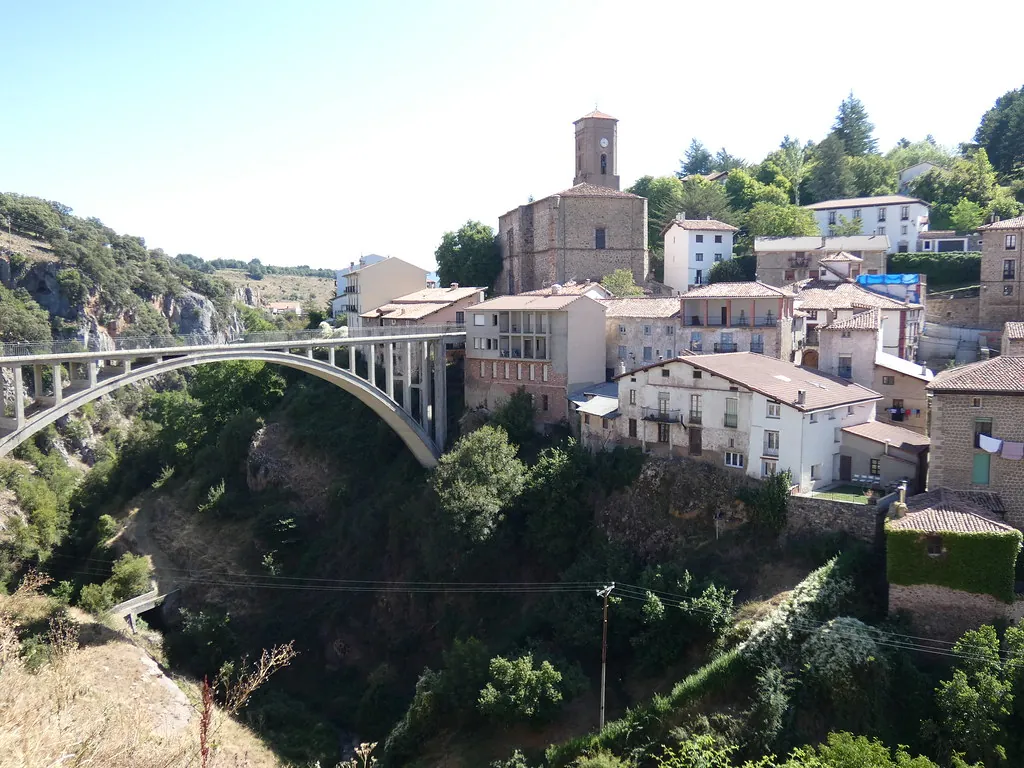
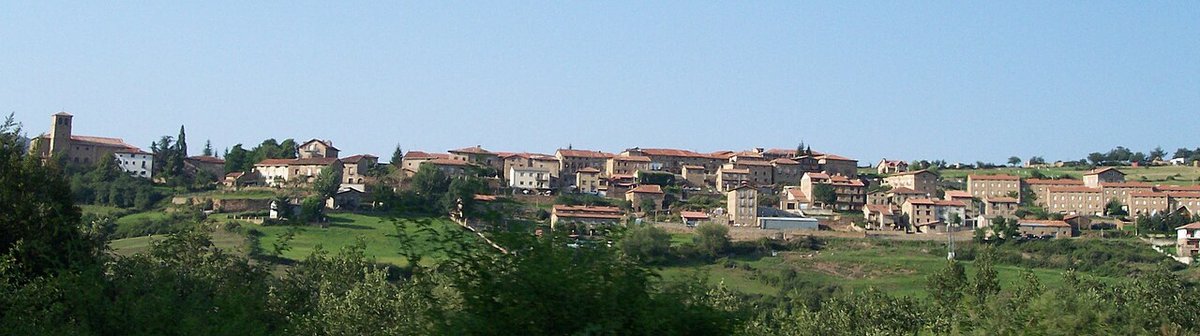
The village sits on a high slope in the La Rioja mountains, within the Cameros area. Around it, pine woods mix with patches of holm oak and low scrub, and the land folds down into small valleys where a stream sometimes appears. The houses, built of grey stone and timber darkened by time, form a compact cluster that can be crossed in minutes. It is not a large place. Walk straight through without stopping and in a quarter of an hour you will have seen it all.
The church and the village core
At the centre stands the church of San Andrés. It does not stand out from afar, but up close the thickness of the walls and the uneven texture of the stone become clear. The tower rises above the rooftops with a quiet presence, as if it has always been there watching over the slope.
A few steps away is the small cemetery, right beside the village. Some graves have moss along the edges and dried flowers that someone replaces from time to time. From here the land opens up towards the nearby hills, a reminder that life here has always been closely tied to the countryside and the rhythm of the seasons.
Paths around Cabezón de Cameros
Beyond the built-up area, the appeal grows if you enjoy walking. Several dirt tracks leave from the edge of the village, climbing gently up the hillside. Not all are signposted, but it is hard to get lost if you stay within reach of the village.
Within half an hour, these paths gain a little height and reveal the scale of the Cameros landscape: rounded hills covered in pines, narrow ravines, and in the distance peaks reaching around or above 1,700 to 1,800 metres. In autumn, the ground is covered with dry leaves that crunch underfoot. In spring, the air often carries the scent of damp earth and newly grown grass.
With a bit of patience, it is easy to spot birds of prey gliding on air currents, or come across deer tracks on quieter paths. In season, the area is also used by local people who go out to gather mushrooms, following the rules that regulate this activity.
A very small village with few services
It helps to arrive in Cabezón de Cameros with the right expectations. This is a very small village with hardly any services, and you may find almost everything closed, especially on weekdays or outside the summer period. If you plan to eat, have something hot to drink or buy supplies, it is usually more practical to do so in other villages in Cameros before arriving.
That lack of activity shapes the atmosphere. For much of the year, the streets are quiet, and it is not unusual to spend a good stretch of time without seeing anyone at all.
Getting there and practical notes
The most common route from Logroño is to follow the N‑111 towards Soria, then turn onto smaller roads that wind into the mountains towards the villages of Cameros. The final kilometres are narrow and full of bends, which is typical for this area. Driving steadily is advisable, and it makes sense to have fuel sorted in larger towns beforehand.
Even for a short walk, comfortable footwear is worth bringing. Some sections of the paths have loose stones, and after rain the ground can become slippery. In winter, if there has been snow or overnight frost, road conditions can be more difficult.
When to visit
Spring and autumn tend to be the most pleasant times for walking in the surrounding hills, with mild temperatures and a landscape that feels alive. In summer, because of the elevation, the air is somewhat cooler than in the Ebro valley, though temperatures drop quickly after sunset.
Winter changes the scene considerably. When snow or frost arrives, the village becomes even quieter, and some access roads may require extra care.
A brief stop in the Cameros mountains
A short visit of one or two hours is enough to get a sense of the place: walk the streets, step into the area around the church, take one of the paths that climbs a little above the village and look out over the valley. Sitting on a stone or by the edge of the track, what stands out most is the silence of the hills and the sound of wind moving through the pines.
Cabezón de Cameros does not revolve around tourism and has little on display in the usual sense. What it offers is a small cluster of stone houses, a wide landscape, and the feeling of being somewhere where time moves more slowly than in the valley. Sometimes, that is enough.