Full Article
about Villanueva de Cameros
Picturesque village in the Camero Nuevo with stone houses and timber framing.
Hide article Read full article
A hillside village where time eases off
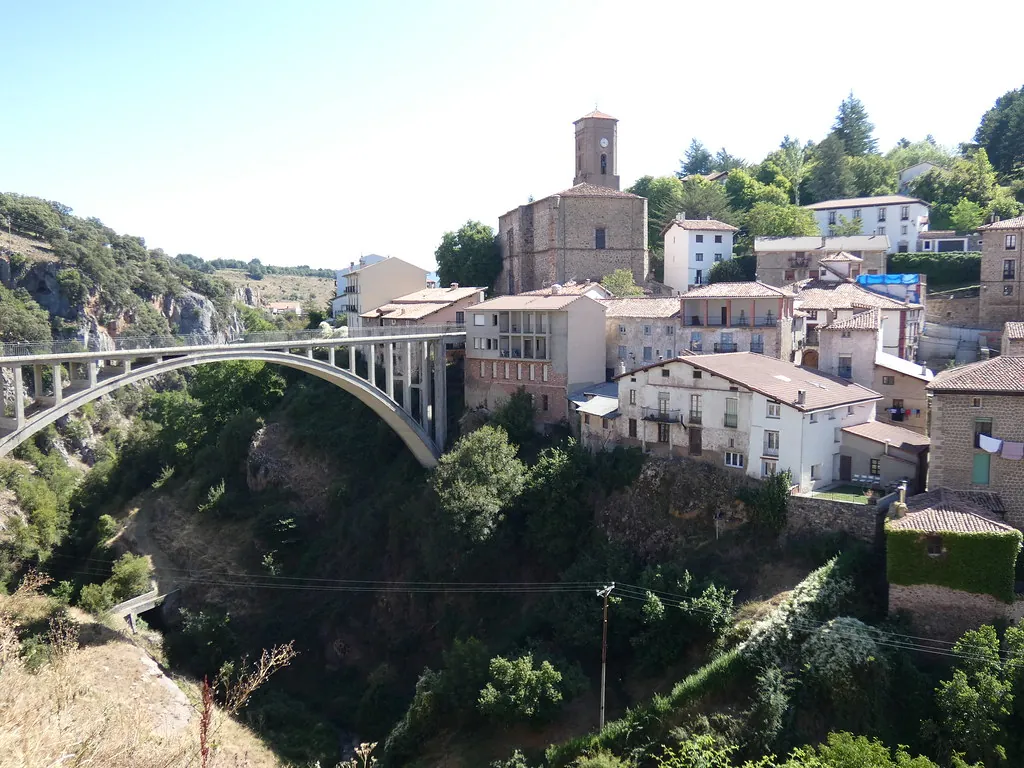
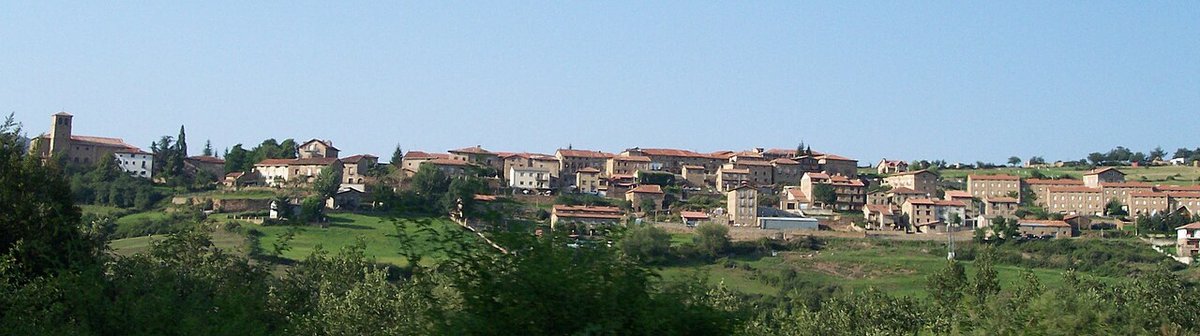
Some places give the impression that the clock has quietly slowed down. Villanueva de Cameros is one of them. A small cluster of stone houses, wooden balconies and reddish roofs sits along the slope as if each building had been placed there carefully over the course of centuries.
The village stands at around 900 metres above sea level, in the heart of the Sierra de Cameros in La Rioja. The altitude makes itself known. The air is usually cooler than in the valley below, and the landscape shifts noticeably with the seasons. This is not a destination of grand monuments or streets lined with shops. It is the sort of place where you park the car, walk for ten minutes, and find yourself on a dirt track with barely a sound around you.
Villanueva de Cameros feels small from the outset, and it is. There are only a few dozen residents. That scale shapes the visit. There is no sense of hurry and little in the way of distraction. The appeal lies in the setting and in the quiet rhythm of village life in the mountains.
A mountain community shaped by transhumance
For centuries, life here revolved around livestock and the seasonal movement of herds, a practice known in Spain as transhumance. Flocks were moved between summer and winter pastures, and the mountains were both workplace and lifeline. That history is still visible in the way the village is built.
The houses have thick stone walls and small windows, designed to withstand long winters. There is a practical solidity to the architecture, as if everything had been constructed with endurance in mind. Even a short walk through the streets reveals that sense of adaptation to climate and terrain.
The parish church is the most recognisable building in the village. Its origins date back to the medieval period, although it has undergone alterations over time. It is not always open, but if the door happens to be unlocked, it is worth stepping inside for a moment. There is a particular stillness to mountain churches, a quiet that seems to echo the slower pace of life outside.
Villanueva de Cameros does not present its history through panels or curated displays. It is woven into the layout of the streets, the materials of the houses and the relationship between the village and the surrounding hills.
Walking out into the Sierra de Cameros
One of the pleasures of being here is that exploring the surroundings requires very little planning. Leave the village from either end and dirt tracks quickly lead into the hills. There is no need to organise a major excursion. A simple walk is enough.
Do not expect perfect signposting or carefully marked routes with information boards at regular intervals. Many of these paths are the old ones, used for generations by local people, by livestock, or by those heading up into the hills for work. The experience is straightforward and unfussy. If the idea of walking for a while without much infrastructure appeals, this is an easy place to do it.
On the nearby slopes, beech, oak and pine grow side by side. The mix of trees changes the character of the landscape throughout the year. In autumn the colours shift noticeably, and the hills attract people who go out in search of wild mushrooms. As anywhere, it is important to know exactly what is being picked and to take care.
The terrain underfoot can be uneven. A casual stroll often involves mud, stones or damp grass, particularly after rain or in shaded areas. That is part of the experience. The Sierra de Cameros does not smooth itself out for visitors.
A short walk through the village
Exploring Villanueva de Cameros itself does not take long. The streets are few and relatively straight, lined with traditional houses alongside some more recent renovations. The walk may be short, but it rewards an unhurried pace.
Look for small details: an old wooden door, a carved coat of arms set into a façade, a yard or corral that is still in use. These are not grand sights, yet together they tell the story of a place that has adapted gradually rather than dramatically.
At the edge of the village, several paths allow you to gain a little height and look out over the Iregua valley. The Iregua is the river that runs through this part of La Rioja, carving a route between mountains and settlements. The surrounding peaks rise above 1,500 metres. From Villanueva de Cameros you are not yet in high mountain terrain, but the landscape begins to feel more rugged and expansive.
There is a clear sense of transition here. The valley lies below, while the higher summits of the Sierra de Cameros stand further on. The village occupies that in-between space, close enough to the mountains to feel their presence, yet still connected to the wider region.
Practical notes for a calm visit
Given its size, Villanueva de Cameros is not a place packed with services or activities. It is best understood as a peaceful stop within a broader route through the Cameros area. Arrive, park at the entrance to the village or in a spot where you are not blocking the narrow streets, and explore on foot. Cars quickly become intrusive in such a small setting.
The road from Logroño typically passes through Torrecilla en Cameros before climbing towards this part of the Sierra. After Torrecilla, the bends increase, pine forests thicken, and there is a gradual feeling of leaving urban noise behind. The approach forms part of the experience, as the scenery grows wilder and the settlements smaller.
Even in summer, it is wise to bring a light layer. Once the sun dips behind the hills or you step into shade, the temperature drops more than expected at 900 metres. The freshness of the air is part of the appeal, but it can catch visitors off guard.
Villanueva de Cameros does not demand a detailed itinerary. It offers something simpler: a short wander through stone streets, a quiet church if the door is open, a path leading into beech, oak and pine. It is a place that works best when taken slowly, without too many plans. In that sense, the slower rhythm that greets you on arrival is not an illusion. It is the essence of the village.