Full Article
about Navajún
World-famous for its pyrite mines; a small village in rugged country.
Hide article Read full article
A village that moves at its own pace
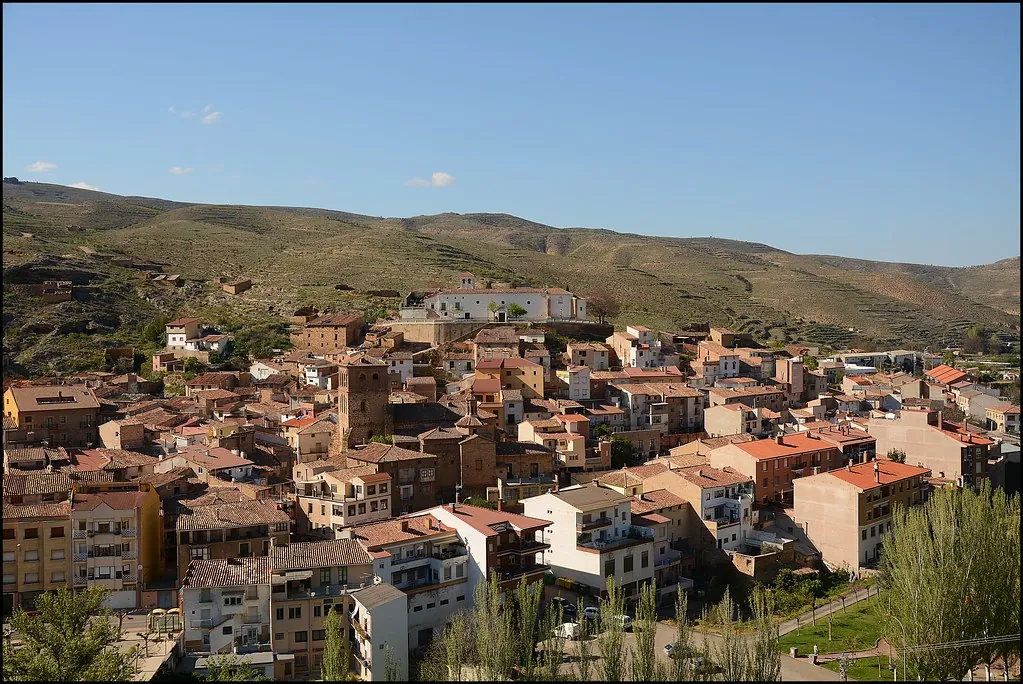
At eight in the morning, the smell of damp earth and burnt wood lingers along the main street of Navajún. There is barely any movement. A half-raised shutter, a door creaking open, and the dry hop of a sparrow crossing the curved tiled roofs, many with moss settled between the joints. The light is still low, and the stone façades hold a cool grey tone that shifts quickly once the sun begins to edge over the surrounding hills.
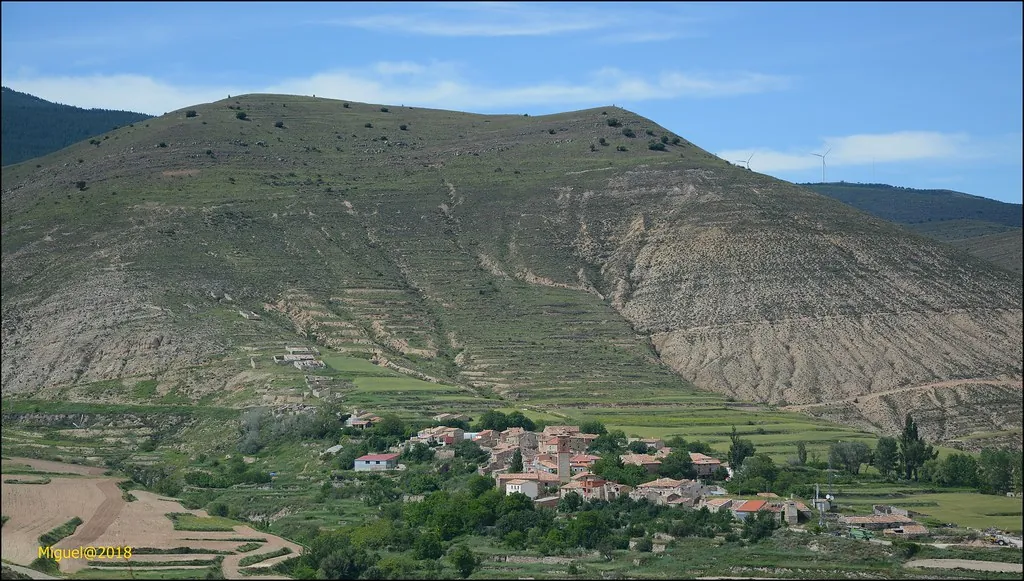
Tourism in Navajún does not follow the pattern seen in other villages in La Rioja. There are no signposted routes or squares filled with terraces. Instead, there is a very small cluster of houses where the sense of isolation is as present as the mountains that enclose it.
A short walk through the village
The main street is brief and slightly uneven. Stone houses line it, some coated in worn plaster, with small windows protected by old iron bars and wooden doors layered with years of paint. A slow walk leads naturally to the church, a simple building with a bell gable that still acts as a reference point for the village.
It does not take long to see everything. In ten or fifteen minutes, most of Navajún has already been covered. The interest lies in the details: tool marks left on certain stones, repairs patched in with brick on older walls, improvised gutters guiding water away during heavy rain.
With so few residents, the quiet becomes noticeable. Now and then there is the distant sound of a tractor engine or a dog barking from a nearby plot. Little else breaks the stillness.
Walking beyond the houses
Stepping outside the village, the land opens into gentle hills dotted with holm oaks, scattered pines and patches of pasture. Rural tracks cross the area, mainly used by locals and those working the land. They are not always signposted, yet they are easy enough to follow at an unhurried pace.
Some paths lead down to small streams that only carry a strong flow after rainfall. Others climb towards low passes where the view spreads out over a mix of scrubland and abandoned fields. There are no prepared viewpoints or explanatory panels. What appears in front of you is simply the landscape as it is.
For those who enjoy walking, it is possible to link tracks and footpaths into routes lasting several hours. It is worth bringing water and wearing footwear with a good sole, as the ground is stony and can turn muddy after rain.
In spring, wildflowers appear among the low shrubs. In autumn, dry leaves cover the ground and the air carries the scent of cold earth.
The mining area
In the nearby hills lie the old pyrite workings that have made Navajún known among geologists and mineral collectors. For years, well-formed cubic crystals were extracted here.
Access to the mines is usually regulated and not always open, so it is advisable to check before heading there with the intention of entering. From some of the surrounding paths, the spoil heaps and cuts in the hillside are visible, reminders of that activity.
When to come and practical notes
Spring and autumn are generally the most pleasant times to walk in the area. In summer, the sun becomes intense from midday onwards, and there is little shade along the tracks. In winter, the wind is more noticeable on the higher ground, and if there has been snowfall, some paths can become difficult.
It is important to arrive prepared. There are no shops or services in Navajún where water or food can be bought. The usual plan is to reach the village, spend some time walking through it, and then head out into the surrounding landscape.
For parking, it is best to leave the car at the entrance. The streets are narrow and still used for the daily routines of those who live here.
A quiet stop in the Cervera area
Many visitors reach Navajún as part of a wider route through the comarca of Cervera del Río Alhama, a district in the south-east of La Rioja. The village sits slightly apart, and perhaps for that reason it keeps a feeling of being set to a different rhythm.
This is not a place to fill a full day with activities. It works more as a pause: a short walk between stone houses, time spent looking out over the surrounding hills, and the silence that settles in once the car engine stops and the only remaining sound is the wind brushing through the holm oaks.