Full Article
about Collado Mediano
Mountain town in a privileged setting; perfect for summer holidays and outdoor activities
Hide article Read full article
Arriving with the Sierra Still Asleep
The first light of day reaches the Sierra de Guadarrama and the town seems to exhale. From the window of the Cercanías train, which has been stopping here for decades, chimney smoke drifts into the mist rolling down from the mountains. Collado Mediano wakes slowly, with the scent of pine slipping in as the carriage doors open.
For many, this is how a visit begins: arriving by train while the hills are still half asleep.
The railway remains part of the town’s rhythm. It shapes both the pace of arrival and the feeling that this is a place slightly apart from the urgency of Madrid. The journey itself prepares you for that shift.
A Station Where Time Lingers
The station holds on to the slower tempo of mountain towns that grew around the railway. The platforms still feel like they belong to another century: worn tiles, wooden benches, travellers watching the bend in the track where the train appears.
For much of the last century, when Madrid’s summer heat became hard to bear, families came here to spend the season. They arrived with heavy suitcases and the expectation of sleeping under blankets even in August. Some of the summer houses from that time are still standing in the streets near the station. They are easy to recognise: detached villas with large gardens, iron gates and pine trees that have long since outgrown the houses themselves.
Today, the train remains a practical way to reach Collado Mediano from Madrid. It brings you within a short walk of the centre and avoids the difficulty of parking during busy weekends, when the town fills with visitors and residents returning to second homes.
Miaccum Among the Pines
On the edge of town, surrounded by pine forest and low rockrose shrubs, lies the archaeological site of Miaccum. It is considered an ancient stopping point along the Roman road network, a place where travellers would change horses, rest and continue their journey through the mountains.
What remains today are the foundations of several rooms, open courtyards and sections of flooring that have survived the centuries. In the late afternoon, the stone still holds the day’s warmth. The site becomes quiet, with only the wind moving through the treetops.
Miaccum is one of the better-known Roman sites in the Guadarrama area, and it is sometimes used for organised visits or school activities. It is worth checking in advance whether it is open or if a guided visit is taking place that day, as access can vary.
The setting does much of the work here. Pines close in around the ruins, and the sense of an old route passing through the landscape remains easy to imagine, even with only fragments left in place.
Crosses, Songs and Winter Nights
Festivals in Collado Mediano still feel closely tied to local tradition. On 3 May, the day of the Cruz de Mayo, children can often be seen carrying small crosses decorated with flowers and pine branches. They take them up towards the area of the chapel near the old cemetery, singing traditional verses that many first learned at school.
In January, when winter has settled firmly over the sierra, the celebration of San Ildefonso arrives. Groups move through the streets with simple instruments and traditional songs. In some doorways, a bottle of homemade aguardiente, a strong spirit, may appear to warm those passing by. It is typically infused with herbs from the surrounding hills, and best approached with a bit of caution.
These moments are not staged for visitors. They follow patterns that have been repeated for years, shaped by the seasons and by the people who live here year-round.
The Anchor in the Square
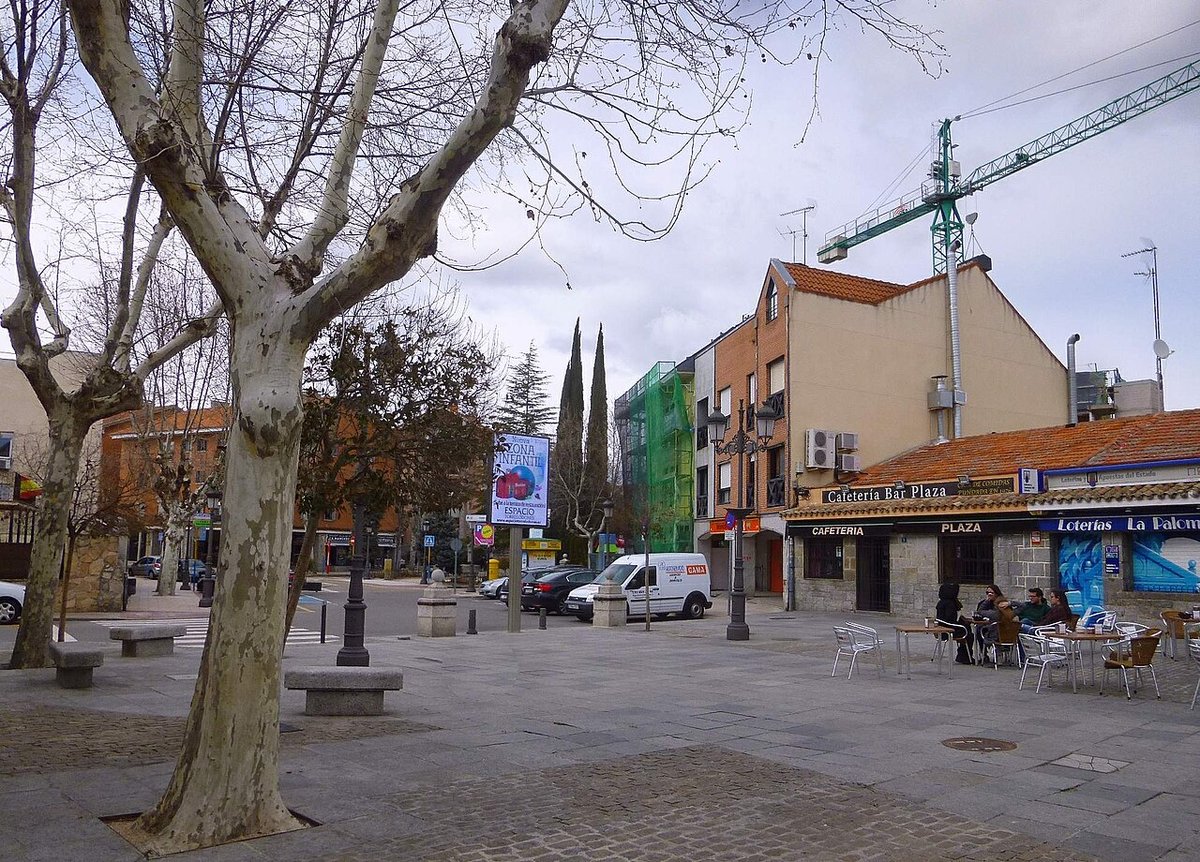
In the main square, there is an object that often surprises newcomers: a large iron anchor, far from any sea.
It was placed here decades ago and is linked to the presence of naval personnel in the area at the time. Over the years, it has become a small symbol of the town. Children climb on it as if it were a piece of playground sculpture, while adults treat it as a meeting point. “See you by the anchor” is still a phrase that makes sense here.
It stands slightly out of context, yet fully absorbed into daily life, part curiosity, part landmark.
When the Town Changes Its Rhythm
Collado Mediano shifts noticeably with the seasons. In August, the atmosphere becomes livelier. Second homes fill up, streets see more movement, and the town takes on a busier character.
For a quieter experience, late spring or early autumn tends to work better. In June, lime trees perfume some of the streets, and there is still a cool current of air coming down from the mountains in the evenings. By October, the landscape begins to smell of damp earth and pine. Nearby woods attract people heading out to walk or to look for mushrooms when the season is favourable.
Comfortable footwear is a good idea. Pavements are often made of granite, and slopes appear when least expected. If you make your way up to the Cerro del Calvario, where an unfinished chapel remains, the view opens across the valley. Scattered rooftops sit among patches of pine forest, and in the distance, the railway line cuts through the sierra.
As evening falls, the town grows quieter in stages. Smaller streets empty first, then the square. When the train passes again, its metallic sound echoing between the trees, Collado Mediano briefly reconnects with its older rhythm, one where time moves more slowly than it does in the city.