Full Article
about Corpa
Small Alcarria town known for its waters; quiet rural setting
Hide article Read full article
A village shaped by the Henares countryside
Tourism in Corpa is less about ticking off sights and more about understanding the landscape of the Henares basin. The village lies around 40 kilometres from Madrid, set within open countryside where cereal fields dominate and the terrain rolls gently rather than dramatically. With just over 800 inhabitants and an elevation close to 800 metres, it keeps the scale and rhythm of an agricultural community in the lower reaches of the Madrid Alcarria.
The surroundings shift noticeably with the seasons. In spring the fields turn green and the contours of the land become clearer. Summer brings the colour of ripened grain, followed by ochre tones and bare earth after the harvest. It is a broad, open setting with no major natural landmarks, where the horizon carries as much visual weight as the village itself.
The layout and history of Corpa
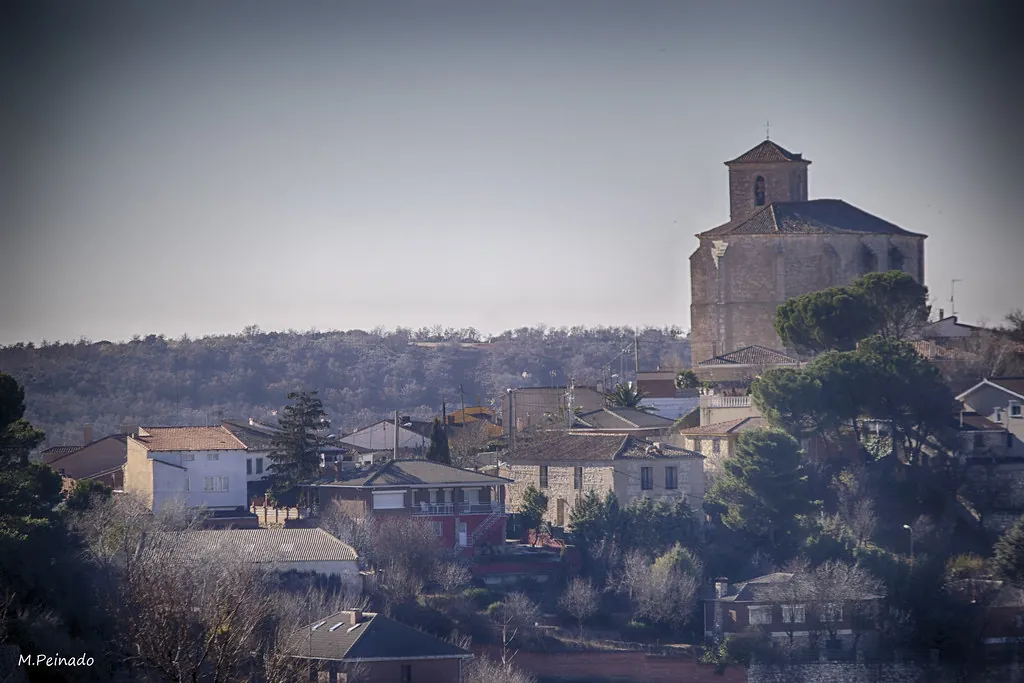
The centre of Corpa is organised around the parish church of San Pedro Apóstol, whose tower rises above the surrounding houses. The building likely stands on a structure dating back to the 16th century, although it has undergone later alterations. It is a restrained church, typical of an agricultural village: a single nave, simple proportions and a role that is more structural than monumental within the townscape.
The oldest streets cluster around this point. They are short, some with a slight incline, lined with two-storey houses traditionally built in rammed earth or brick. Wide doorways remain visible, originally designed for carts or storage, along with simple iron window grilles. Many interior courtyards sit hidden behind walls, a common feature in villages across this stretch of countryside.
The historic centre is not extensive, but it is consistent. Much of the village still reflects the scale and character of rural architecture in the area, without major disruptions or contrasts.
Fields, tracks and wildlife
Just a few minutes beyond the built-up area, agricultural tracks lead out across the fields. These dirt paths are used by farmers and also provide the clearest routes for walking through the surrounding landscape.
The Henares countryside forms part of a wider environment where bird species associated with open land can still be seen. With some patience, it is possible to spot great bustards, harriers or other birds of prey making use of thermal currents. Observation is best done from the paths and at a distance, as these species are sensitive to movement near cultivated areas.
One of the defining features here is the breadth of the horizon. There are no large forests or abrupt changes in relief. Instead, the view moves steadily across cereal plots, fallow land and small patches of holm oak. The effect is subtle but constant, shaped by light, season and distance rather than dramatic features.
Walking through the campiña
The simplest way to explore Corpa is on foot, following the tracks that leave directly from the village. These are not marked routes in a formal sense, but working paths that connect fields and low rises in the terrain.
Some stretches offer views back towards the village, where the church tower of San Pedro Apóstol acts as a visual anchor above the fields. Early morning and late afternoon tend to bring out the soft relief of the landscape more clearly, as the light defines the gentle slopes.
For anyone interested in landscape photography, this is a particularly open setting where seasonal and daily changes alter the same view quite noticeably. The absence of large obstacles means that light and colour take on a more central role.
Traditions rooted in rural life
Local festivities revolve around San Pedro Apóstol, celebrated at the end of June. During these days the village becomes busier than usual, with activity centred on the square and nearby streets.
Throughout the year, customs linked to rural life are still present. In autumn, for instance, family gatherings connected to the matanza del cerdo, the traditional pig slaughter, continue to take place. While this practice is becoming less visible, it remains part of the shared memory of many villages in the area.
These are not events designed primarily for visitors. They are rooted in local life and in the ties of those who live in Corpa or have family connections there.
A short visit, a clear impression
Corpa can be explored comfortably in a few hours. A walk around the church and the surrounding streets gives a clear sense of the village’s structure. From there, heading out along one of the agricultural tracks allows a broader view, placing the village within its landscape.
In summer, the central hours of the day are best avoided, as the open countryside offers very little shade. Water, a hat and suitable footwear for dirt paths are usually enough for a simple visit.
Reaching Corpa from Madrid takes less than an hour by road, typically via the A-2 followed by regional roads for the final stretch.
Corpa does not function as an organised tourist destination, nor does it rely on major monuments. Its interest lies elsewhere: in the shape of the village, the agricultural land that surrounds it, and the way that landscape changes over the course of the year.