Full Article
about Fuente el Saz de Jarama
A farming and commuter village on the Jarama flood-plain; noted for its monumental church.
Hide article Read full article
A village above the Jarama
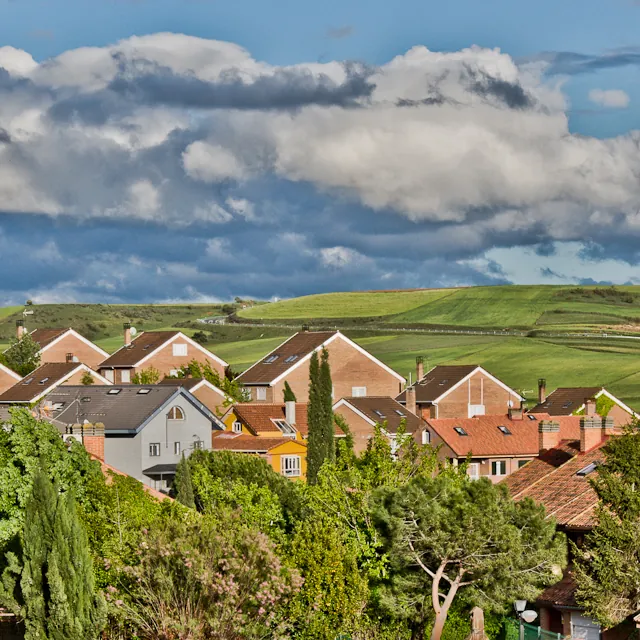
The Jarama flows slowly across the plain, and the village rises on a low hill overlooking one of its bends. Approaching from the road that comes from Algete, Fuente el Saz de Jarama appears as a small cluster of houses gathered around the church: dark roofs, a square tower, and beyond them the open farmland of the Jarama countryside.
For centuries, this was a place of passage between Madrid and La Alcarria. It was also a settlement shaped by water, specifically the spring that gives the village its name. That link between landscape and daily life still defines how the place is understood: a modest settlement, tied to the river valley and the surrounding fields.
From willow to self-rule
The name is thought to come from a spring beside a willow tree, known in Arabic as “saz”. After the Christian conquest, around the 12th century, the area remained a small community of shepherds and farmers. For a long time it depended on nearby Talamanca del Jarama, which acted as the main town in the area.
A turning point came in the 16th century. Around 1578, Philip II sold jurisdiction over the village to a Genoese banker, a practice used at the time to ease the Crown’s finances. The residents gathered funds to regain control, and shortly afterwards, around 1580, they were granted the status of villa. This allowed them to appoint their own local authorities and manage taxes and justice independently.
Even by the 19th century, Fuente el Saz remained small. Census records from the middle of that century show a population of only a few hundred, with the basic services of the time: a school, a mill and bread ovens. In 1833, during Spain’s provincial reorganisation, the municipality briefly became part of Guadalajara before being incorporated into the province of Madrid.
The Virgin found in the reeds
The village’s patron saint is the Virgen de la Cigüeñuela. According to local tradition, after a flood of the Jarama, a small image of the Virgin was found in a patch of reeds, watched over by two storks. The villagers carried it to the church, but the next day it was discovered again in the same spot.
This was taken as a sign. A small hermitage was built at that location, marking the place where the image was said to have appeared.
Each year, around 8 September, the image is carried in procession to that site. The route is usually followed at night, and in some stretches bonfires are lit along the path. The atmosphere blends celebration with inherited custom: families walk together behind the image, while smoke and firelight trace the route across the countryside.
A church and the shape of the village
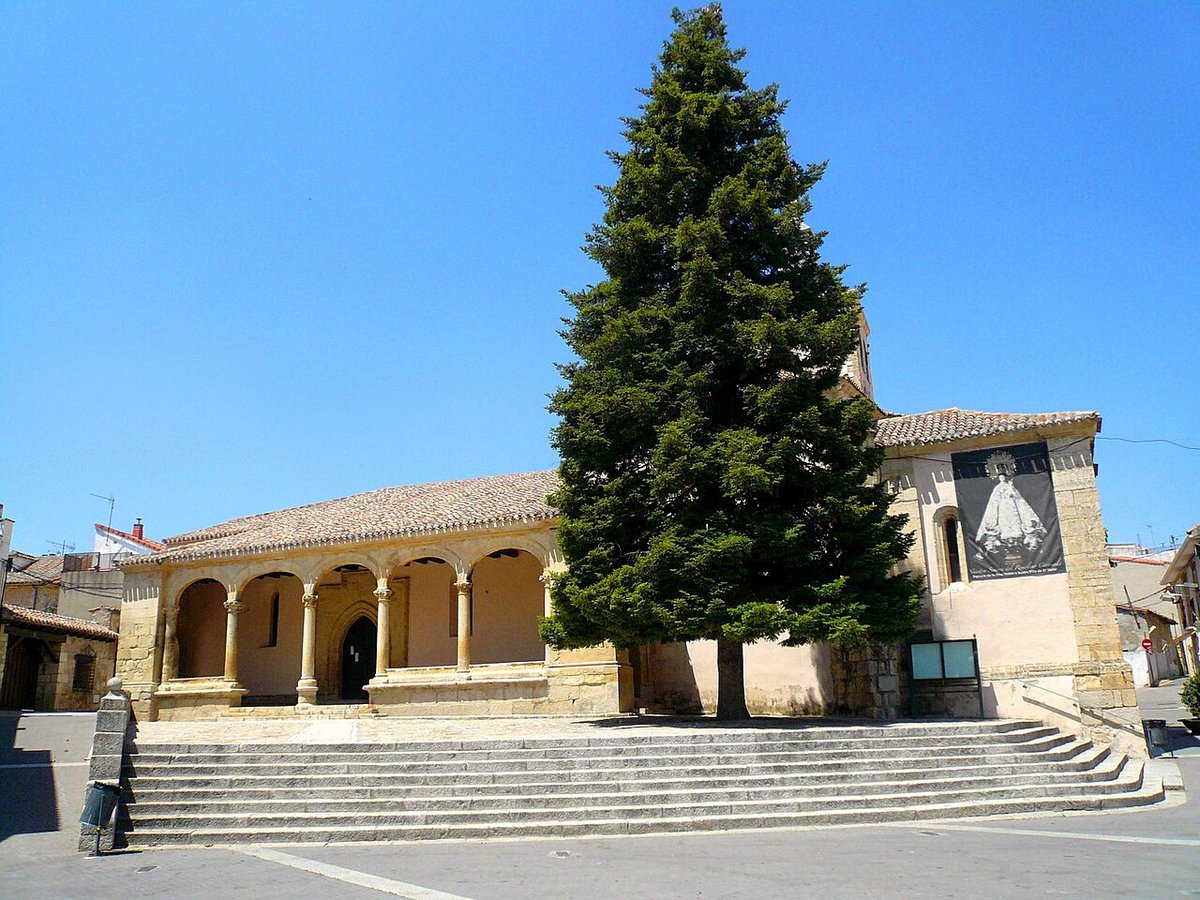
The church of San Miguel Arcángel is the most prominent building in Fuente el Saz. Its main structure dates from the 16th and 17th centuries. It has a single nave and a straight apse, with a restrained style typical of churches built in the Madrid countryside with limited resources.
The tower was added later, in the 18th century. Built from carefully cut stone blocks, it opens at the top into the bell chamber. From there, the view extends over the Jarama plain and much of the village itself.
Inside, a late 18th-century Neoclassical altarpiece is preserved, attributed to a workshop that worked across several nearby villages. The figure of Saint Michael defeating the dragon includes a curious detail: the proportions of the face do not quite match the body, likely the result of a hurried adjustment during its carving.
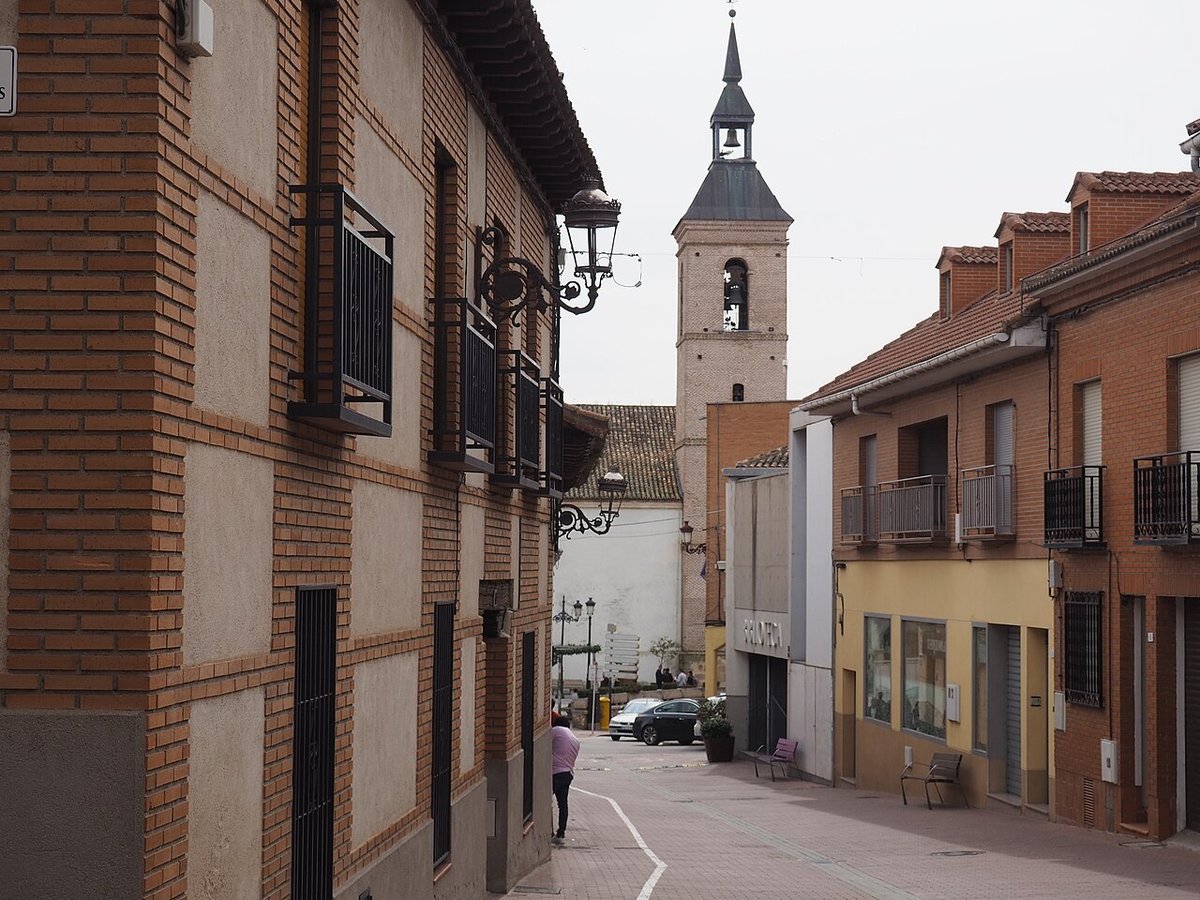
Around the church stand many of the oldest houses. These are low buildings with wide gateways and entrance halls that once allowed animals and carts to pass through. Some still show traces of timber framing, although stone masonry is more common, using material taken from the nearby hills.
The once-a-year cake
One of the most recognisable traditions takes place on 5 February, the feast day of Santa Águeda. Before dawn, a group of women gathers to light the ovens and prepare the tortas de Santa Águeda.
The dough is made with flour, lard, sugar and aniseed. It is shaped into large, round cakes and decorated with fork marks: crosses, diamond shapes or simple lines. In the past, these were shared among neighbours. Today they are usually sold in the main square, with proceeds going towards activities organised by the local women’s association.
The recipe is not written down. Each family keeps its own version, with small variations in the use of aniseed or the level of sweetness. Fresh from the oven, the cakes are firm on the outside and still warm within.
Walking the edges of the plain
Fuente el Saz lies just over thirty kilometres from Madrid, set within the Jarama countryside. The village itself is compact and easy to explore on foot. The church marks the highest point, and from there the layout of the streets becomes clear. Nearby, old gateways and interior courtyards still appear among the houses.
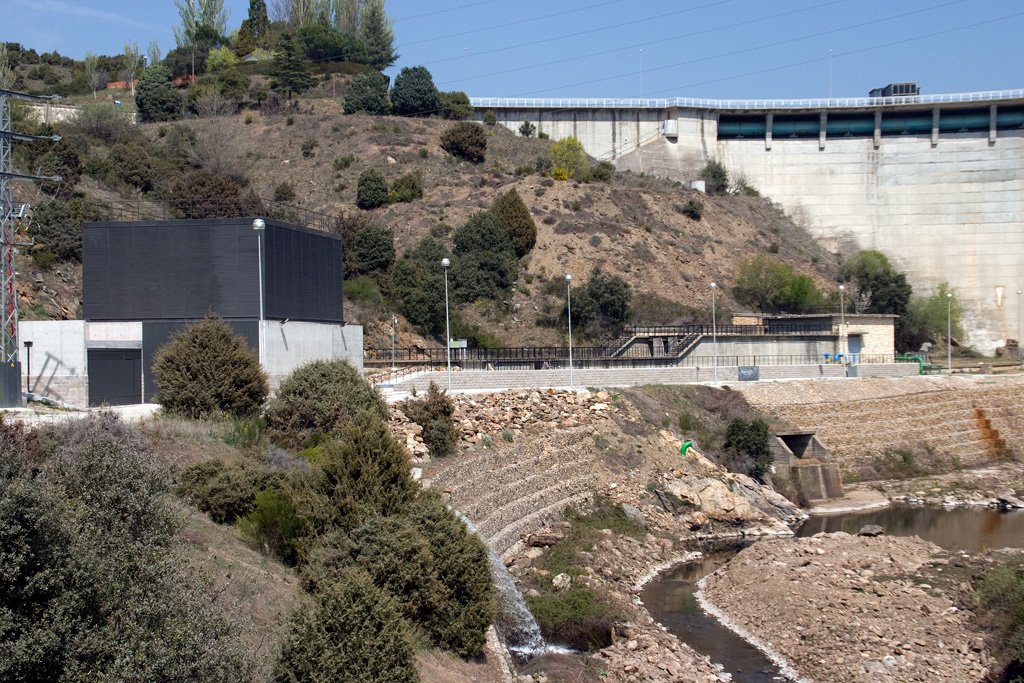
At the edge of the village, agricultural tracks lead down towards the Jarama plain. Some follow older working paths and pass close to remains of hydraulic infrastructure and an occasional old mill. They are not always signposted, but they offer a way to understand the landscape that has shaped the village for centuries, where water, fields and quiet routes still define the rhythm of the place.