Full Article
about El Vellón
Mountain village watched over by an Arab lookout; surrounded by scrub and holm oaks.
Hide article Read full article
At eight in the morning, El Vellón still feels cool, the air carrying the scent of fresh bread mixed with the dampness of holm oak. The main square is barely awake. A few residents cross it with shopping bags, while many shutters remain half closed. From a sunlit table, the mist can be seen lifting slowly over the dehesa, the open pastureland that surrounds the village. The day begins without hurry, which is typical in this part of the Sierra Norte.
Wool, paths and quiet countryside
The name El Vellón comes from wool. For centuries, fleece shaped the local economy, with flocks moving across these hillsides and shepherds heading down towards the markets of Madrid. Even now, the soft clinking of sheep bells can still be heard in the surrounding fields.
One of the most popular walking routes follows the line of the canal. The path is wide and easy to follow, used both by walkers and cyclists. It passes through stretches of holm oak and quejigo oak, and in autumn the ground becomes covered in leaves that shift into copper tones. Before the sheep come into view, their presence is usually announced by the faint ringing of bells drifting through the trees.
The landscape here does not feel staged or polished. It is shaped by long use, by grazing and seasonal change, and by the quiet rhythm of rural life that still continues.
A watchtower above the Jarama valley
A few kilometres from the centre, a dirt track branches off from the road and climbs towards a hill covered in pine and rockrose. At the top stands the Atalaya de El Vellón, a cylindrical masonry tower that once formed part of the Andalusí defensive system overlooking the Jarama valley.
The tower itself cannot be visited inside, but the hill where it stands acts as a natural viewpoint. From this height, the landscape opens out in all directions: holm oaks, patches of grazing land, and further away, the gentle rises that separate El Vellón from neighbouring villages. When there is a bit of wind, the scent of crushed thyme rises easily from the path.
The walk up is straightforward, although the final stretch has loose stones. Comfortable footwear is advisable. It is not a demanding climb, but enough to remind you that this is still a working countryside rather than a manicured park.
Stone, bells and village life
Back in the village, the Plaza Mayor holds a stone picota, a kind of historic pillory that marks the fact that El Vellón once had its own jurisdiction centuries ago. Its surface has been smoothed over time, and by generations of children who have climbed it while playing.
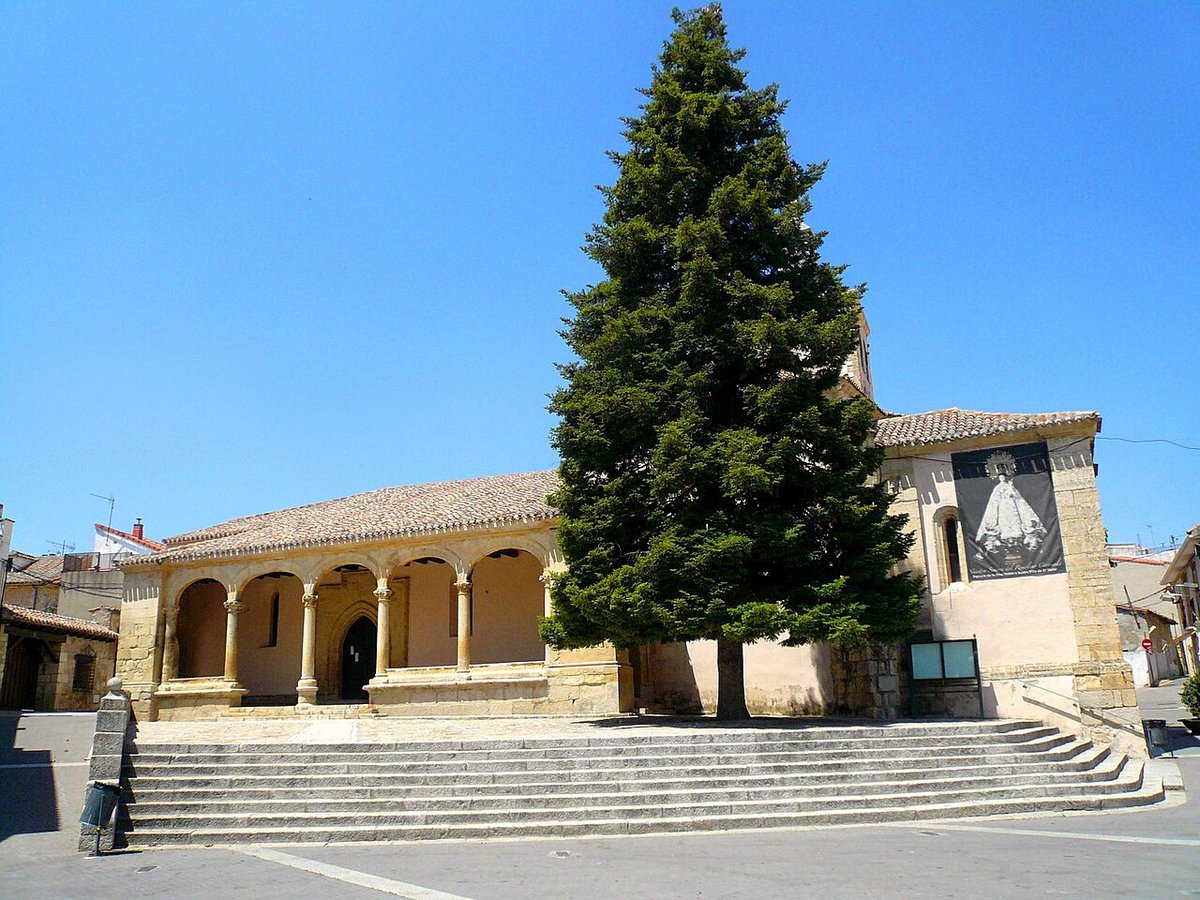
Opposite the square stands the church of Nuestra Señora de la Asunción, built between the late Middle Ages and the beginning of the early modern period. The interior is simple: a single nave, plain arches and a wooden roof structure. In moments of silence, the beams can be heard creaking, something common in churches of this style.
The church is often open in the mornings, although this depends on the day. If it is closed, it is sometimes possible that a nearby resident holds the key, a reminder of how closely daily life and local heritage remain connected here.
There is no sense of rush in the centre. The square is a place to pass through slowly, to sit for a while, or simply to watch the rhythm of the village unfold.
Autumn light and local flavours
Autumn is often the most pleasant time to visit. The light becomes lower and clearer, and the grey granite façades take on a softer tone towards the end of the afternoon. In the square, ash trees shed their leaves, which crackle underfoot.
At weekends in October and November, many people arrive from Madrid. Some come for a meal, others for a short walk in the surrounding countryside. Lamb has long been raised in this area, so it is common to find it on menus in the village bars as the colder weather sets in.
For those looking for a quieter visit, weekdays or early Saturday mornings tend to be calmer. At those times, the village returns to its slower pace, closer to what it feels like on an ordinary day.
The road out and the silence beyond
El Vellón lies less than an hour from Madrid, reached via the A-1 and the turn-off onto the M-122. The final stretch passes through pinewoods and small dehesas, with gentle bends in the road. On Sunday afternoons, there is often heavier traffic as people make their way back to the capital.
Before leaving, it is worth taking a short walk along the paths that lead out into the countryside. Just a few minutes from the built-up area, the sound of traffic fades, replaced by the wind moving through the leaves of the holm oaks.
Near the road towards El Espartal, there is a spring where many locals stop to fill bottles. The water runs cold even in summer. Bringing an empty bottle in the car is a simple idea that fits naturally with the pace of the place.
El Vellón does not rely on grand landmarks or busy attractions. Its appeal comes from small details: the echo of bells across the fields, the texture of stone worn smooth, and the way the day unfolds without urgency.