Full Article
about Patones
Famous for Patones de Arriba; a slate-black-architecture village counted among the prettiest.
Hide article Read full article
A Village Shaped by Stone
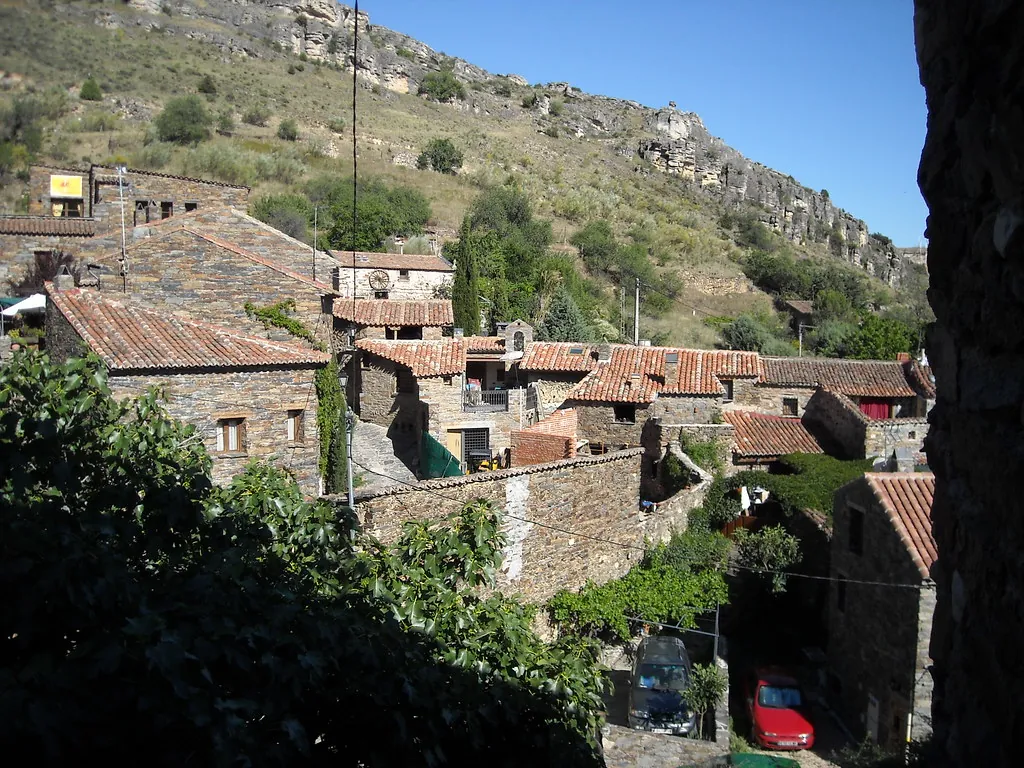
Tourism in Patones is closely tied to its geology. The village stands on a slate hillside at the eastern edge of the Sierra Norte de Madrid, where ravines and streams have gradually carved into the terrain. That setting explains almost everything about its appearance. Streets climb the slope, and houses are built from the same dark stone that surfaces all around.
Today the municipality has around six hundred residents and is organised into two distinct centres. Patones de Arriba is the historic settlement, documented since the Early Modern period. Here, the houses adapt to the hillside through terraces and narrow lanes that follow the natural contours. For much of the 20th century the village remained fairly isolated, a factor that helped preserve its traditional architecture. Weekends bring a noticeable change in atmosphere with visitors arriving from Madrid, while weekdays tend to be much quieter.
Patones de Abajo lies at the bottom of the valley and developed later. This is where the town hall, more recent housing and basic services are located. The gradual shift of population from the upper settlement took place mainly in the middle of the last century, when daily life in Patones de Arriba was becoming increasingly impractical.
Architecture and Heritage on the Hillside
Patones de Arriba was designated a protected historic ensemble in the 1970s. What is protected is not a single monument but a way of building closely linked to the land itself. Walls are made of slate, laid either dry or with mortar. Roofs are tiled. The layout of the streets follows the lines of the slope rather than imposing a grid.
The small church of San José occupies one of the central points in the upper village. The building is modest and reflects successive alterations carried out over the centuries. Its interest lies less in its size than in how it fits into the square and the surrounding network of streets.
In Patones de Abajo stands the parish church dedicated to the Virgen de la Oliva, associated with an old local devotion. The present building is relatively recent when compared with the traditional houses of the upper village.
Walking through Patones de Arriba makes clear how closely construction and terrain are connected. The slate used in the walls comes from the surrounding hillsides, giving the whole settlement a uniform, dark tone that changes subtly with the light. Terraces and stepped paths allow the houses to sit securely on steep ground.
Paths, Hills and Open Slopes
The landscape around Patones is rugged. Slate hillsides dominate the scene, dotted with scattered holm oaks and Mediterranean scrub. For centuries this land was used for grazing and for activities such as charcoal production. As a result, old paths still appear, once linking animal pens, vegetable plots and small terraced fields.
Several of these routes are now used for hiking. Some begin directly in Patones de Arriba and cross the nearby hills, from where it becomes clear how the village fits into the slope. The climb provides a broader perspective of the valley and the ridgelines that enclose the municipality.
Spring brings flowers to the low scrub. In summer, early starts are advisable, as there is little shade on the exposed hillsides. Seasonal contrasts are noticeable here, and the open terrain offers limited shelter from the elements.
The rock faces in the surrounding area also attract people who practise climbing, particularly in certain parts of the valley. The same geological features that shaped the village have created vertical surfaces that draw outdoor enthusiasts.
Food from the Sierra Madrileña
The cooking associated with Patones reflects the traditions of the Sierra madrileña, the mountainous area north of Madrid. It is hearty food, designed for long days outdoors and for the colder months of the year.
Roast lamb appears frequently when local culinary traditions are mentioned. Migas, a dish based on fried breadcrumbs, and various legume stews are also common. Seasonal vegetables grown in market gardens near the valley of the Jarama river play their part as well, connecting the village table to nearby agricultural land.
These dishes belong to a rural context in which work in the fields and on the hills demanded filling meals. The emphasis is on substance and seasonality rather than elaborate presentation.
Planning a Short Visit
A typical visit begins in Patones de Abajo, where most people leave their car before walking up to Patones de Arriba. The main path takes around a quarter of an hour and gains height quickly, so a steady pace is advisable.
Once at the top, the best approach is simply to wander. The streets rise between slate houses, sometimes narrowing into tight passageways. The village is small enough to explore fully in about an hour. From several points along the edge of the settlement, views open out towards the valley and the surrounding hills.
Weekends tend to be busier, and parking in the lower village fills up early. Those looking for a calmer atmosphere may prefer to arrive early or visit during the week.
The streets of Patones de Arriba are steep, with cobbled sections in places. Footwear with a good grip is helpful, especially after rain. In summer the sun can be intense on the open slopes. In winter the wind is often noticeable in the higher areas.
Patones does not rely on grand monuments or large-scale attractions. Its appeal lies in the way geology, architecture and landscape fit together on a steep hillside in the Sierra Norte de Madrid. The dark slate, the narrow streets and the open views towards the valley define a place that still reflects the conditions in which it developed.